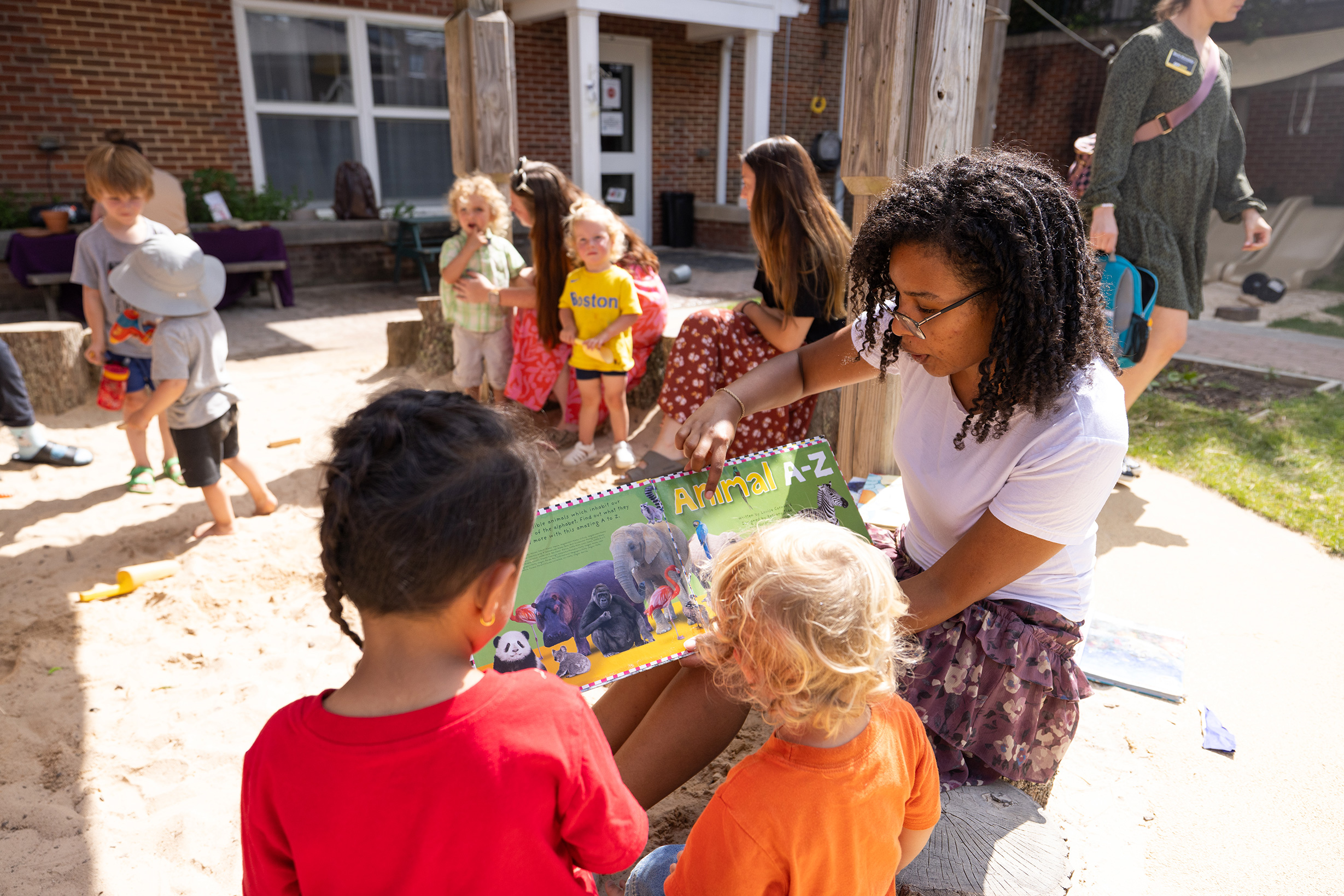
Shany Chacon Walker, an App State junior child development major from Boone, far right in the foreground, reads to the children enrolled in the university’s Lucy Brock Child Development Laboratory program. Photo by Chase Reynolds
BOONE, N.C. — For over 85 years, Appalachian State University’s Lucy Brock Child Development Laboratory program (Lucy Brock) has provided high-quality early learning experiences to local children and hands-on opportunities to future educators.
Operated by the Reich College of Education, Lucy Brock began as a part-time, half-day program for children of university faculty and staff. Today, it serves over 90 families in the High Country and nearly 600 lab students annually. The program has expanded beyond its Boone campus, partnering with Watauga County Schools to operate preschool classrooms at Parkway and Blowing Rock Elementary schools.
“Since its inception, Lucy Brock has introduced generations of children to a love and passion for learning that lasts a lifetime,” said App State Chancellor Heather Norris. “This program exemplifies the higher education mission of teaching, research and service, serving as a valuable resource to our High Country community.”
In addition to serving children from birth through age 5, Lucy Brock functions as a professional preparation site for early childhood educators, integrating research-based practices with experiential learning.
“For 85 years, Lucy Brock has stood as a beacon of excellence in early childhood education, nurturing curiosity, compassion and creativity in our youngest learners, while preparing future educators with the knowledge, skills and heart to lead in classrooms across the country,” said Reich College Dean Melba Spooner.
“It is a living legacy, where theory meets practice, where research informs care and where every child is given the opportunity to thrive,” she added.

Pictured at the July event celebrating the 85th anniversary of App State’s Lucy Brock Child Development Laboratory program are, from left to right: Lucy Brock Director Dr. Andrea Anderson ’94 ’10 ’20; Dr. Hannah Reeder, assistant dean for partnerships and innovation in the Reich College of Education; App State Chancellor Heather Norris; retired Watauga County Schools teacher Minnie Snead ’60, who was taught by Lucy Brock as a student at Appalachian State Teachers College (now Appalachian State University); U.S. Rep. Virginia Foxx; Lucinda Payne-Smith ’04 ’08, whose family includes three generations of Lucy Brock students; and Reich College of Education Dean Melba Spooner. Photo by Chase Reynolds
Learning rooted in experience
Lucy Brock’s educational philosophy is rooted in the Reggio Emilia Approach, which encourages children to construct their knowledge through experience. This approach positions Lucy Brock as more than a care center; it is a space where teacher- and child-led research informs the curriculum and learning experience.
In practice, this includes observing what the children are curious about; growing the food they eat in an on-site garden for nutritious meals; documenting the children’s experiences through photos and narrative; and utilizing multiage grouping for consistency and continuity of care.
As a laboratory setting, Lucy Brock provides App State students the opportunity to engage in clinical field experiences, during which they observe classroom practices and incorporate these observations into their coursework. Additionally, students are able to spend time with the children under the mentorship of Lucy Brock teachers.
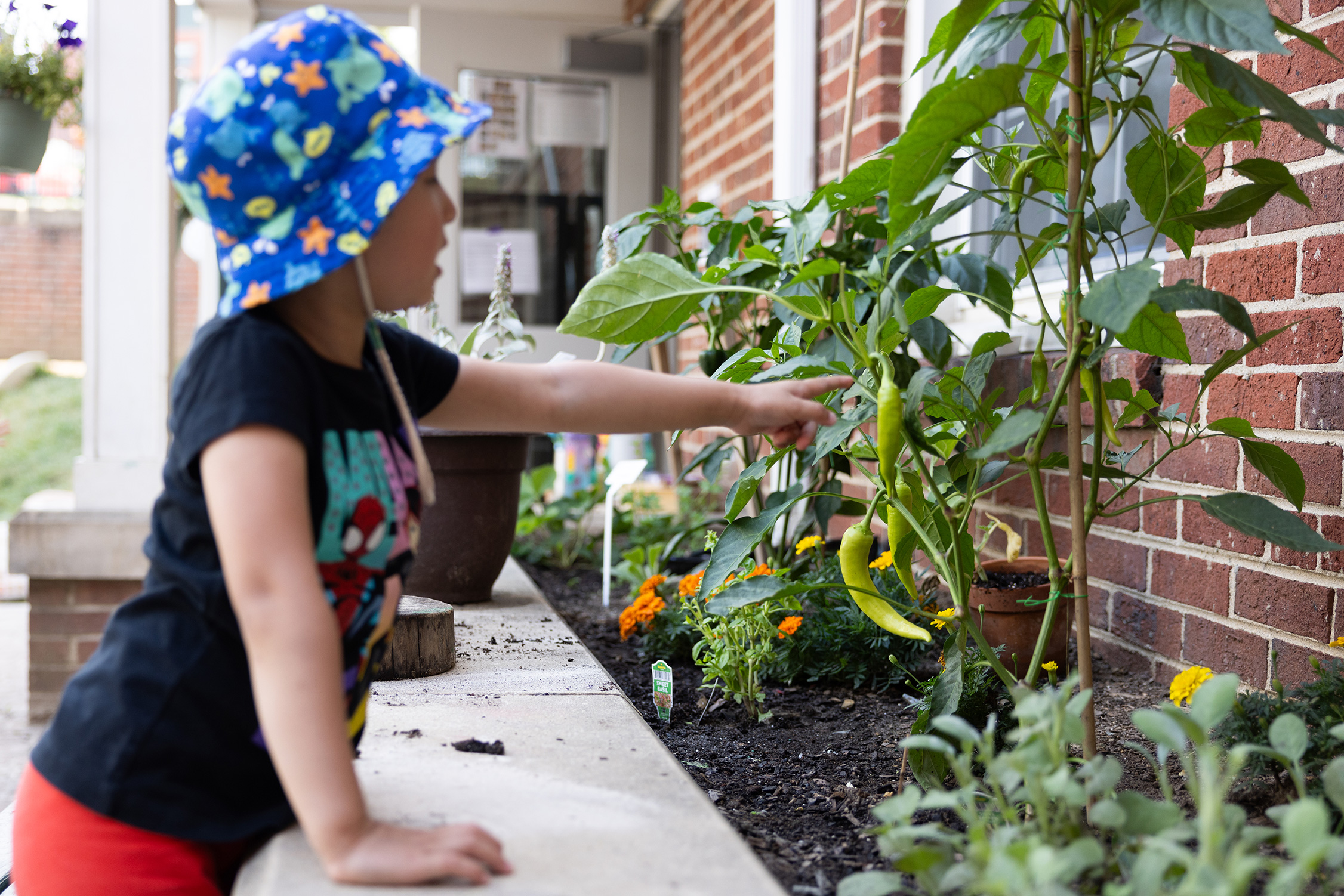
A child enrolled in App State’s Lucy Brock Child Development Laboratory is pictured identifying vegetables that are grown in the Lucy Brock garden. The garden’s food is used to create nutritious meals for the program’s students. Photo by Chase Reynolds
This video highlights the 85-year legacy of App State's Lucy Brock Child Development Laboratory program and its impact on generations of children and early childhood educators.
Leading with innovation and intention through research
“Lucy Brock bridges theory to practice and is a place where dedicated teachers provide exceptional care and learning for children while also mentoring future educators through meaningful, practice-based learning,” said Dr. Hannah Reeder, assistant dean for partnerships and innovation in the Reich College of Education.
Research conducted by the lab’s faculty and staff contributes significantly to the body of knowledge in child development and helps advance best practices in the field. A few highlights of their research projects over the past few years include:
- Farm to Early Childhood Education initiative
Supported by a Chancellor’s Innovation Grant, Lucy Brock partnered with the Beaver College of Health Sciences’ nutrition program to launch the region’s first Farm to Early Childhood Education initiative. The program, which connects local farms with early childhood centers to provide children with fresh, locally sourced food, earned recognition from REACH (Recognizing Early Childhood Education’s Advancing Children’s Healthy Habits) for excellence in child nutrition. - Rebecca Carver Institute on Experiential Education
Faculty and staff led a session titled “Enacting Belonging and Mattering in Experiential Education” at the Rebecca Carver Institute, showcasing Lucy Brock’s commitment to research-informed practice. - Zaentz Early Education Innovation Challenge
In October, Lucy Brock Director Dr. Andrea Anderson ’94 ’10 ’20 represented the program and the Department of Child Development, Literacy and Special Education at the 2024 Zaentz Early Education Innovation Challenge at Harvard. The program was selected as one of 10 national finalists and won the Audience Choice Award for its presentation on the benefits of hands-on lab school experiences.

Dr. Andrea Anderson ’94 ’10 ’20 shares her experience as both a former student and the current director of App State’s Lucy Brock Child Development Laboratory at the July event celebrating the program’s 85th anniversary. Photo by Chase Reynolds
Coming full circle — from student to teacher to director
Anderson, a three-time App State alumna, began her early childhood education career at Lucy Brock.
“As a first-generation college student, I nervously stepped into the world of Lucy Brock — a place that would become a cornerstone of my career,” she recounted.
It was in one of Lucy Brock’s observation booths where she met “Ms. Harris — a master teacher who transformed my understanding of what early childhood education could be,” she said. “I watched in awe as she engaged 3- and 4-year-olds with creativity, sophistication and joy.”
For Anderson and many others like her, these weren’t simply learning moments; they were life-changing experiences. And they represented the essence of Lucy Brock: A place where aspiring educators are nurtured, challenged and inspired.
“At Lucy Brock, we believe in the transformative power of education,” Anderson said. “We create an environment where college students and young children learn together, asking questions, thinking critically and engaging deeply with the world around them. That’s what Lucy Brock did for me. And that’s what we continue to do every day.”

Pictured at the July event celebrating the 85th anniversary of App State’s Lucy Brock Child Development Laboratory program are, from left to right: Rhonda Russell, senior lecturer in App State’s Department of Child Development, Literacy and Special Education; Lucy Brock Director Dr. Andrea Anderson ’94 ’10 ’20; Shirley Harris, a retired App State academic advisor; and Professor Emeritus Dr. Ellen Carpenter, former director of Lucy Brock and past chair of the Department of Family and Child Studies. Photo by Chase Reynolds
A multigenerational impact
During a July event celebrating the program’s 85th anniversary, App State alumna Lucinda Payne-Smith ’04 ’08 — a former Lucy Brock student and parent of a current Lucy Brock child — shared her family’s multigenerational connection to the program, which dates back to her father’s time as a student of Lucy Brock’s.
“Even as a young child, I understood that my time at Lucy Brock mattered,” said Payne-Smith. “My elementary teachers often commented on my curiosity and linked it to my early experiences there.”
“That’s still true today,” she continued. “Lucy Brock teachers support their students as they investigate the world around them, helping them become the next generation of curious, confident, lifelong learners.”
Now a senior lecturer in App State’s Department of Psychology, Payne-Smith sees the program’s impact from both professional and parental perspectives.
“Even when something works — with a class or an individual child — the teachers keep thinking, keep questioning, keep learning,” said Payne-Smith. “They read, reflect and refine. They push the research forward while advocating for all children.”
She added, “As a professional, it’s thrilling to see the research I study and teach being applied in real time. As a parent, it gives me confidence that my children are growing in a space guided by the best of what we know.”
What do you think?
Share your feedback on this story.
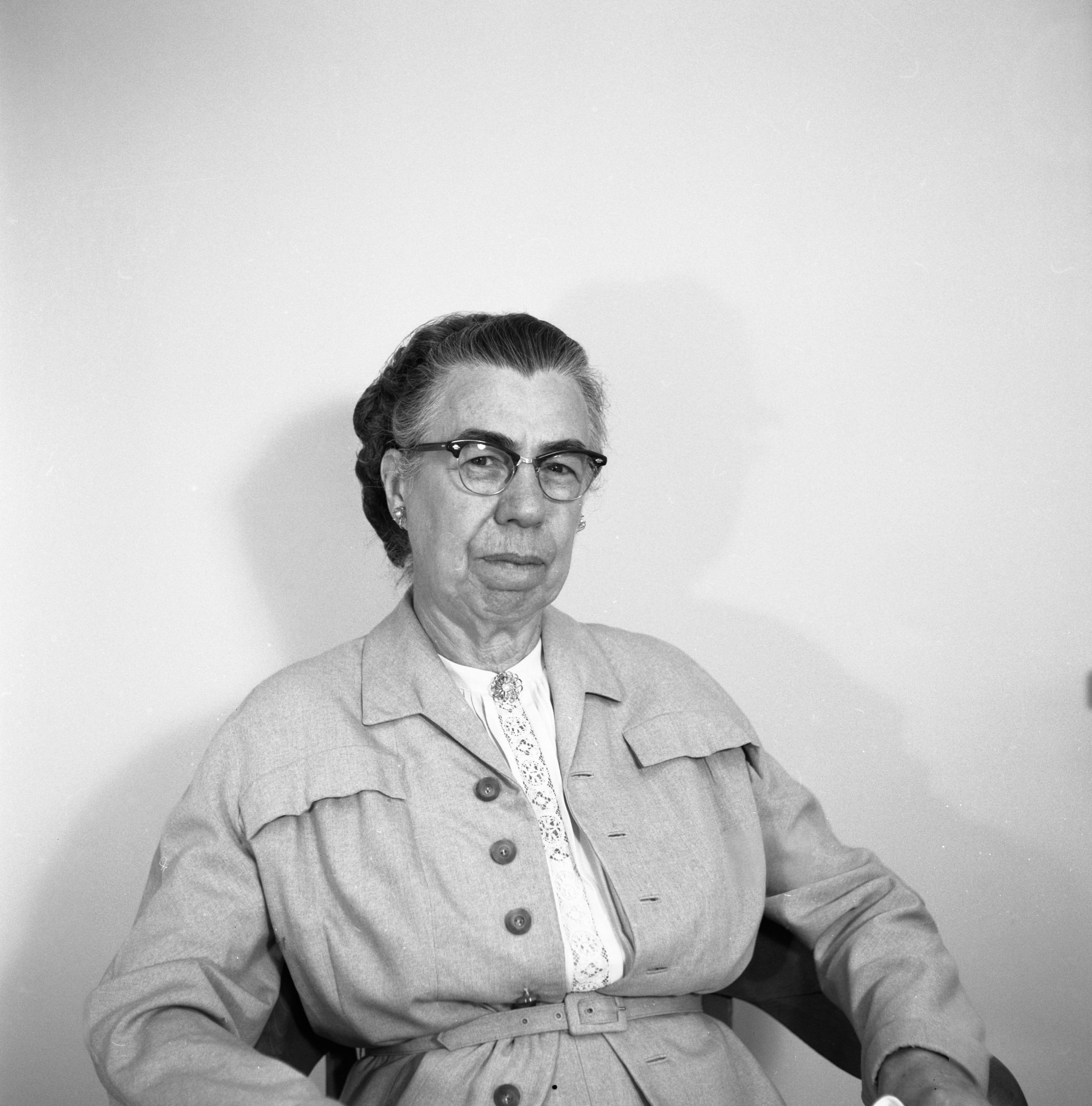
Lucy Brock, who served as chair of App State’s former Department of Home Economics for 21 years, from 1940 until her retirement in 1961. Photo courtesy of Appalachian State University Historical Photographs Collection

Cassandra Parrish, assistant director of App State’s Lucy Brock Child Development Laboratory, presents at the university’s annual Founders Day Research Showcase in 2022. Parrish, along with Lucy Brock Director Dr. Andrea Anderson ’94 ’10 ’20 and Dr. Ellen Carpenter, the program’s former director, compiled their research on the history of Lucy Brock and its impact on early childhood education. Photo submitted
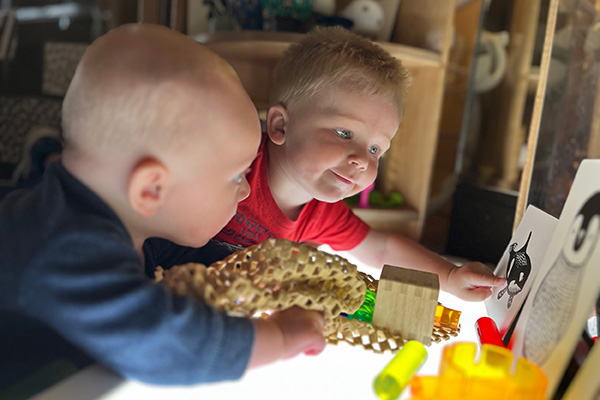
Lucy Brock Child Development Laboratory
The Lucy Brock Child Development Laboratory (LBCDL) at Appalachian State University, operated by the Reich College of Education’s Department of Child Development, Literacy and Special Education, serves as a professional development site for individuals planning to work with young children. As a university lab intended to provide the highest quality education and care for regional children, the program staff model evidence-based practices in the field of early childhood education and apply innovative approaches that contribute to new definitions of recommended practice. Learn more at https://lucybrock.appstate.edu.
About the Department of Child Development, Literacy and Special Education
The Department of Child Development, Literacy and Special Education, housed in App State's Reich College of Education, offers innovative baccalaureate and graduate degree programs that focus on all facets of child development, reading, writing and language arts, as well as specific areas of special education. These programs provide coursework and field experiences in a variety of settings and can lead to licensure. Learn more at https://clse.appstate.edu.
About the Reich College of Education
Appalachian State University offers one of the largest undergraduate teacher preparation programs in North Carolina, graduating about 500 teachers a year. The Reich College of Education enrolls more than 2,000 students in its bachelor’s, master’s, education specialist and doctoral degree programs, with offerings that span multiple fields — from teacher preparation, counseling, and therapy, to higher education, school and student affairs administration, library science, educational leadership and more. With over 10,000 alumni employed in North Carolina public schools, there is at least one Reich College graduate in every county in the state. Learn more at https://rcoe.appstate.edu.
About Appalachian State University
As a premier public institution, Appalachian State University prepares students to lead purposeful lives. App State is one of 17 campuses in the University of North Carolina System, with a national reputation for innovative teaching and opening access to a high-quality, cost-effective education. The university enrolls more than 21,000 students, has a low student-to-faculty ratio and offers more than 150 undergraduate and 80 graduate majors at its Boone and Hickory campuses and through App State Online. Learn more at https://www.appstate.edu.
Lucy Brock, who served as chair of App State’s former Department of Home Economics for 21 years, from 1940 until her retirement in 1961. Photo courtesy of Appalachian State University Historical Photographs Collection
Cassandra Parrish, assistant director of App State’s Lucy Brock Child Development Laboratory, presents at the university’s annual Founders Day Research Showcase in 2022. Parrish, along with Lucy Brock Director Dr. Andrea Anderson ’94 ’10 ’20 and Dr. Ellen Carpenter, the program’s former director, compiled their research on the history of Lucy Brock and its impact on early childhood education. Photo submitted

![NC universities ranked by free-speech advocacy group [faculty and staff featured]](/_images/_posts/2026/09/free-speech-advocacy-600x400.jpg)


![Nepal’s Hydropower Industry Was Booming. Now 900 Workers Are Missing. [faculty featured]](/_images/_posts/2026/08/hydropower-industry-600x400.jpg)