Dendur, an ancient Egyptian temple salvaged from a dam project on the Nile River and reconstructed in New York’s Metropolitan Museum of Art, is the subject of years of research by App State’s Dr. Erin Peters and the Met’s “Dendur Decoded” virtual reality experience. Peters, assistant professor of art and visual culture in App State’s Department of Art, served as a key consultant on the project, helping to bring new vigor, form and color to the temple’s layered history. Photo courtesy of the Metropolitan Museum of Art
BOONE, N.C. — Rescued from rising waters, transported across an ocean and rebuilt in New York’s Metropolitan Museum of Art, the ancient Egyptian Temple of Dendur serves as an example of how history, often regarded as static, evolves over lifetimes. Dr. Erin Peters, assistant professor in App State’s Department of Art, is helping bring new vigor, form and color to the temple’s history through the Met’s “Dendur Decoded.”
An immersive virtual reality (VR) and online experience, “Dendur Decoded” presents the temple’s changing worlds using image galleries, an interactive film, a 3D reconstruction puzzle and a meditative space where visitors can reflect on the experience. It allows global audiences to view the exhibit through a personal VR headset or the Met’s website.
Serving as a key consultant on the project, Peters, whose research specialty is Roman Egypt (the time period of the temple), handled much of the research, drafting, writing and editing for “Dendur Decoded,” performing numerous research dives into publications and archival records in collections across the globe and dating over two centuries. She also lent her voice to the project, providing narration for the VR experience.
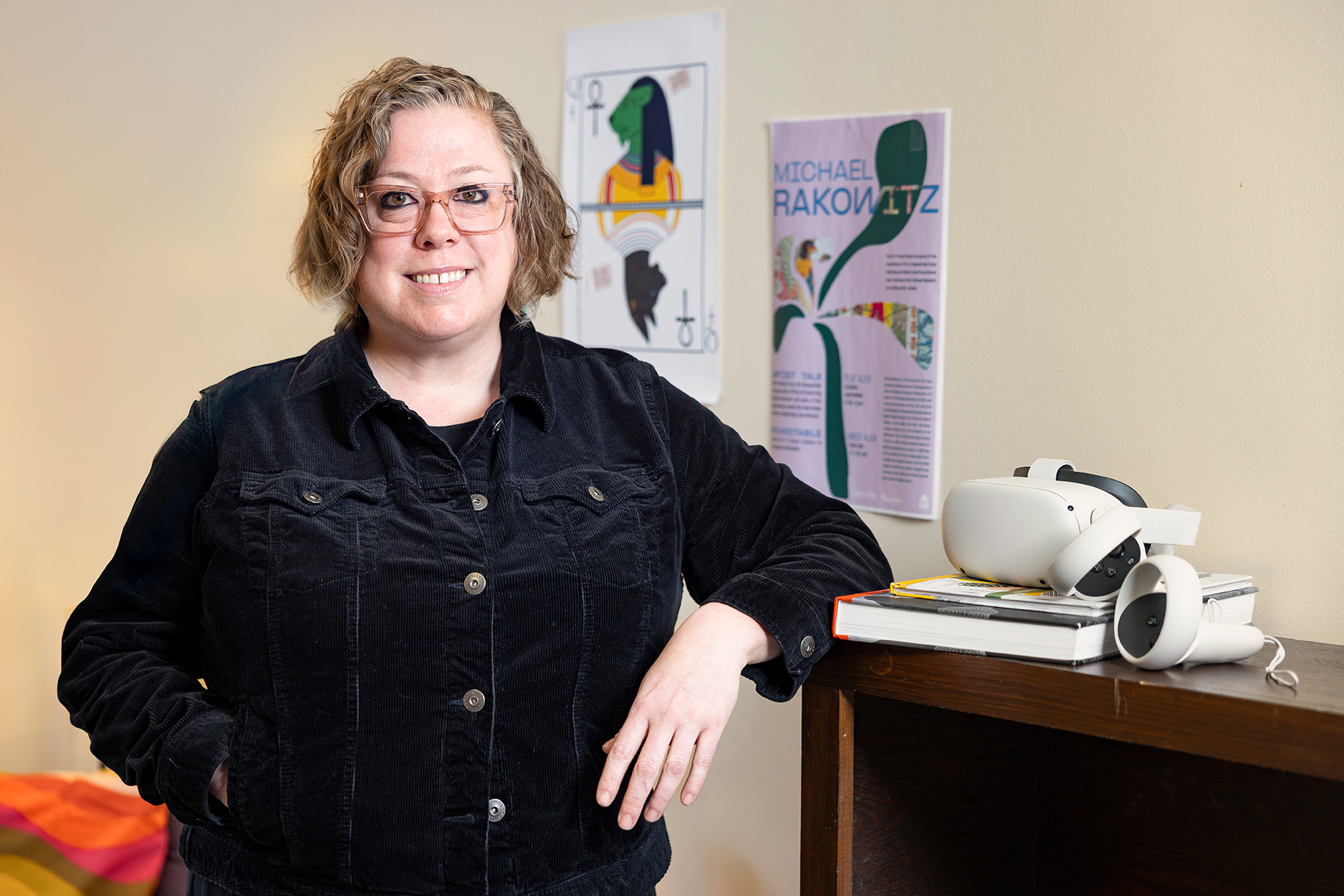
Dr. Erin Peters, assistant professor of art and visual culture in App State’s Department of Art, is pictured in her office on App State’s Boone campus. Photo by Kyla Willoughby
In October, Peters and a group of students in her Art Criticism and Theory seminar class traveled to the Met, where they discussed the Dendur project with the museum’s digital team and chief curator of Egyptian art — an opportunity that allowed students to explore their classroom studies in a real-world context.
Peters highlighted that by engaging in experiential learning, “App State students learn about the potential applications of new technologies — such as projection mapping, animation and virtual reality — in the field of art history, and how these technologies can bring exhibitions to life for museum patrons and educators.”
While the exhibit is a milestone, it is not a stopping point. Peters will continue years of inquiry she undertook while working as a 2013–14 fellow in the Met’s Department of Egyptian Art, and, subsequently, as an assistant curator of science and research at the Carnegie Museum of Natural History.
Her field and lab research into ancient Egyptian polychromy — the painting of reliefs and sculptures — formed the foundation for the Met’s “Color the Temple,” a project that reawakened the hues and movements of the temple using projection mapping technology, animation and virtual color. The exhibit has endured, displayed periodically since 2016.
“Through its evolution into the digital realm, the Temple of Dendur becomes far more accessible to global audiences — and it also opens up new ways of experiencing history,” Peters said. “The question for me has been: How can we tell all the different stories? Not just the story of Dendur as an ancient temple, but its later lives as a Coptic church (an Egyptian church with roots in early Christianity), a dwelling, a tourist destination and now a museum exhibition. Digital technology helps us reveal all of those layers.”
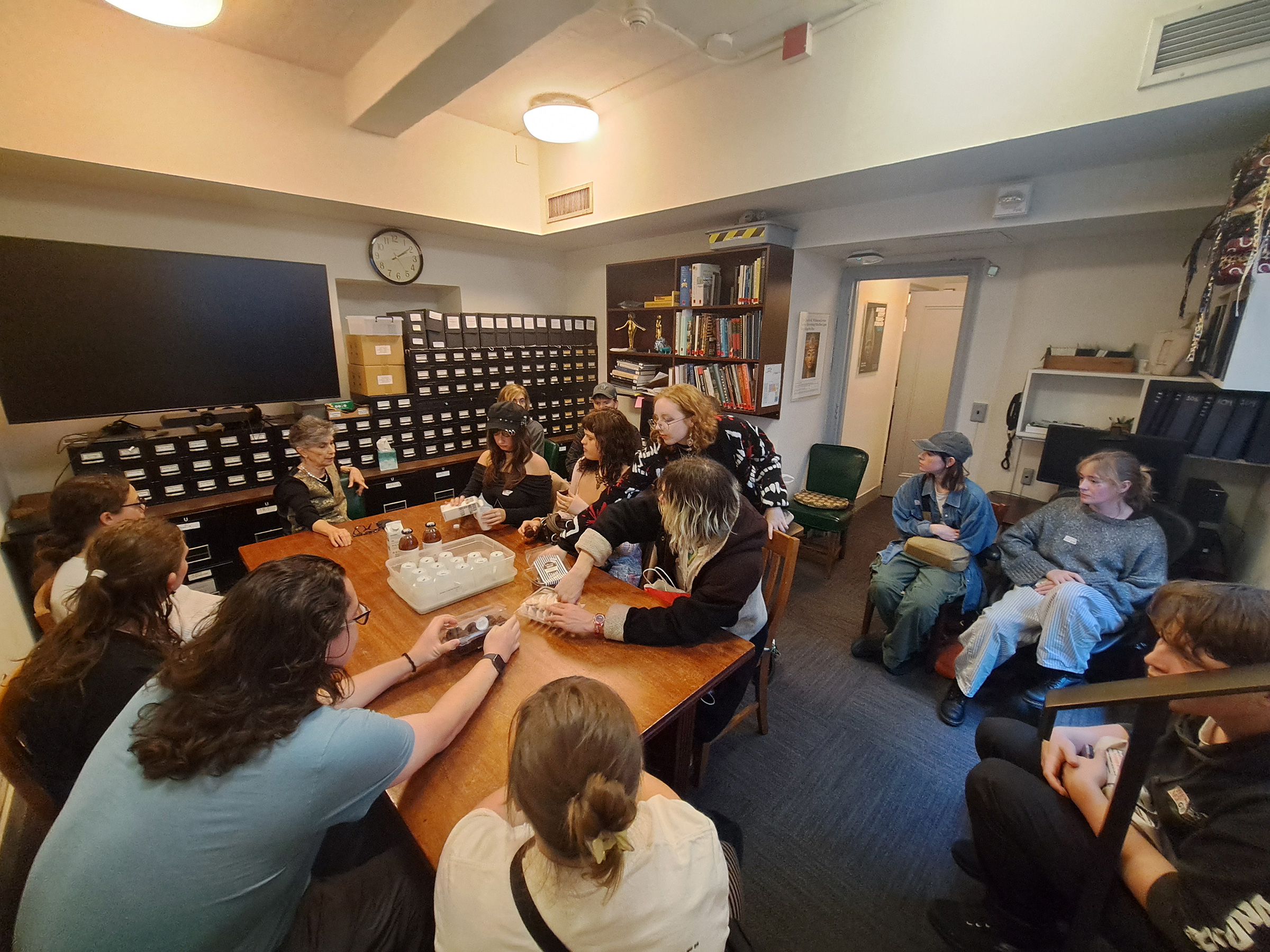
App State students of Dr. Erin Peters’ Art Criticism and Theory seminar engage in experiential learning on a trip to New York City, where they met with Diana Craig Patch, curator in charge of Egyptian art at the Metropolitan Museum of Art, to discuss the Met’s “Dendur Decoded” virtual reality experience and “Divine Egypt” exhibition. Peters, assistant professor of art and visual culture at App State, served as a key consultant on the “Dendur Decoded” project, helping to bring new vigor, form and color to the temple’s layered history. Photo submitted
The history, and enduring mysteries, of Dendur
Originally built on the banks of the Nile River, Dendur served as a site of worship for the Egyptian goddess Isis and other deities — along with many other uses over the ensuing centuries. Its uniform brown stone was once brightly painted, and the temple was likely hung with colorful shrouds.
Built during the reign of Emperor Augustus, Dendur was part of an international campaign launched in the 1960s to research, excavate and move significant sites threatened by the Aswan High Dam, which created the 2,000-square-mile Lake Nasser and submerged millennia of history. Reassembled block by block in New York City, the stones retain inscriptions of Augustus as a pharaoh making offerings to the gods. There are hieroglyphs, Coptic inscriptions and even 19th-century graffiti.
So much of what now merely appears as monochromatic stone was once alive with a range of brilliant Egyptian pigments, said Peters.
Digital technology can restore colors that have been lost to time, said Peters, adding that it can also fill broken and missing pieces, restore original meanings and make the timeworn and disfigured appear fresh and more complete.

“Dendur Decoded,” an immersive digital reality experience offered through the Metropolitan Museum of Art and created in part by App State faculty member Dr. Erin Peters, shows a simulation of the ancient Egyptian temple surrounded by a flooded Nile River. Photo courtesy of the Metropolitan Museum of Art
Dendur continues to hold as many questions as it does answers. The temple’s mysteries have been heavily studied — they were the subject of Peters’ doctoral thesis.
“The more we look at it and the more we research it, the more questions it asks of us, in a way that I think is exciting and generative,” Peters said.
Peters shared that she is interested in learning more about how space was added to the temple over time to accommodate increased public worship. Other points of intrigue that Peters plans to investigate further include:
- unusual carved figures that were placed at the back of the temple’s innermost room;
- markings that might indicate the sanctuary was used differently than other ancient Egyptian temples;
- the possibility of a secret room or crypt where an oracle may have hidden and spoken to temple visitors; and
- the temple’s references to two human figures — Pedisi and Pihor — who may have been defied (honored as gods) due to their drowning in the Nile River, as was a custom at the time.
Peters will return to Egypt in March 2026 to continue searching for the stories of Dendur and other ancient temples.
What do you think?
Share your feedback on this story.
About the Department of Art
One of seven departments housed in the College of Fine and Applied Arts, the Department of Art at Appalachian State University prepares students to explore art, identity, expression and creative problem-solving while challenging them to go beyond their previous limits by discovering new connections to culture. The department offers degrees in art and visual culture, art education, graphic design, studio art, photography and graphic communications management, with minors in art history, studio art, photography and graphic communications management. Learn more at https://art.appstate.edu.
About the College of Fine and Applied Arts
Appalachian State University’s College of Fine and Applied Arts is a dynamic and innovative group of seven academic departments, bringing together a variety of perspectives, experiences and real-world education to provide unique opportunities for student success. The college has more than 3,500 undergraduate and graduate majors. Its departments are Applied Design, Art, Communication, Military Science and Leadership, Sustainable Development, Sustainable Technology and the Built Environment, and Theatre and Dance. Learn more at https://cfaa.appstate.edu.
About Appalachian State University
As a premier public institution, Appalachian State University prepares students to lead purposeful lives. App State is one of 17 campuses in the University of North Carolina System, with a national reputation for innovative teaching and opening access to a high-quality, cost-effective education. The university enrolls more than 21,000 students, has a low student-to-faculty ratio and offers more than 150 undergraduate and 80 graduate majors at its Boone and Hickory campuses and through App State Online. Learn more at https://www.appstate.edu.