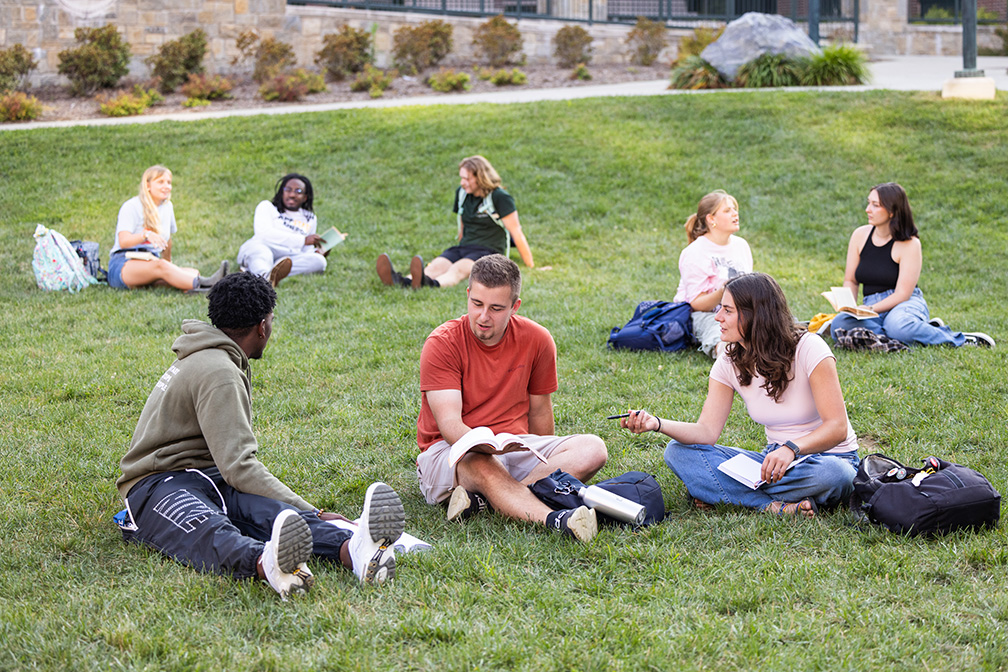
BOONE, N.C. — Appalachian State University’s comprehensive, nonpartisan Civic Literacy Initiative aims to foster a civically engaged and informed university community. The program — which began in fall 2024 and is led by App State Student Affairs — focuses on three critical areas of civic engagement: dialogue across differences, voter participation and free speech and expression.
“We recognize that effective leadership in today’s world requires the ability to understand and work with different perspectives,” said App State Interim Vice Provost of Student Affairs Jeff Cathey. “Our approach combines classroom learning with practical experience to create intentional opportunities for students to engage with different perspectives, understand civic processes and develop the essential skills needed to be effective as leaders in their communities.”
The ultimate goal of the program is to prepare students for engagement as thoughtful participants who become adept at collaborating across differences, appreciate the increasing complexity of the challenges they will face and become civic leaders who embrace respectful, candid dialogue.
Dr. Heather Jo Mashburn, App State’s director of community-engaged leadership, explained that the Civic Literacy Initiative is integrated into existing student success initiatives at App State, creating additional touchpoints for student engagement and support.
“This comprehensive approach helps ensure that civic literacy becomes an integral part of the student experience, rather than an isolated program,” said Mashburn, adding that much research shows the best problem-solving approaches involve fostering environments that respect and value differences and ensure multiple perspectives are included.
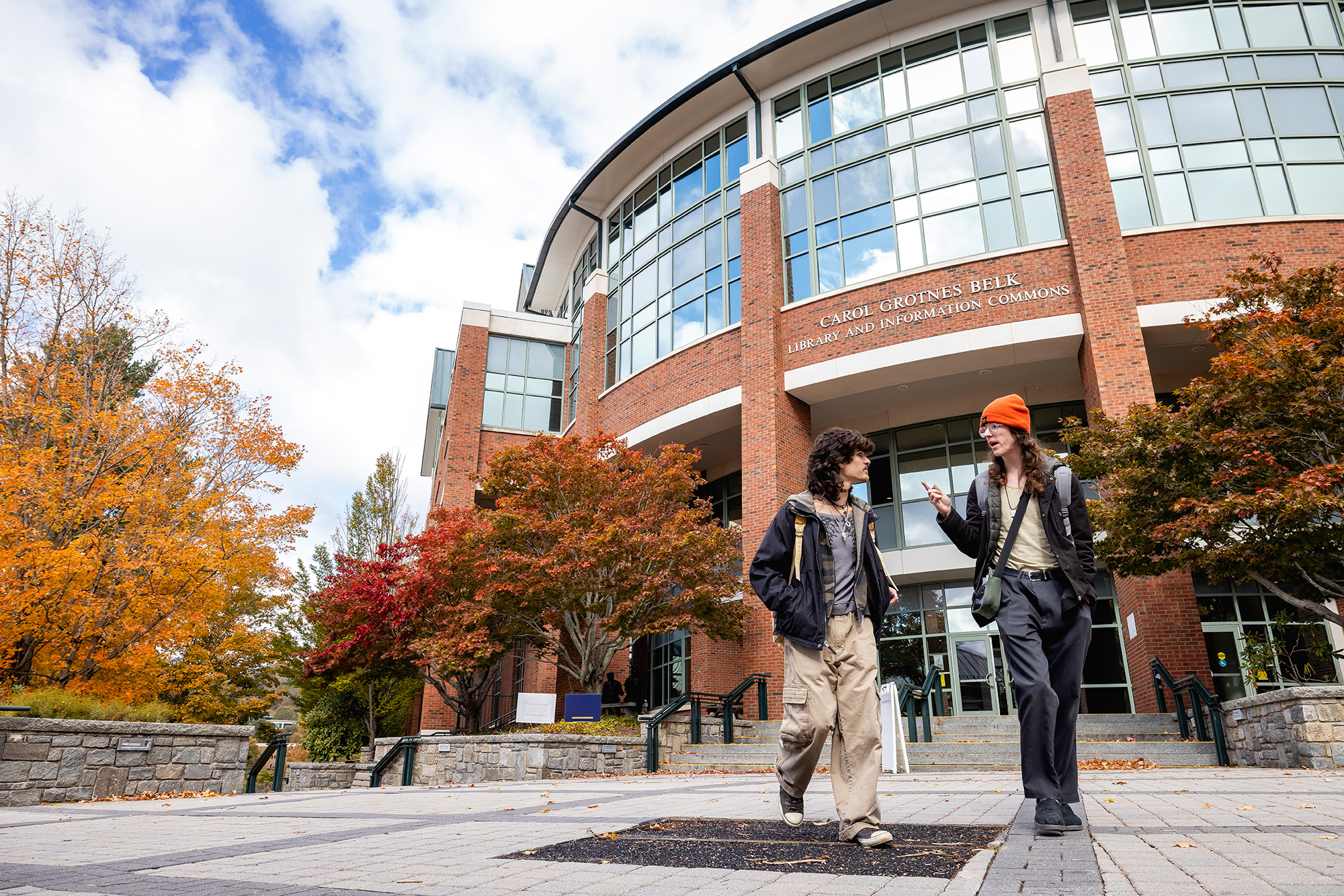
Two App State students are pictured engaged in a discussion outside Belk Library and Information Commons on the university’s Boone campus. Photo by Kyla Willoughby
Dialogue across differences
App State’s Civic Literacy Initiative includes a strong focus on helping students develop skills to effectively build constructive dialogue around difficult topics and discuss challenging societal issues. To this end, the university’s Office of Community-Engaged Leadership has partnered with the Constructive Dialogue Institute (CDI) to offer a constructive dialogue program.
CDI’s Perspectives program, available to App State students, faculty and staff, blends psychological concepts with interactive scenarios to equip people with the skills needed for understanding different perspectives and achieving healthy conflict resolution. The online program can be completed asynchronously, with the option to add three in-person, peer-to-peer conversation activities so that participants can practice their new skills. By participating in Perspectives, Mountaineers gain practical skills in:
- Active listening
- Empathetic communication
- Finding common ground
- Resolving conflicts constructively
A total of 520 App State students, faculty and staff took part in the online Perspectives modules during the 2024–25 academic year, including a number of student leadership organizations — the Student Government Association, Plemmons Leadership Scholars, Student Ambassadors and Student Orientation Undergraduate Leaders — as well as Plemmons Student Union employees. Over the fall 2025 semester, 391 members of the App State Community engaged with the Perspectives program.
The program has impressive, measurable results: More than 77% of App State students who engaged with Perspectives report increased confidence navigating difficult conversations and communicating across differences, and 78% report the program helped them gain valuable professional and life skills.
Student leaders in App State’s Civic Literacy Student Fellows program play a pivotal role in strengthening both constructive dialogue and voter education at the university, helping to build an informed, active and involved student body through peer engagement and campus collaborations. Their work includes fostering constructive dialogue and understanding of governmental processes at all levels through events and professional development opportunities.
Free speech and expression
Underpinning the Civic Literacy Initiative is App State’s commitment to protecting and celebrating free speech — recognizing that free speech is not just a right but a fundamental skill for engaged citizenship.
“Your voice matters” is the guiding principle for the initiative’s approach to free speech, Mashburn shared. Students are encouraged to engage in robust discussions and challenge existing perspectives to strengthen their critical thinking skills.
“The guarantees of the First Amendment are more than a passive right we casually enjoy — they are the engine of civic literacy,” said App State’s Jamie Parson, senior vice provost and one of the university’s free speech officers. “The ability to openly challenge and discuss various viewpoints — even those we find uncomfortable — is precisely how our community of faculty, staff and students enhances the critical thinking skills that are necessary for us to be an informed and responsible society.”
University departments and organizations frequently engage in meaningful dialogue on freedom of speech throughout each academic year. These take the form of classroom discussions, programs and events such as the university’s annual Constitution Day, during which students, faculty, staff and visitors honor and often debate First Amendment topics.
App State’s two designated free speech officers — Parson and Cathey — serve as liaisons for the University of North Carolina System Office. They work to ensure App State complies with both federal and state constitutional laws and UNC System policy regarding free speech and expression on campus. They are also available to answer any questions or concerns from students, faculty, staff or others related to free speech or free expression.

App State’s Party at the Polls event, held Oct. 30, 2024, on Sanford Mall, celebrated early voting. Students were treated to music, food and activities, while also having the opportunity to get their voting questions answered and cast their early voting ballot. The event was part of the university’s Civic Literacy Initiative, launched in fall 2024. Photo by Kyla Willoughby
Voter participation
Increasing voter education and participation is one of the primary goals of App State’s Civic Literacy Initiative — a goal supported by App State’s Voter Coalition and Civic Literacy Student Fellows, who collaborate to increase civic literacy on campus through nonpartisan activities such as educational presentations and voter registration programs.
“With primaries and midterms quickly approaching, we are working diligently to plan engaging and educational programs for campus,” said Ashley Vinson, associate director of community-engaged leadership at App State.
Last summer, App State’s Civic Literacy Initiative program received an Ask Every Student grant from the Students Learn Students Vote Coalition — a national, nonpartisan organization dedicated to increasing college student voter participation. This funding supports the initiative’s newly launched Faculty Civic Champion Program, through which App State faculty have the opportunity to:
- foster a civically engaged and informed campus community;
- build skills to facilitate dialogue across differences;
- choose from opportunities that work best for them and their courses; and
- be rewarded for their commitment and effort.
Civic Literacy Fellows — a program that has grown to include 14 fellows representing multiple areas of study — assist in maintaining and growing voter participation among the App State student body through educational events leading up to local, state and national elections.
Additionally, fellows attended the National Student Vote Summit in November 2025 at the University of Maryland, College Park, where they collaborated with other students, staff and faculty from across the country. They attended workshops, roundtables and networking sessions to share and gain information and resources around strengthening nonpartisan campus civic engagement strategies.
Moving forward, the fellows are focused on maintaining their momentum beyond election cycles. Their plans include creating spaces for students to contact legislators, providing weekly breakdowns of current legislation and Supreme Court cases and developing a podcast featuring local government officials.
App State earned a 2024 Highly Established Action Plan Seal of recognition through the ALL IN Campus Democracy Challenge — a designation recognizing nationwide higher education institutions with strong action plans to increase nonpartisan democratic engagement by promoting civic learning, political engagement and college student voter participation. Additionally, the university was one of 14 North Carolina colleges and universities to receive a 2024 Voter Friendly Campus designation, which recognizes schools that planned and implemented practices to encourage student voter registration and participation in the general election.
Assessing program success and campus community impact
As the Civic Literacy Initiative continues to develop, the university will assess its impact through various metrics, including:
- student participation rates;
- retention data;
- community engagement levels; and
- long-term civic engagement after graduation.
For more information about App State’s Civic Literacy Initiative and the program’s upcoming events, visit civicliteracy.appstate.edu.
What do you think?
Share your feedback on this story.


About the Office of Community-Engaged Leadership
The Office of Community-Engaged Leadership at Appalachian State University engages students in academic, experiential and community-oriented programs that enhance their capacity to serve and lead in socially responsible ways for the benefit of their local and global communities. The office comprises the former Appalachian and the Community Together (ACT) and Leadership Education and Development (LEAD) offices. Learn more at https://cel.appstate.edu.
About Student Affairs at App State
Student Affairs at App State supports student success and well-being by fostering a culture of care, inclusion and engagement. Its mission is to develop lifelong learners and dynamic leaders through meaningful experiences that challenge and support students. Grounded in a commitment to care, engage and transform, Student Affairs creates a student-centered environment that encourages resilience, leadership, service and global learning. Student Affairs encompasses the following units: Campus Activities, Case Management, the Child Development Center, Community-Engaged Leadership, Counseling and Psychological Services, Office of the Dean of Students, New Mountaineer and Family Engagement, Off-Campus Student Services, Plemmons Student Union, Student Conduct, M.S. Shook Student Health Service, Student Legal Services, Student Veteran Services, University Recreation, and Wellness and Prevention Services. Learn more at https://studentaffairs.appstate.edu.
About Appalachian State University
As a premier public institution, Appalachian State University prepares students to lead purposeful lives. App State is one of 17 campuses in the University of North Carolina System, with a national reputation for innovative teaching and opening access to a high-quality, cost-effective education. The university enrolls more than 21,000 students, has a low student-to-faculty ratio and offers more than 150 undergraduate and 80 graduate majors at its Boone and Hickory campuses and through App State Online. Learn more at https://www.appstate.edu.

![NC universities ranked by free-speech advocacy group [faculty and staff featured]](/_images/_posts/2026/09/free-speech-advocacy-600x400.jpg)


![Nepal’s Hydropower Industry Was Booming. Now 900 Workers Are Missing. [faculty featured]](/_images/_posts/2026/08/hydropower-industry-600x400.jpg)