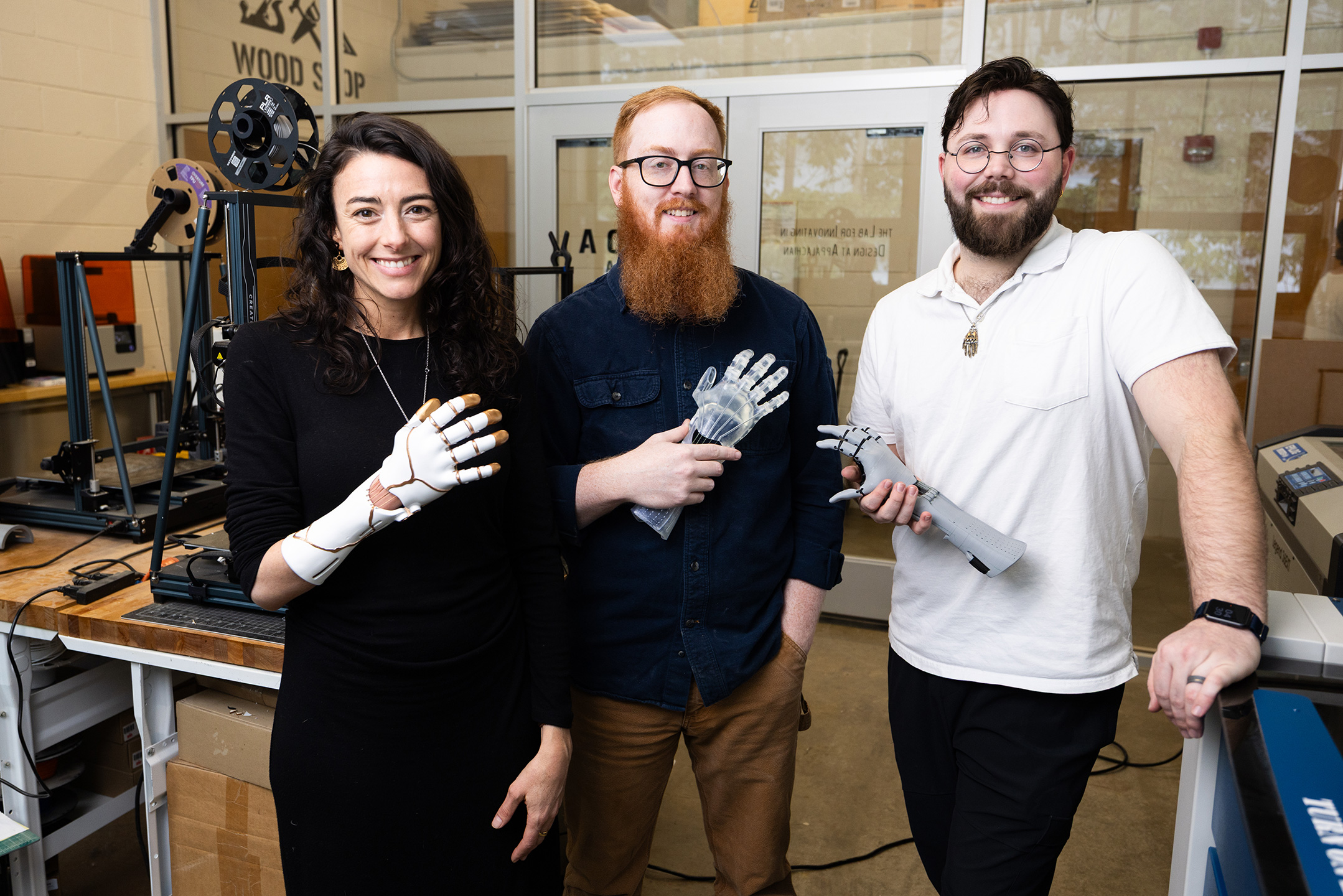
A team of industrial design students at App State is taking a human-centered approach to innovation, using 3D printing technology to design and develop next-generation prosthetic hands that are both accessible and customizable for users. Pictured, from left to right, are App State assistant professor Jimena Vergara-Sanz, who leads the project in collaboration with associate professor Dr. Garner Dewey (not pictured); Davey West, lab operations manager in App State’s Department of Applied Design; and senior industrial design major Walt Rakestraw. Vergara-Sanz, who was born without her right hand, wears one of the prosthetic hand prototypes developed by the team. Photo by Chase Reynolds
BOONE, N.C. — Worldwide, only one in 10 people has access to a prosthetic device. An industrial design team of Appalachian State University students and faculty hopes their research will contribute to more affordable, customizable solutions.
Using 3D printers in App State’s Makerspace and Lab for Innovative Design at Appalachian, the team is conducting a multiyear research project, focused on creating wrist-powered prosthetic hands that are both accessible and customized to users’ needs.
The initiative was inspired by Jimena Vergara-Sanz, assistant professor in App State’s Department of Applied Design, who was born without her right hand. Vergara-Sanz shared that, growing up in Colombia, where disability stigma was far more pronounced than in the United States, she spent her childhood navigating a world that often defined her by what she lacked. Over the course of a decade, she tried four different prosthetic devices — each one promised as a solution — but the devices ended up in the back of her closet, mostly unused.
“The designs were robotic, rigid and made me feel more limited than free,” said Vergara-Sanz, whose early experiences — and the realization that prosthetics are too often evaluated through technical efficiency rather than lived human experience — now shape her mission as a designer, researcher and academic.
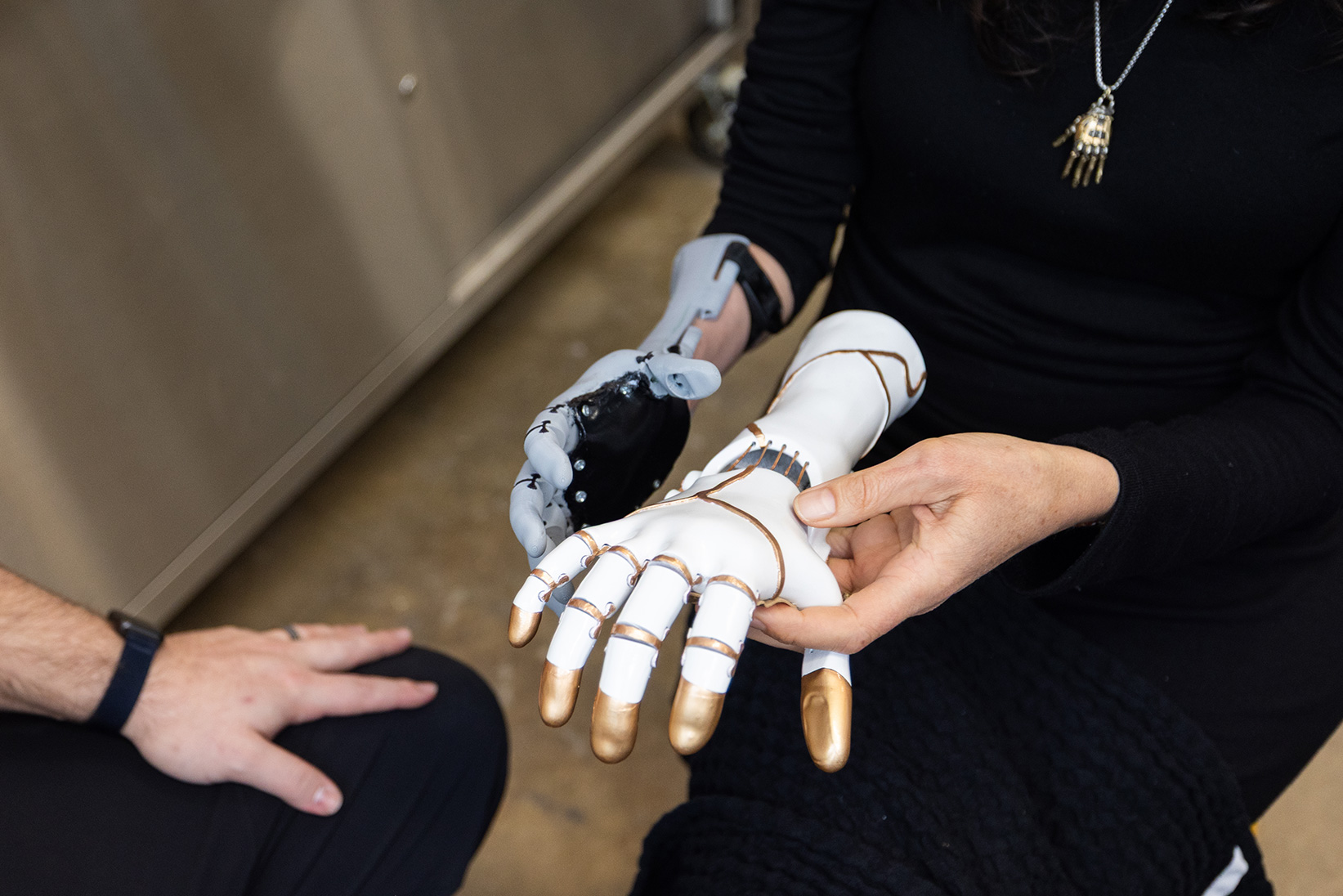
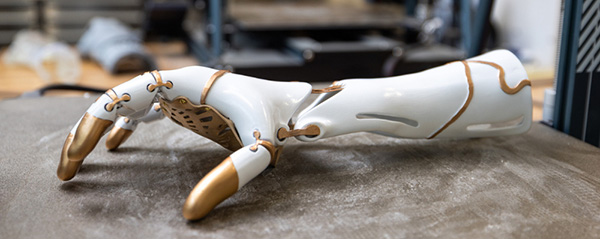
App State assistant professor Jimena Vergara-Sanz holds the latest kinetic hand model developed by her App State research team while wearing its immediate predecessor. Inspired by the Japanese art of Kintsugi, the practice of repairing broken ceramics with gold, the new model is intentionally designed to appear broken and reassembled with golden seams. It invites conversation, Vergara-Sanz said, using form and material expression to reframe disability as something visible, meaningful and powerful. Photo by Chase Reynolds
Led by Vergara‑Sanz in collaboration with Dr. Garner Dewey, associate professor of industrial design at App State, and Davey West, the department’s lab operations manager, the project brings together industrial design students with different areas of expertise:
- Senior Walt Rakestraw, of Reidsville, has spent two years on the team and is completing his capstone on parametric modeling for prosthetic design. Parametric modeling is a computer-aided design technique that involves creating 3D models using parameters, relationships and constraints.
- Junior Diana Beltran, of Mount Juliet, Tennessee, has focused on developing user personas that have helped guide aesthetic decisions.
Vergara‑Sanz said the students’ work demonstrates the potential of human-centered design in addressing global accessibility challenges.
“This project exemplifies the kind of work we strive to cultivate in our department — work that is not only technically innovative but deeply grounded in empathy, lived experience and real-world impact,” said Department of Applied Design Chair Sheryl Oring. “It’s an extraordinary example of how research, teaching and community impact can come together in powerful ways.”
Rakestraw shared that, through this work, “we realized we weren’t just solving technical problems. We were learning how a living body and a technical object relate to one another. A prosthetic is not simply a product — it’s a relationship. If that relationship creates discomfort or resistance, then the design has failed.”
For Vergara-Sanz, the project is more than an academic pursuit — it allows her and her team to contribute to next-generation prosthetics, helping to bridge the gap between design and orthotics and prosthetics. Equipping designers with the tools and knowledge required to understand the technical aspects of creating prosthetics could greatly elevate the lived experience for users, she explained.
“This work has been deeply personal, but it has also become collective. Watching students grow as designers, listeners and collaborators has shown me that design education can truly shape more empathetic and responsible ways of engaging with the world,” she said.
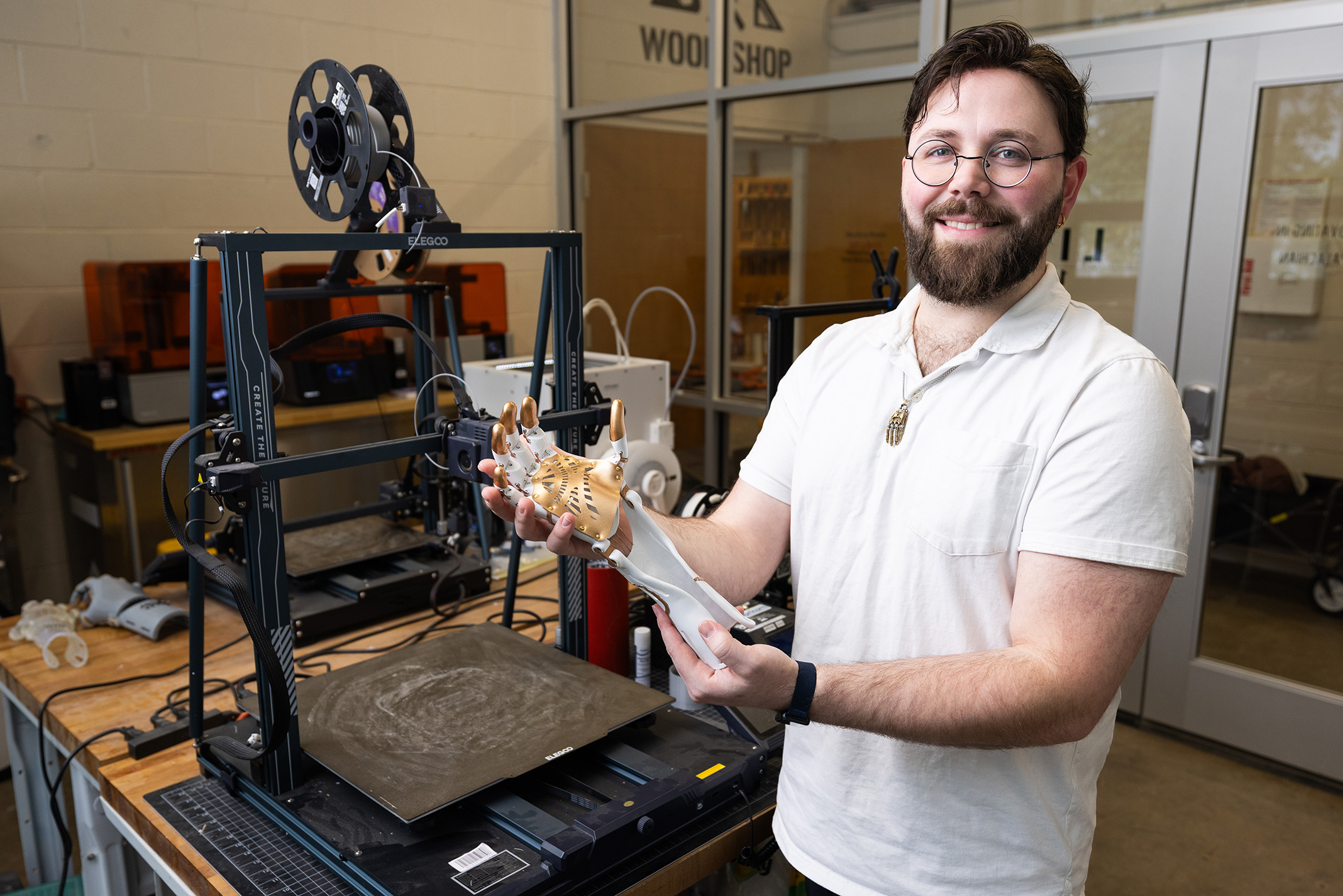
App State senior industrial design major Walt Rakestraw holds a prosthetic hand prototype he helped create using 3D printing technology available in the university’s Makerspace and Lab for Innovative Design at Appalachian. Photo by Chase Reynolds
Advancing innovation through the lens of lived experience
The team’s research began with an open-source model of a kinetic, or user-powered hand provided by e-NABLE, a global community of volunteers who use 3D printing to create free or low-cost prosthetic upper-limb devices. Vergara-Sanz learned of e-NABLE’s work through Frankie Flood, a professor in App State’s Department of Art who helped develop several components for the first 3D hand design created by e-NABLE.
To date, the team has printed more than a dozen test models for clay modeling research and continues to refine components. Current challenges include reducing the bulk of the tension straps, which can interfere with clothing, as well as identifying alternatives to brittle acrylic materials and establishing partnerships with local orthotists and prosthetists, tapping their expertise to refine the design’s aesthetics and expand user testing.
“When we printed the initial hands and Jimena tried to use them, she could only tolerate them for a few minutes,” Rakestraw said. “The pain in her residual limb — her puño, which means fist in Spanish — was so intense that using the hands was simply not an option.”
That early feedback prompted a series of fundamental adjustments. Rakestraw reshaped the interior of the socket to better match the anatomy of Vergara‑Sanz’s residual limb, extended the socket length and redistributed pressure based on guidance from orthotist and prosthetist specialists in Mexico and Colombia. The team also recalculated wrist and arm alignment using X‑rays and tactile evaluation, translating those measurements into digital models.
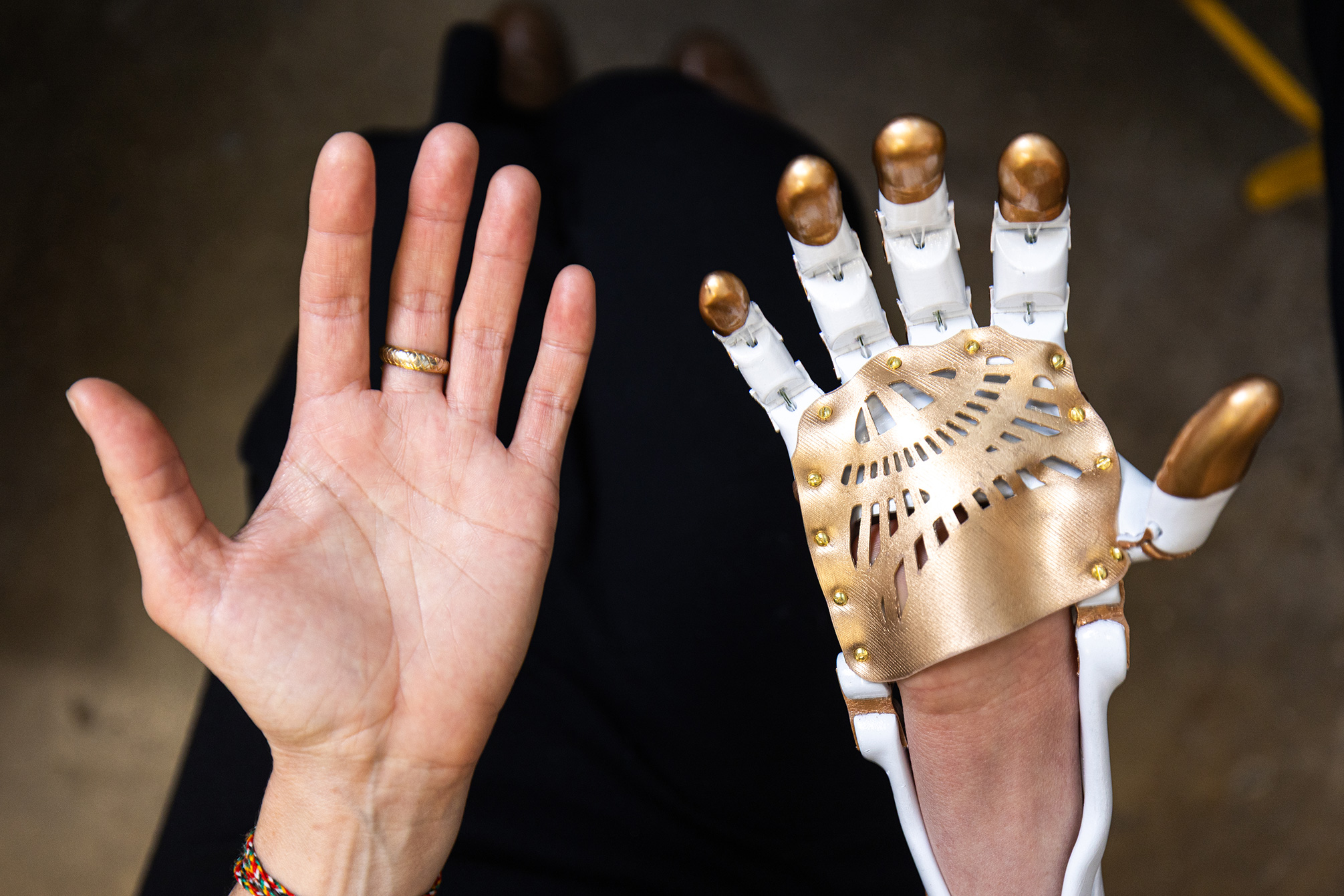

Jimena Vergara-Sanz, assistant professor in App State’s Department of Applied Design, wears the latest kinetic hand model developed by a team of App State industrial design students that she, along with associate professor Dr. Garner Dewey, leads as part of a multiyear research project. The project uses 3D printing technology to design and develop next-generation prosthetic hands that are both accessible and customizable for users. Shown at right, Vergara-Sanz, who was born without her right hand, forms a mudra — a symbolic hand gesture representing abundance and gratefulness — with her new prosthetic hand. Photo by Chase Reynolds
Other top priorities for the team: accessibility and costs. Their goal is to produce a functional prosthetic for under $100 using 3D scanning tools such as EM3D, a specialized iPhone app for 3D scanning. They have met with Ugani’s global prosthetics innovation team, a social-impact group of engineers working to expand access to affordable, high-quality prosthetic care. Ugani developed an add-on for Blender (open-source 3D modeling software) that automatically generates sockets from limb scans, and Beltran is creating a tutorial to support remote scanning for future users.
Material testing for the models has also been a major component of the project. Standard PLA (polylactic acid) offered clean prints but lacked the strength needed for everyday use. The next step up, PLA plus, offered greater strength and improved reliability, while TPU (thermoplastic polyurethane) provided better hinge flexibility and reduced friction. West led the team in collaborating with Formlabs, supplier of 3D printers and printing materials, to explore clear and elastic resins, which offered a balance of durability and flexibility.
“The added weight of resin felt closer to what Jimena’s body perceives as balanced,” Rakestraw explained. “It also opened new aesthetic possibilities through transparency and color.”
Working closely with Dewey, Beltran developed four personas, ranging from a young female to an older male, each with distinct preferences for color, texture and function. These personas include mood boards and design guidelines intended to demonstrate how aesthetics can influence self-perception and reduce stigma. One example, a persona named Larabel, explores playful design elements for younger users.
Rakestraw’s capstone project focuses on developing a parametric modeling system that allows designers to adjust hand dimensions using sliders, automatically scaling the prosthetics for different users with varying needs.
“Good design helps people feel seen,” Rakestraw added. “That’s what we’re working toward.”
What do you think?
Share your feedback on this story.


About the Department of Applied Design
One of seven departments housed in the College of Fine and Applied Arts, the Department Applied Design at Appalachian State University fosters excellence in design education, design research and professional placement. The department balances theoretical and pragmatic approaches while exploring an awareness of impact through design decisions on the global community. Faculty focus on a holistic approach to creative problem-solving by integrating sustainability and ethical responsibility in teaching and practice. The department offers bachelor’s degrees in apparel design and merchandising, industrial design and interior design. Learn more at https://design.appstate.edu.
About the College of Fine and Applied Arts
Appalachian State University’s College of Fine and Applied Arts is a dynamic and innovative group of seven academic departments, bringing together a variety of perspectives, experiences and real-world education to provide unique opportunities for student success. The college has more than 3,500 undergraduate and graduate majors. Its departments are Applied Design, Art, Communication, Military Science and Leadership, Sustainable Development, Sustainable Technology and the Built Environment, and Theatre and Dance. Learn more at https://cfaa.appstate.edu.
About Appalachian State University
As a premier public institution, Appalachian State University prepares students to lead purposeful lives. App State is one of 17 campuses in the University of North Carolina System, with a national reputation for innovative teaching and opening access to a high-quality, cost-effective education. The university enrolls more than 21,000 students, has a low student-to-faculty ratio and offers more than 150 undergraduate and 80 graduate majors at its Boone and Hickory campuses and through App State Online. Learn more at https://www.appstate.edu.


![NC universities ranked by free-speech advocacy group [faculty and staff featured]](/_images/_posts/2026/09/free-speech-advocacy-600x400.jpg)


![Nepal’s Hydropower Industry Was Booming. Now 900 Workers Are Missing. [faculty featured]](/_images/_posts/2026/08/hydropower-industry-600x400.jpg)