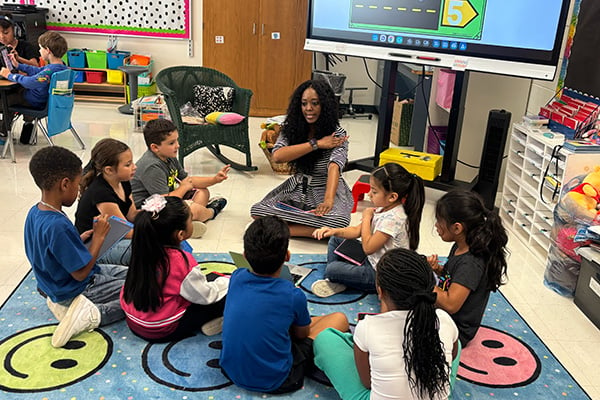
A Cove Creek Elementary School student practices reading as an App State teacher candidate displays words on a whiteboard. Photo by Chase Reynolds
BOONE, N.C. — Since its launch in fall 2023, Appalachian State University’s early literacy field experience program has served nearly 500 K–3 students with reading support across Watauga and Catawba counties. The program has also supported nearly 460 App State teacher candidates in the elementary and special education degree programs, who have gained hands-on experience in local schools.
The initiative, within the Department of Child Development, Literacy and Special Education, is supported by ongoing donations from the Mebane Charitable Foundation, which has contributed nearly $250,000 to date. The funding provides technology and instructional materials, professional learning opportunities and early literacy mentors — education professionals who mentor and coach App State teacher candidates in the field alongside literacy education faculty.
“App State’s early literacy outreach model represents the very best of what it means to serve our communities and future educators as a College of Education,” said Reich College of Education Dean Melba Spooner. “By forging mutually beneficial partnerships that place our teacher candidates directly in local schools and pairing them with the consistent guidance of our literacy faculty and mentors, we are not only preparing highly skilled educators — we are also meeting an urgent need of young readers across Watauga County and Hickory City Schools.”

Teacher candidates and faculty in App State’s Reich College of Education pose for a group photo during an early literacy field experience program at Cove Creek Elementary School. Photo by Chase Reynolds
Through these teaching opportunities, App State students gain experience with instruction that aligns with the science of reading, the Comprehensive University of North Carolina System Literacy Framework and the North Carolina Literacy Instruction Standards, explained Dr. Beth Buchholz, associate professor in the Department of Child Development, Literacy and Special Education and director of App State’s literacy education graduate program.
“We started at Hardin Park and Cove Creek schools in Watauga County and have since expanded to Green Valley in Watauga and Jenkins Elementary School in Hickory,” said program coordinator Jenny McCourry, lecturer in the Department of Child Development, Literacy and Special Education. “Next semester, we will expand to Valle Crucis Elementary School.”
The program builds on the long-established model of the college’s Anderson Reading Clinic — available at both App State campuses, in Boone and Hickory — and was created to meet growing demand, ensuring students whose families cannot travel to the Boone campus still have access to reading support. It follows the state-mandated Multi-Tiered System of Supports (MTSS), with App State Block 1 students — who are early in their elementary education and special education programs — leading reading interventions for children at all levels, especially Tier 2 students who have been identified as needing individualized support through small-group or one-on-one settings.
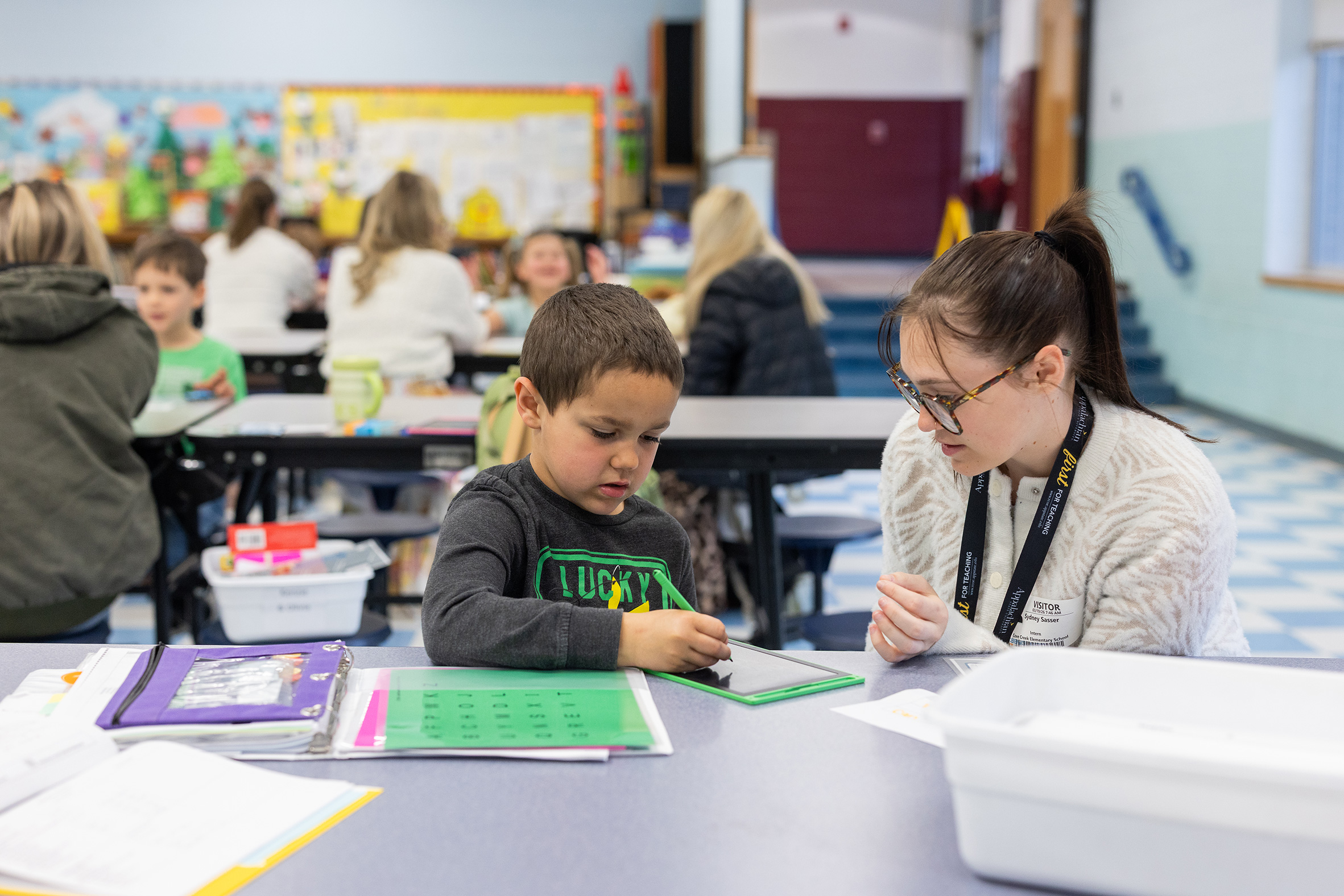
An App State teacher candidate helps a Cove Creek student with a writing exercise during the early literacy program. Photo by Chase Reynolds

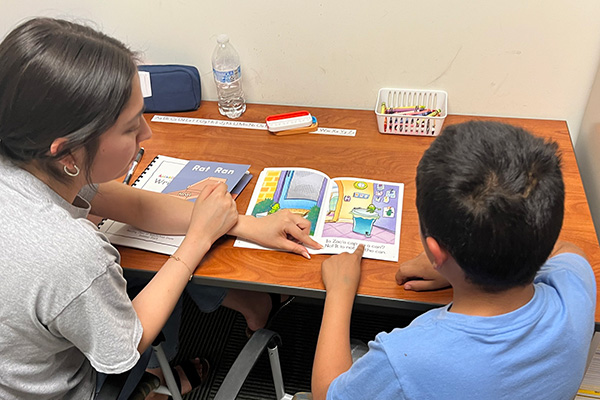
Jenny McCourry, program coordinator of App State’s early literacy field experience program and lecturer in the Department of Child Development, Literacy and Special Education, left, assists a Cove Creek Elementary School student with a reading exercise. Photo by Chase Reynolds
Mebane Foundation funding is also making possible the expansion of literacy field experiences for Block 2 teacher candidates, who are further along in the elementary education program. During the semester following their early literacy intervention field experience, teacher candidates gain additional teaching experience by providing intensive, individualized literacy instruction for children at both campus locations of the Anderson Reading Clinic.
What sets the program apart is twofold:
- its integrated model, which combines classroom-based experiences, faculty-supported training in early literacy and research opportunities for teacher candidates working directly in schools; and
- its ability to help address a critical gap: Instead of simply observing or shadowing, App State teacher candidates act as an extension of the school’s instructional staff, providing high-quality literacy interventions for students in need of additional support beyond their classroom literacy instruction.
Cove Creek Elementary School Principal Scott Carter, a partner in the program since its inception, said it has been a game changer for his staff.
“With everything teachers have on their plates today, very few actually have the time to provide true Tier 2 instruction,” said Carter. “Having App State students come in allows our teachers to support students in other ways, and I can’t express how valuable this partnership is for student success. It’s really cool to witness.”
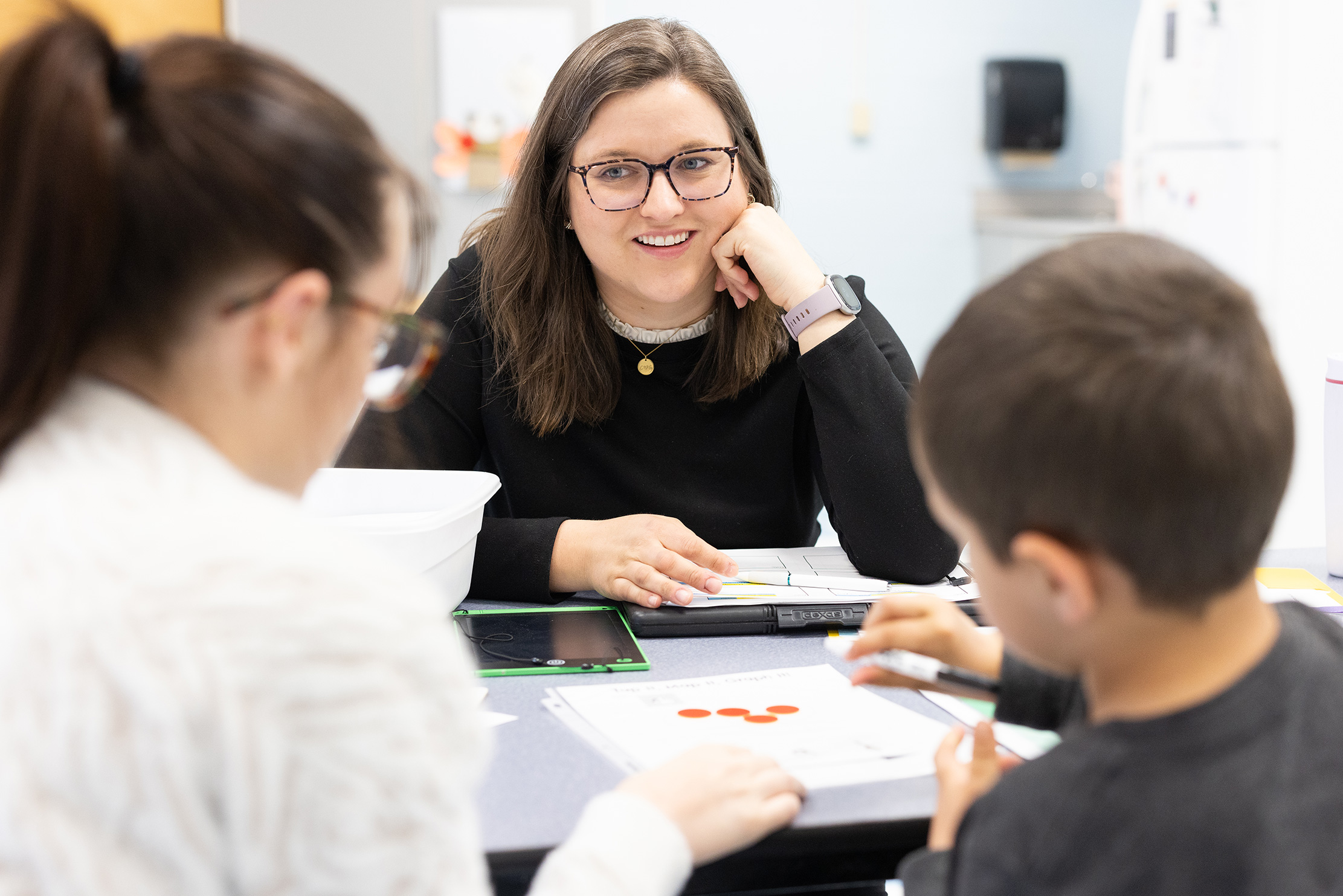
Dr. Ashley Pennell, assistant professor in App State’s Department of Child Development, Literacy and Special Education and assistant director of the university’s Anderson Reading Clinic, center, observes an App State teacher candidate as they guide a Cove Creek Elementary School student through a literacy intervention. Photo by Chase Reynolds
K–3 and App State students grow together
Dr. Kristen Evans, an App State assistant professor of literacy education who has worked with teacher candidates at Cove Creek, explained that the Block I field placement serves as a vital bridge between coursework and classroom practice, grounding university learning in school settings.
“Candidates apply what they are learning in real time, as theory, pedagogical content knowledge and practice are intentionally woven together,” said Evans. “By working directly with students in authentic instructional contexts, teacher candidates deepen their understanding of literacy development while learning how responsive, research-based instruction can directly impact learners.”

A Cove Creek Elementary School student gives an App State teacher candidates a high-five during a literacy intervention. Photo by Chase Reynolds
McCourry added, “It’s a win-win, because our teacher candidates develop their skills, and the students they serve make real progress.” She described the process as collaborative, with support from App State literacy faculty and early literacy mentors in the elementary schools.
The teacher candidates also collect data to monitor student reading progress, and McCourry said she has seen growth across the board every semester — and, in some cases, monumental growth.
“Our teacher candidates do an amazing job taking care of everything, and they’re surrounded by people who are very knowledgeable and know how to support them,” she said. “It’s the perfect formula for success, and it’s always so gratifying to see consistent, positive progress for the K–3 students.”

A Cove Creek Elementary School student practices writing words during an intervention in App State’s early literacy field experience program. Photo by Chase Reynolds

A Cove Creek Elementary School student forms sentences using word-labeled cards during a hands-on literacy activity with App State teacher candidates. Photo by Chase Reynolds
Carter said the program has an impact beyond literacy development, giving his students at Cove Creek a noticeable boost in enthusiasm.
“Our kids are so excited to see App State students, and you can tell they’re building genuine relationships,” he said. “Anybody who works in education will tell you that step one is meeting students’ basic needs and helping them feel safe and secure, and the App State students are doing just that. They have the kids eager to learn, and you can see their motivation.”
The feeling is mutual for App State teacher candidates, who not only support K–3 students but also witness firsthand the difference their work makes.
“The most valuable part of this field experience was seeing how the kids grew and the confidence they gained over the semester,” said App State junior Laken Crowe, an elementary education major from Newland. “It really showed me how important early literacy instruction is. Knowing the material is one thing, but being engaged with the students made me see just how meaningful it can be.”

An App State teacher candidate supports a Cove Creek Elementary School student as they practice writing during an early literacy session. Photo by Chase Reynolds
Measuring progress and informing practice
In addition to their classroom work, students in App State’s early literacy field experience program collect data to track student progress, analyze reading growth and identify trends that inform literacy instruction.
“The data shows this is really working,” said McCourry. “Being able to gather this information and receive feedback helps us continue to model effective strategies, and that’s crucial.”
Student progress is measured using DIBELS (Dynamic Indicators of Basic Early Literacy Skills), a series of short tests that assess phonemic awareness, the alphabetic principle, accuracy, fluency, comprehension and more.
Overall, kindergartners showed the strongest growth, highlighting that early intervention is key and that the program — coupled alongside other early literacy interventions, such as tutoring or summer reading programs — is helping contribute to the students’ success.
The most recent data from spring 2025 shows significant growth and impact across all partner schools, with average DIBELS composite scores improving substantially from the beginning to the end of the 2024–25 academic year.

Dr. Beth Buchholz, associate professor in App State’s Department of Child Development, Literacy and Special Education, far right, observes a Block 2 App State student, left, during a tutoring session at the Anderson Reading Clinic on App State’s Boone campus. Photo by Rebekah Saylors
Research also tracks the growth of App State teacher candidates, monitoring their development in early literacy knowledge and teaching skills.
Misty Kimel, a literacy education graduate student from Winston-Salem, said the data shows positive results for the undergraduate students’ learning as well.
“It’s really cool to see the undergrad students step into this role and witness their growth,” she said. “I was a teacher for more than 10 years, and there was never a field experience like this. I truly think it’s a game changer.”
Kimel serves as a research assistant on the project as part of App State’s Graduate Research Assistant Mentoring Program, with her work guided under the mentorship of Dr. Ashley Pennell, assistant professor in the Department of Child Development, Literacy and Special Education and assistant director of the Anderson Reading Clinic.
Pennell studies how mentored teaching experiences help teacher candidates apply foundational reading theory from their coursework to actual practice with children.
The App State research team, spearheaded by Pennell, shared its findings at the 2025 North Carolina Association of Colleges for Teacher Education Fall Forum and the 2025 Association of Literacy Education Researchers conference, aiming to showcase the program as a model for other institutions.
“It would be amazing to see this model replicated in other schools, because we’re really proud of the results we have seen,” said McCourry.
What do you think?
Share your feedback on this story.
About the Department of Child Development, Literacy and Special Education
The Department of Child Development, Literacy and Special Education, housed in App State's Reich College of Education, offers innovative baccalaureate and graduate degree programs that focus on all facets of child development, reading, writing and language arts, as well as specific areas of special education. These programs provide coursework and field experiences in a variety of settings and can lead to licensure. Learn more at https://clse.appstate.edu.
About the Reich College of Education
Appalachian State University offers one of the largest undergraduate teacher preparation programs in North Carolina, graduating about 500 teachers a year. The Reich College of Education enrolls more than 2,000 students in its bachelor’s, master’s, education specialist and doctoral degree programs, with offerings that span multiple fields — from teacher preparation, counseling, and therapy, to higher education, school and student affairs administration, library science, educational leadership and more. With over 10,000 alumni employed in North Carolina public schools, there is at least one Reich College graduate in every county in the state. Learn more at https://rcoe.appstate.edu.
About Appalachian State University
As a premier public institution, Appalachian State University prepares students to lead purposeful lives. App State is one of 17 campuses in the University of North Carolina System, with a national reputation for innovative teaching and opening access to a high-quality, cost-effective education. The university enrolls more than 21,000 students, has a low student-to-faculty ratio and offers more than 150 undergraduate and 80 graduate majors at its Boone and Hickory campuses and through App State Online. Learn more at https://www.appstate.edu.
![The Catawba Valley has a healthcare provider shortage. App State has a program to help [faculty featured]](/_images/_posts/2026/10/healthcare-provider-shortage-600x400.jpg)
![Science Says I’ve Been Jumping My Bike Wrong For 30 Years [faculty featured]](/_images/_posts/2026/09/jumping-my-bike-600x400.jpg)