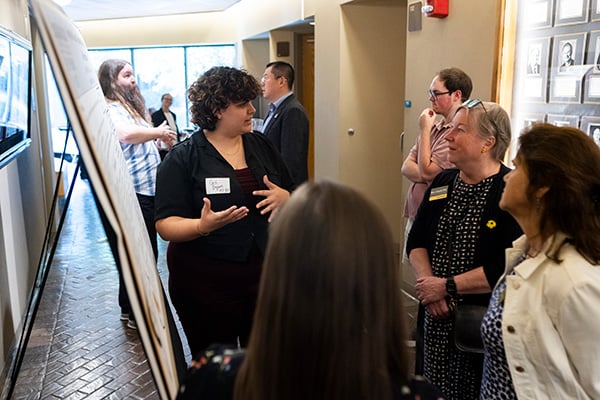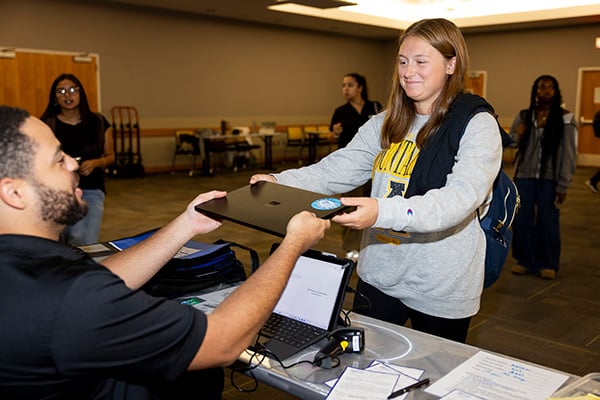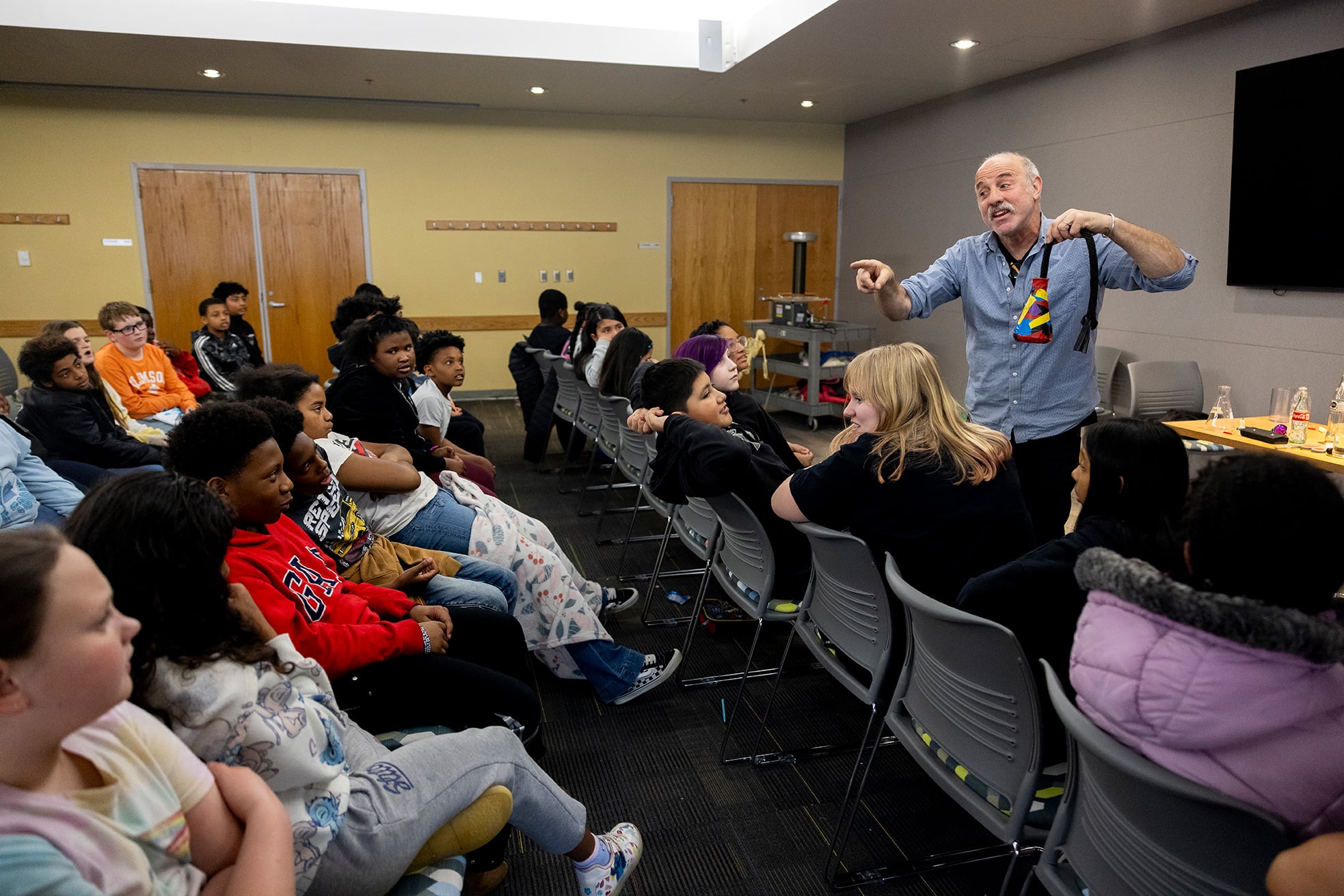
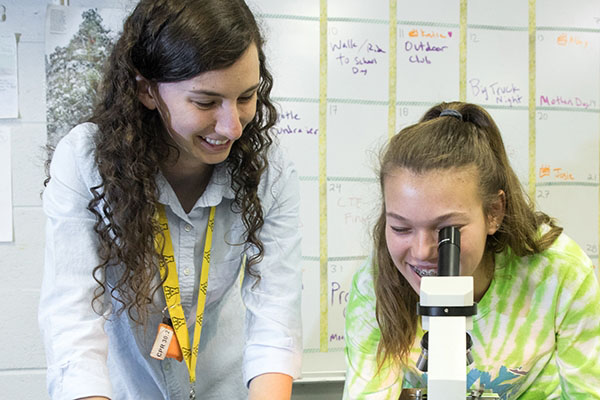
Jeff Goodman, a retired Reich College of Education instructor, interacts with students from the Appalachian State University Academy at Middle Fork during a hands-on presentation at the university’s STEAM Expo, held March 25 on the Boone campus. Goodman regularly returns to campus to volunteer in student-centered events. Photo by Kyla Willoughby
BOONE, N.C. — What do you get when a middle school student tests their vertical jump, a local teacher discovers a new lesson plan and a college teacher candidate shares their passion for educating? The annual STEAM Expo at Appalachian State University.
More than 400 regional middle and high school students gathered on App State’s Boone campus this spring to take part in the expo — an event that brings science, technology, engineering, arts and mathematics to life through interactive demonstrations, hands-on activities and direct engagement with App State faculty and students.
One of App State’s largest outreach events, the expo serves as a dual-purpose educational hub, offering visiting students in grades 6–12 a preview of future career paths while providing App State education majors and regional teachers with an immersive environment to refine innovative teaching techniques. It is hosted by the Reich College of Education’s Mathematics and Science Education Center (MSEC).
“The STEAM Expo serves as a bridge where the classroom meets the real world,” said MSEC Director Dr. Chrystal Dean. “We aren’t just showing students STEAM; we are letting them do STEAM. For the visiting students, it’s a high-impact sneak peek at university-level inquiry.”

At App State’s STEAM Expo, held March 25 on the Boone campus, Raymond Cheek, a seventh grade science teacher at Watauga County Schools’ Hardin Park School, right, volunteered to try the Van de Graaff generator during one of the hands-on presentations from the Department of Physics and Astronomy. Photo by Kyla Willoughby
With a strong emphasis on participation, students from area schools — including students from App State’s Academy at Middle Fork lab school — rotated through a variety of rooms and stations during the March 25 event, interacting with App State faculty and students through engaging exhibits and hands-on activities.
New to this year’s event were STEAM Blasts, through which students explored potential STEAM majors and learned about faculty-led research, as well as the experiences of App State students in STEAM programs. Each blast consisted of a 10-minute presentation focused on real-world research or a particular STEAM major, followed by a five-minute Q&A session.
“We recognize that a standard lecture format doesn’t always ignite a passion for the sciences and math in a 14-year-old,” said Dean, who is also a professor of mathematics education. “Our new STEAM Blasts are a perfect example of innovative teaching: They provide brief, high-energy demonstrations designed to mirror the fast-paced way today’s students consume information.”

Students from area schools participate in App State’s STEAM Expo, rotating through various stations hosted by App State departments and programs to learn more about science, technology, engineering, arts and mathematics. The expo was held March 25 on App State’s Boone campus. Photo by Kyla Willoughby
App State’s annual STEAM Expobrings science, technology, engineering, arts and mathematics to life for students in grades 6–12 — through interactive demonstrations, hands-on activities and direct engagement with App State faculty and students. More than 400 regional students took part in this year’s event. Watch this video for expo highlights.
Building the future STEAM workforce
Beyond teaching STEAM concepts, a central goal of the expo is to inspire students to pursue studies in science, technology, engineering, arts and mathematics.
“The expo demystifies the scientist archetype by connecting visitors with App State students who were in their shoes only a few years ago,” explained Dean. “For example, through our STEAM Blasts, faculty and researchers pitch their majors directly to prospective students and answer the ‘What can I do with this degree?’ question in real time.”
She added, “We aren’t just recruiting students for college; we are recruiting the next generation of North Carolina’s STEAM workforce.”
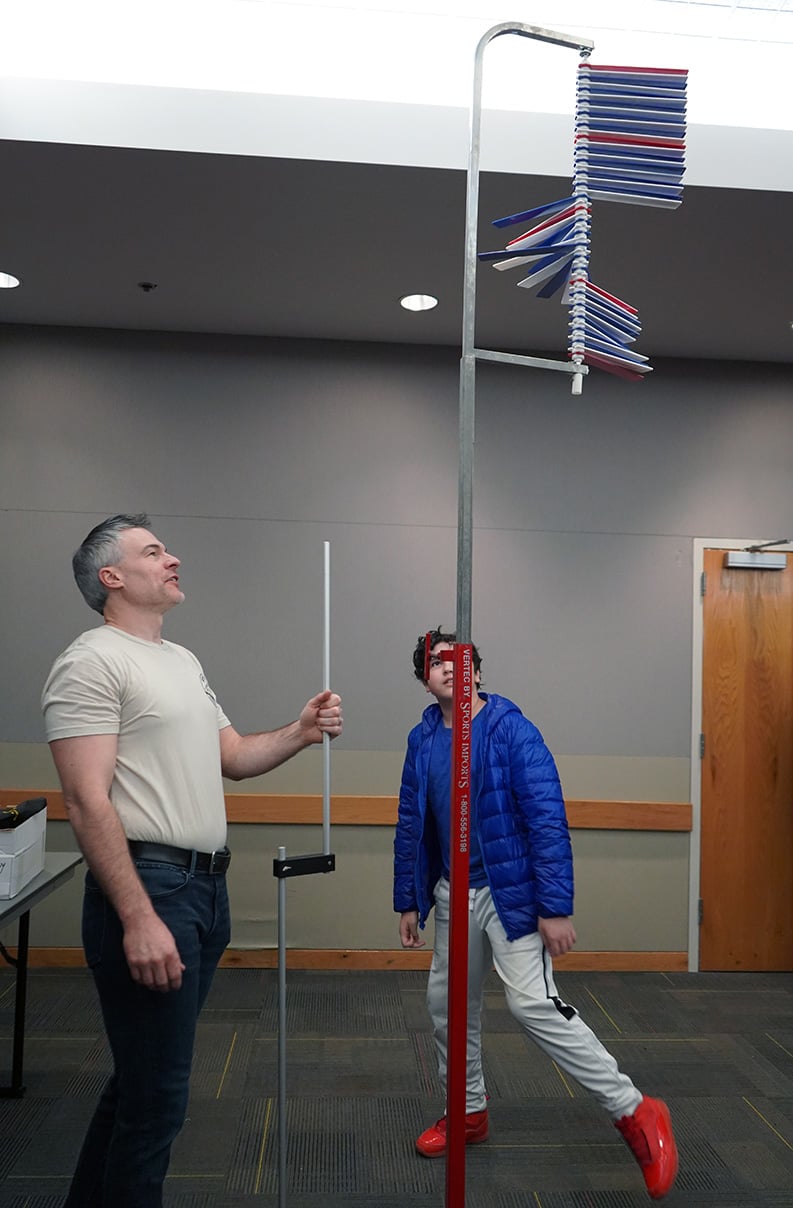

Left: Dr. Matthew Rogatzki, associate professor in the Department of Kinesiology, reviews a student’s vertical jump — part of a hands-on activity at the university’s STEAM Expo, held March 25 on App State’s Boone campus. Right: A student from Hardin Park School tests his vertical jump. Photos by Rebekah Saylors
For Dr. Matthew Rogatzki, associate professor in the Beaver College of Health Sciences’ Department of Kinesiology, this is what inspired him to participate and host a hands-on activity at the STEAM Expo.
“As a first-generation college student, I didn’t know what to expect with my college experience, and I did not know what majors were offered at the university I attended,” he said. “Participating in this event was a way for me to give back by showcasing my chosen field of study and helping students see possibilities they may not know exist.”
Rogatzki’s exhibit featured a vertical jump test and a handgrip strength test, translating abstract concepts such as power, force and bioenergetics (how living systems receive and use energy) into tangible experiences.
“Students were interested in the competitive nature of the tests,” he observed. “They would test and retest themselves to try to improve their scores and beat their peers.”
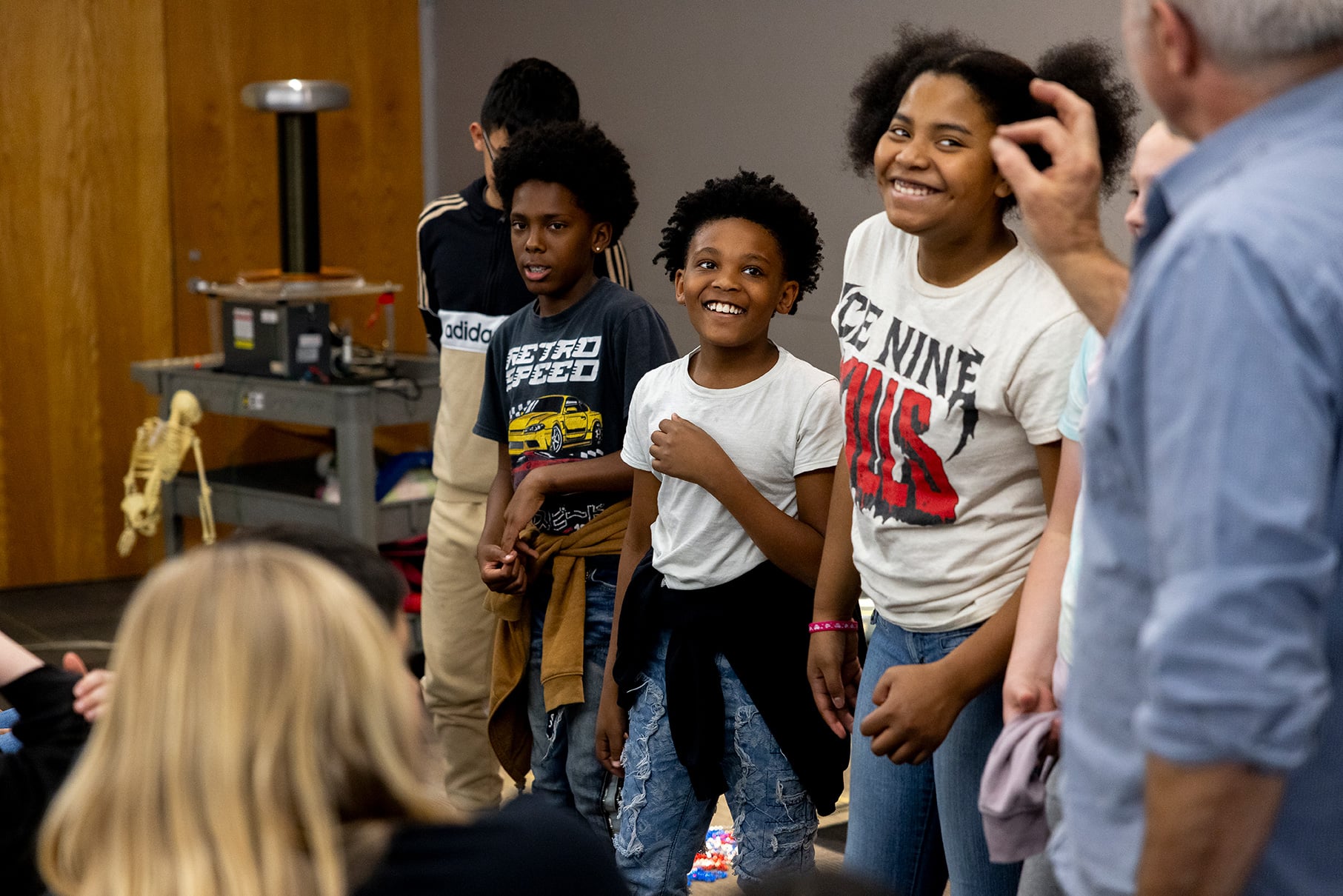
Students from the Appalachian State University Academy at Middle Fork lab school volunteer to assist with a demonstration at the university’s STEAM Expo, held March 25 on the Boone campus. Photo by Kyla Willoughby
Learning beyond the classroom
For regional educators, the STEAM Expo is a valuable extension of classroom learning.
“Middle and high school are key times when students begin to shape their academic interests and career goals,” said Raymond Cheek, a seventh grade science teacher at Watauga County Schools’ Hardin Park School.
“The STEAM Expo offered an excellent opportunity for them to experience hands-on learning outside the classroom, explore new technologies and interact with professionals who use science, engineering and creativity in their work,” he added. “I wanted my students to see that what they’re learning now can lead to exciting future possibilities.”
The experience also informed Cheek’s own practice. Seeing inquiry-based demonstrations and interdisciplinary collaboration in action has inspired him to adapt several expo activities for his own classroom — to encourage more student-driven exploration.
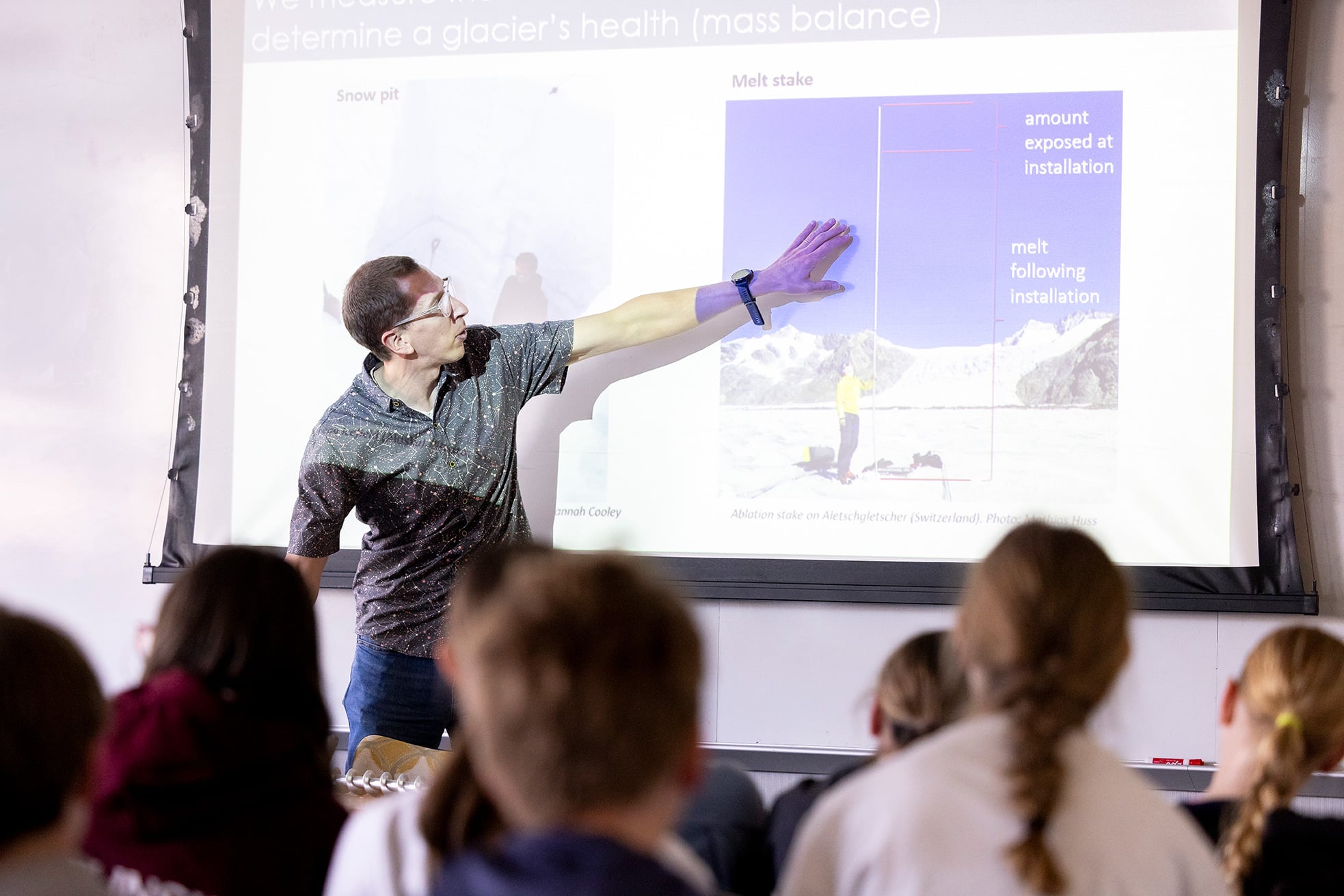
Dr. William H. Armstrong, associate professor in App State’s Department of Geological and Environmental Sciences, shares with students how to measure snow melt on a glacier during App State’s March 25 STEAM Expo, held on the Boone campus. Photo by Kyla Willoughby
College students as leaders and learners
The experiential learning at the STEAM Expo isn’t limited to middle and high school students. Elementary education majors from the App State Hickory campus hosted an Energy Station Booth as an expo activity.
“The students were fully engaged, interacting with middle school learners,” said Dr. YeJun Bae, assistant professor in the Department of Learning, Teaching and Curriculum. “They expressed how valuable it felt to be part of a real community event, and it was inspiring to see their confidence and enthusiasm grow throughout the day.”
This reciprocal model of learning turns the event into a shared educational experience that benefits learners at every level, explained Bae. For App State students, the event provided an authentic teaching experience, leadership development and a tangible sense of purpose, reinforcing the value of experiential learning.

Dr. YeJun Bae, assistant professor in the Department of Learning, Teaching and Curriculum, far left, and her App State elementary education students hosted a booth at the university’s annual STEAM Expo, held March 25 on the Boone campus. Photo submitted
Measuring impact and sustaining momentum
According to Dean, the “STEAM power” — or impact of the event — is measured through a mixture of quantitative and qualitative data, ensuring the expo’s continued growth and effectiveness. This data includes:
- Participation breadth: The number of school districts represented and the total student headcount.
- Engagement depth: Post-event assessments of how the expo activities aligned with teacher curricula and sparked student interest.
- Blast feedback: Real-time Q&A engagement that took place during the event’s STEAM Blasts.
- Volunteer retention: The number of App State faculty and students who return year after year to take part in the event.
Long after the event concludes, the impact of the STEAM Expo continues to ripple outward into classrooms, career aspirations and lifelong learning journeys.
“There is a unique electricity in the air during the STEAM Expo,” observed Dean. “When you see a middle schooler’s eyes light up because they finally ‘get’ a physics concept, or see a high school junior realize they could actually be a researcher at App State, that’s the real win.”
What do you think?
Share your feedback on this story.
About the Reich College of Education
Appalachian State University offers one of the largest undergraduate teacher preparation programs in North Carolina, graduating about 500 teachers a year. The Reich College of Education enrolls more than 2,000 students in its bachelor’s, master’s, education specialist and doctoral degree programs, with offerings that span multiple fields — from teacher preparation, counseling, and therapy, to higher education, school and student affairs administration, library science, educational leadership and more. With over 10,000 alumni employed in North Carolina public schools, there is at least one Reich College graduate in every county in the state. Learn more at https://rcoe.appstate.edu.
About Appalachian State University
As a premier public institution, Appalachian State University prepares students to lead purposeful lives. App State is one of 17 campuses in the University of North Carolina System, with a national reputation for innovative teaching and opening access to a high-quality, cost-effective education. The university enrolls more than 21,000 students, has a low student-to-faculty ratio and offers more than 150 undergraduate and 80 graduate majors at its Boone and Hickory campuses and through App State Online. Learn more at https://www.appstate.edu.
![Science Says I’ve Been Jumping My Bike Wrong For 30 Years [faculty featured]](/_images/_posts/2026/09/jumping-my-bike-600x400.jpg)
![NC universities ranked by free-speech advocacy group [faculty and staff featured]](/_images/_posts/2026/09/free-speech-advocacy-600x400.jpg)