
BOONE, N.C. — Appalachian State University is the recipient of a $838,276 grant from Dogwood Health Trust, which supports App State’s work as part of the Health Policy Research Consortium — an initiative aimed at addressing physical and mental health issues, substance use and misuse, and housing and food insecurity in Western North Carolina.
A significant investment by the trust, the grant is focused on responding to challenges faced across the region prior to Hurricane Helene and exacerbated by the storm, said Dr. Adam Hege, the grant’s principal investigator and associate dean for research and graduate education in App State’s Beaver College of Health Sciences.
“Data collected from needs assessments of counties across Western North Carolina reveal these issues are negatively impacting residents and have been doing so over time,” said Hege, who also serves as an associate professor in the Department of Public Health. “This is due in large part to structural and systemic barriers, poverty and lack of access to needed services and resources.”
The two-year funding will support rural health research efforts and partnerships developed by App State faculty and students, spearheaded by the Appalachian Institute for Health and Wellness. A number of issues that surfaced in the wake of Hurricane Helene will be examined as part of the project’s multidisciplinary research, which includes mapping of local cash assistance efforts, tackling critical housing and planning challenges and surveying health and resource needs and disparities.
Formed in 2023, the consortium includes collaborators from University of North Carolina Asheville, East Tennessee State University, Western Carolina University and the Western North Carolina Health Network. In addition to Hege, App State’s representatives in the consortium are Dr. Martie Thompson, App State’s Blue Cross and Blue Shield of North Carolina Endowed Professor in Public Health, and Jennifer Schroeder Tyson ’07, research assistant professor, both serving in App State’s Department of Public Health. Thompson and Schroeder Tyson are co-principal investigators on the grant.
“We have a team of scholars who have diverse expertise and are highly motivated by the opportunity to create lasting change in our region,” said Hege. As the grant’s principal investigator, Hege will lead and support App State faculty researchers — while coordinating across the consortium — in developing projects, engaging in data collection and analysis strategies and creating policy briefs to share with state and local policymakers.
The grant allows researchers to move into the implementation phase of an agenda formed over two years of refinement and stakeholder engagement. It includes funds for guest speakers and community listening events, with research being shared with the communities through reports, podcasts, social media, presentations, town halls and panel discussions.
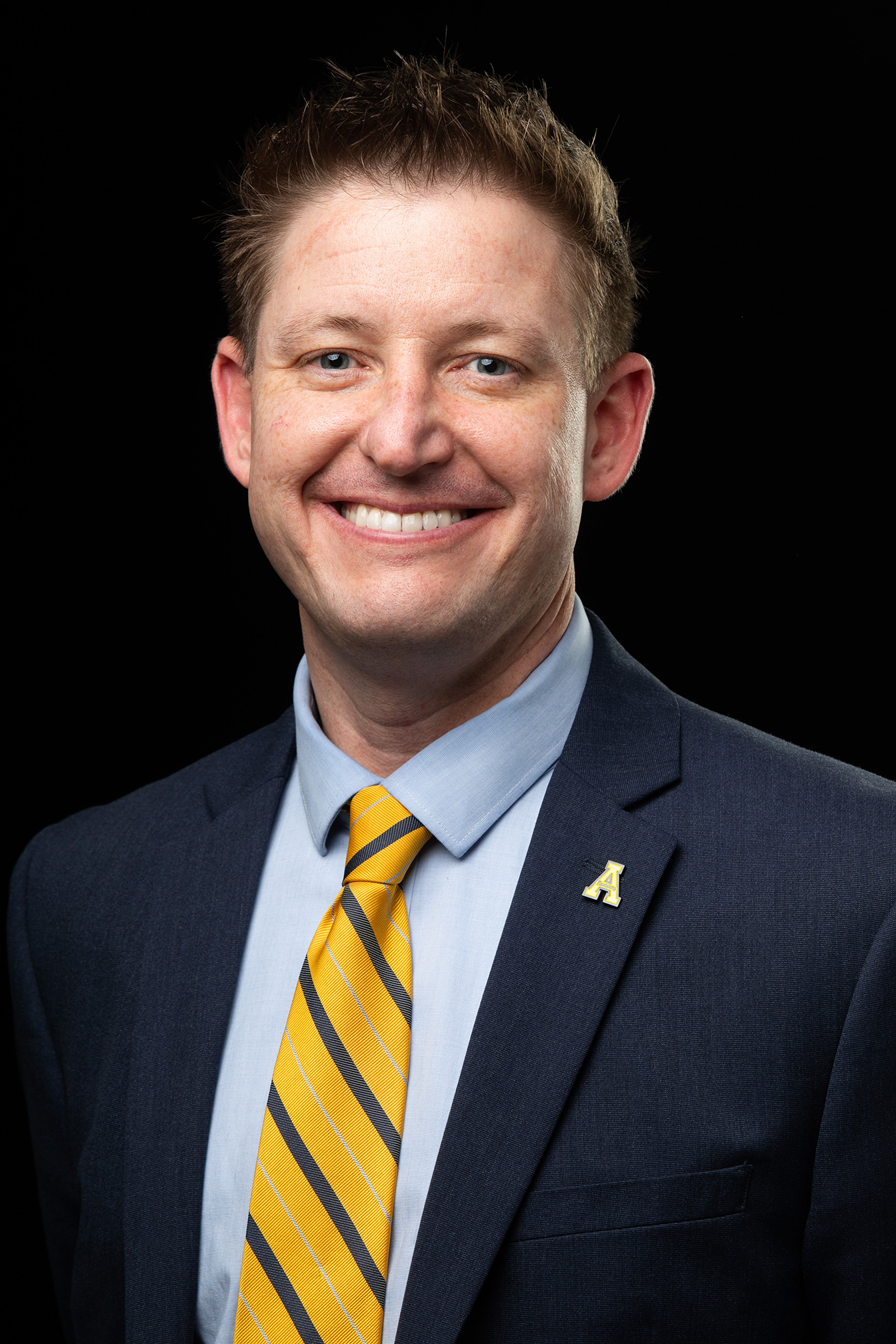
Adam Hege, associate dean for research and graduate education in App State’s Beaver College of Health Sciences and associate professor in the college’s Department of Public Health. Photo by Chase Reynolds

Jennifer Schroeder Tyson ’07, research assistant professor in App State’s Department of Public Health. Photo by Chase Reynolds

Dr. Martie Thompson, the Blue Cross and Blue Shield of North Carolina Endowed Professor in Public Health in App State’s Department of Public Health. Photo by Chase Reynolds
Empowering communities through collaborative research
Ongoing changes to federal programs and funding will likely increase challenges across the region, Hege said, making it critical for interdisciplinary researchers to strengthen collaborations and help shape decision-making by policymakers — and to do so with the assistance of community-based and community-informed inquiry.
Thompson will help lead and support all research activities funded through the initiative, working with faculty to develop and implement research projects and disseminating their research findings to partners and stakeholders.
Schroeder Tyson will help foster growth and engagement among local scholars and practitioners. Rather than researching communities, the initiative engages in research with them, she explained, ensuring that local voices, experiences and priorities directly shape the questions being asked and the solutions being implemented. The translation of research in rural settings ensures that expertise and data-driven insights are linked with lived reality in Appalachia and lead to action plans, health interventions and, ideally, equitable policy solutions, said Schroeder Tyson.
“This approach empowers residents, community leaders and local health agencies to co-create strategies that address pressing health and policy challenges,” she said.
At App State, the grant will fund multiple interdisciplinary initiatives:
Dr. Maggie Sugg, alongside Hege, Thompson and Schroeder Tyson, will take an interconnected approach to examining the health impacts of Helene. Sugg, associate professor and honors program director in the Department of Geography and Planning, will survey regional health professionals to understand key risks of the populations they serve.
By combining the survey information with Federal Emergency Management Agency data, hospital records and information on aid distribution, landslide locations and precipitation patterns, Sugg’s team will track how the storm’s damage and displacement are affecting health outcomes and which communities face the greatest risks, Sugg explained.
Dr. Leah Hamilton, professor in the Department of Social Work, is launching a three-year project mapping and analyzing local cash assistance efforts that took place in the aftermath of Helene, during which numerous faith-based groups, nonprofit organizations and mutual aid networks stepped up to render assistance. Hamilton’s team will document and assess how the grassroots response shaped financial stability, food security, access to essential resources and other important social determinants of health — with a goal of identifying gaps and strategic opportunities in collaboration with community partners.
“This effort will fill a major knowledge gap by elevating the role of trusted local organizations during crises and providing actionable data to strengthen rural health, economic security and long-term resilience in the region,” Hamilton said.
Working alongside Dr. Chris Quattro, assistant professor in the Department of Geography and Planning, geography graduate student Ethan Antonelli ’25, of Wake Forest, is engaged in deep data collection on housing supply, costs, quality and spatial distributions in Western North Carolina following Helene.
The effort — aided by undergraduate students in Quattro’s Planning Studio course and bolstered by App State’s Research Institute for Environment, Energy and Economics — will support the regional housing plan of the High Country Council of Governments and offer a foundation for housing solutions. Antonelli is the recipient of the 2025 Outstanding Student Award from the American Planning Association’s North Carolina chapter.
“The Health Policy Research Consortium and its advisory committee are individuals with lived experience who reside and work in, and who are deeply invested in, the Western North Carolina region — sharing a vision of equal opportunity to access health and well-being,” Hege said. “Their feedback, insight and suggestions ensure the work remains grounded in community realities.”
What do you think?
Share your feedback on this story.

Ongoing post-Helene projects examine flood forecasting models, backup energy systems, ecological impacts, private well contamination and health solutions


App State experts break down the factors that led to disastrous impacts across the Southern Appalachians

About the Beaver College of Health Sciences
Appalachian State University’s Beaver College of Health Sciences (BCHS), opened in 2010, is transforming the health and quality of life for the communities it serves through interprofessional collaboration and innovation in teaching, scholarship, service and clinical outreach. The college enrolls more than 3,600 students and offers 10 undergraduate degree programs, nine graduate degree programs and four certificates across seven departments: Kinesiology, Nursing, Nutrition and Health Care Management, Public Health, Recreation Management and Physical Education, Rehabilitation Sciences, and Social Work. The college’s academic programs are located in the Holmes Convocation Center on App State’s main campus and the Levine Hall of Health Sciences, a state-of-the-art, 203,000-square-foot facility that is the cornerstone of Boone’s Wellness District. In addition, the college supports the Appalachian Institute for Health and Wellness and has collaborative partnerships with the Wake Forest University School of Medicine’s Physician Assistant Program, UNC Health Appalachian and numerous other health agencies. Learn more at https://healthsciences.appstate.edu.
About Appalachian State University
As a premier public institution, Appalachian State University prepares students to lead purposeful lives. App State is one of 17 campuses in the University of North Carolina System, with a national reputation for innovative teaching and opening access to a high-quality, cost-effective education. The university enrolls more than 21,000 students, has a low student-to-faculty ratio and offers more than 150 undergraduate and 80 graduate majors at its Boone and Hickory campuses and through App State Online. Learn more at https://www.appstate.edu.
Ongoing post-Helene projects examine flood forecasting models, backup energy systems, ecological impacts, private well contamination and health solutions
App State experts break down the factors that led to disastrous impacts across the Southern Appalachians



![Science Says I’ve Been Jumping My Bike Wrong For 30 Years [faculty featured]](/_images/_posts/2026/09/jumping-my-bike-600x400.jpg)
![NC universities ranked by free-speech advocacy group [faculty and staff featured]](/_images/_posts/2026/09/free-speech-advocacy-600x400.jpg)