App State’s Team Sunergy and its solar racing vehicle, Autumn, cross the finish line on day eight of the 2026 Electrek American Solar Challenge in Amarillo, Texas, completing the cross-country road race. Photo by Kyla Willoughby
BOONE, N.C. — Appalachian State University’s solar vehicle racing team, Team Sunergy, made history at the international 2026 Electrek American Solar Challenge (ASC), becoming the only team to capture the first-place win twice in the competition’s multi-occupant vehicle (MOV) category. The team qualified for the road race with a second-place finish in the Electrek Formula Sun Grand Prix (FSGP) just days earlier and took home ASC's MOV Practicality Award.
Racing Highway 66 from Minneapolis to Amarillo, Texas, in a significant test of its new vehicle, Autumn, the student-powered team demonstrated it could build an improved two-person cruiser from the wheels up — once again employing the teamwork, strategy and endurance needed to overcome the challenges inherent on the long road to the podium.
“The perseverance, determination and Appalachian grit that this team demonstrated are what won us the race,” said Team Sunergy advisor Jim Dees. “It should make every Mountaineer proud.”

Members of App State’s Team Sunergy celebrate with their first-place trophy after winning the multi-occupant vehicle category of the 2026 Electrek American Solar Challenge. Photo by Kyla Willoughby
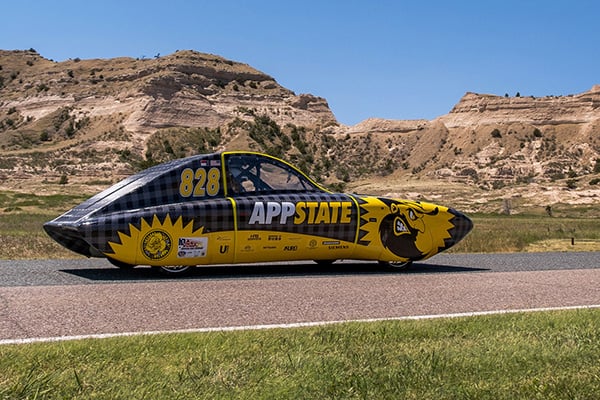
Autumn, a 660-pound vehicle built of carbon fiber, traveled nearly 1,830 miles with an average speed of 31.7 mph and received a total score of 92.7 out of 100 in the ASC, held July 25–Aug. 1. Team Sunergy spent the past five years designing, building and testing Autumn — which is 40% lighter and 60% more aerodynamic than its predecessor, ROSE (Racing on Solar Energy), which captured the MOV category win at the ASC in 2021.
Autumn’s energy efficiency score was well above its competitors, and the vehicle received the MOV Practicality Award for being most comparable to a standard production car. ASC contestants were scored on distance completed, efficiency metrics and practicality.
“Team Sunergy exemplifies the type of empowering, student-engaged innovation and experiential education that characterizes who we are as a research institution,” said Dr. Christine Ogilvie Hendren, vice chancellor of research and innovation at App State. “It illustrates that App State generates high-impact problem solvers who know how to commit to one another and collaborate to make big things happen.”
Team Sunergy completed 685 miles with 221 laps in the closed-track FSGP, held July 17–23 at the Brainerd International Raceway in Brainerd, Minnesota. Key FSGP scoring metrics included miles driven, energy usage and speed maintenance.

App State’s Team Sunergy drives along Highway 66 on day two of the 2026 Electrek American Solar Challenge, en route to Illinois State University. Team member Caroline Flanigan, a senior sustainable technology major, drives the team’s solar racing vehicle, Autumn, with graduate student Andy Bir ’25 as passenger. Photo by Kyla Willoughby
Driven by resilience
A number of challenges during the FSGP gave Team Sunergy members valuable knowledge for their success in the ASC, said Aidan Jogodka, the team’s media co-lead and a senior from Raleigh majoring in political science.
“A lot of us have been spending our entire college careers working on the car in many different ways. At no point was giving up an option,” Jogodka said.
Team Sunergy manager Zach Howard ’25 ’26 shared Jogodka’s sentiment, highlighting the team’s persistence.
“There were many points during the build of Autumn where we had every factor against us,” Howard said. “To be able to pull off this car and win the American Solar Challenge on Autumn’s debut race — it’s a feeling of relief I cannot explain.”
For App State’s Team Sunergy, the road to victory in the 2026 Electrek American Solar Challenge (ASC) was a journey of determination, resilience and history-making achievement. Watch this video to learn how the tenacious student-led solar vehicle racing team built a new vehicle from scratch and overcame the odds to secure an international championship — becoming the first team to earn two first-place finishes in the ASC’s multi-occupant vehicle category. Video by Team Sunergy media co-lead Aidan Jogodka and App State University Communications
To qualify for the FSGP track race, Autumn had to pass multiple days of rigorous safety, compliance and performance inspections called scrutineering. Team Sunergy had to troubleshoot braking and tire pressure and encountered a steep learning curve with the new battery system — forcing the team into a literal sprint through the final two inspection stations before time ran out. Similar difficulties rendered four of the initial nine teams unable to race.
Once at the starting line, Autumn failed to start due to a battery overcharge, leaving the racers off track for several hours past the start time as they searched for a solution. The energy system continued to pose challenges through the FSGP, but the team was able to grasp the car’s usage pattern and hatch a strategy to maximize its capabilities so that Autumn ran out of power and died just after it crossed the finish line.
“We heard the contactors click as we were crossing the line — meaning the battery was completely dead — so it could not have been more perfectly timed,” said team mechanical member Jacob Calder, a senior from Greenville majoring in sustainable technology. “And the last half of that day, we ran almost purely off the sun.”

Pictured rushing the stage after learning of their first-place win at the 2026 Electrek American Solar Challenge are, from left to right: Team Sunergy electrical lead Nathan Care, of Henderson; team manager Zach Howard ’25 ’26, of Holly Springs; team advisor Patrick Laney ’23 and team driver Mike Burry, of Troutman. Photo by Kyla Willoughby
Once Autumn was on the open road of the ASC, the challenges kept coming, and Autumn’s efficiency would prove critical.
“It was cloudy and stormy the entire first three days, so there was basically no solar at the solar challenge,” Jogodka said.
The weather made the team unable to arrive at a designated stop before the station closed. This forced them to make the decision to complete the stage a day late by adding the missed mileage to the next day’s race itinerary.
“We did have a stronger, crazy efficient vehicle, but I think the strongest thing we had was our people,” Jogodka said. “I think it’s easy to give up when you don’t see a solution in sight, and that’s something as a team we’ve never chosen to do.”
As Team Sunergy crossed the finish line in Amarillo, the years of preparation and weeks of racing strain and uncertainty broke over them in a wave.
“Seeing the payoff was amazing — people just started crying,” Jogodka said. “It’s a trophy, but that’s also five years of design and work we’re holding in our hands there.”

Holding history: Pictured, from left to right, are former Team Sunergy administrator Lee Ball and team advisors Chris Tolbert, Ray Sinclair and Jim Dees with Team Sunergy’s first-place trophy. The team is the first to win the Electrek American Solar Challenge twice in the multi-occupant vehicle category. Photo by Kyla Willoughby
Bringing home more than trophy
Ariana Jones ’26, of Raleigh, joined Team Sunergy during her first year at App State and is now working for Southern Energy Management in Charlotte. As a group of supporters welcomed the team back to Boone on Aug. 5, she reflected on the quieter moments that had as much meaning as the high points.
“There were the times when it was 10 p.m. and we still had work to do and we had the music on, laughing together as friends and staying up later than you should,” said Jones, Team Sunergy electrical co-lead. “It’s the friendship and bonding, brainstorming and time with the team that I’ll miss and take with me.”
Rebecca Hoskins, Team Sunergy electrical sub-lead, said the constant support of teammates kept the hurdles from becoming overwhelming.
“There were hard aspects of the race, but those moments only last so long when everyone around you is focused on succeeding despite any and all challenges,” said Hoskins, a senior from Colfax majoring in sustainable technology. “Being surrounded by the most hardworking and passionate people I know inspires me to put everything I have into the team every day.”
Supported by App State’s Research Institute for Environment, Energy and Economics, student-led Team Sunergy is a flagship innovative effort that blends knowledge across disciplines. Visit App State’s Team Sunergy website to learn more about the team and its history, including the three solar vehicles it has built to date.
What do you think?
Share your feedback on this story.
About App State’s Team Sunergy
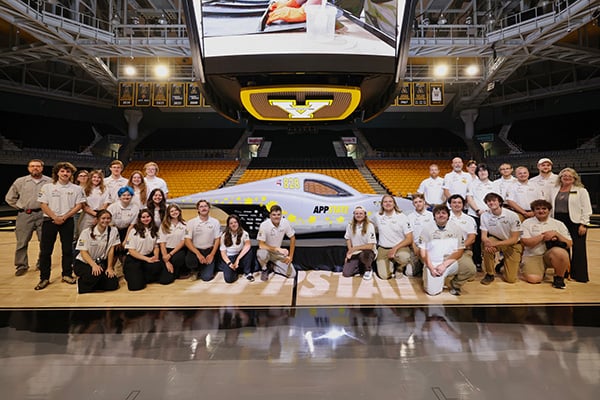
Appalachian State University’s internationally recognized Team Sunergy is an interdisciplinary, student-led team with a passion for sustainable transportation — and the ingenuity, innovation and drive to create it. The team began in fall 2013, as a class project to build a solar-powered golf cart, and has evolved into an award-winning program that has achieved podium finishes in every year of competition in both the Formula Sun Grand Prix and American Solar Challenge (ASC), including first-place finishes in both the 2021 and 2026 ASCs. Both collegiate races set the standards for and test the limits of solar vehicle technology. Team Sunergy’s first vehicle, Apperion, was a modified single-occupant race car; it was replaced by the two-passenger ROSE (Racing on Solar Energy) in 2018, and in summer 2026, the team unveiled its current vehicle, Autumn — a two-passenger Cruiser Class car. Learn more about App State’s Team Sunergy at https://sunergy.appstate.edu.
About Appalachian State University
As a premier public institution, Appalachian State University prepares students to lead purposeful lives. App State is one of 17 campuses in the University of North Carolina System, with a national reputation for innovative teaching and opening access to a high-quality, cost-effective education. The university enrolls more than 21,000 students, has a low student-to-faculty ratio and offers more than 150 undergraduate and 80 graduate majors at its Boone and Hickory campuses and through App State Online. Learn more at https://www.appstate.edu.

![Science Says I’ve Been Jumping My Bike Wrong For 30 Years [faculty featured]](/_images/_posts/2026/09/jumping-my-bike-600x400.jpg)
![NC universities ranked by free-speech advocacy group [faculty and staff featured]](/_images/_posts/2026/09/free-speech-advocacy-600x400.jpg)