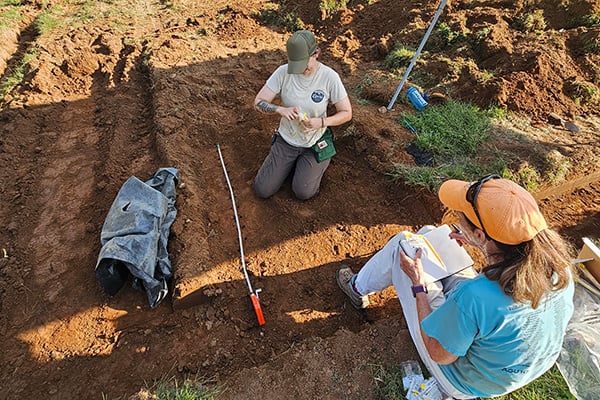
App State student researcher Khloe Springsteen, left, and professor Dr. Ellen Cowan collect soil samples at the excavation of Fort Defiance in Lenoir. Photo by Cory Dalton/Seramur & Associates PC
BOONE, N.C. — Appalachian State University excavation work at Fort Defiance has pinpointed the footprint of the Revolutionary War-era structure, helping historians answer long-standing questions and create an augmented reality (AR) rendering of the Lenoir site.
Additionally, researchers, App State student scholars and historians are working together to honor the contributions of enslaved people who lived and labored at the site and whose unmarked graves were recently discovered using ground-penetrating radar during a student research project guided by Dr. Ellen Cowan.
“There was a lot of disagreement in the past about where the fort could be,” said Cowan, professor in the Department of Geological and Environmental Sciences (GES). “We found it in a nice, strategic location at the top of a bluff looking down the Yadkin Valley.”
The work sheds light on enduring mysteries of how the fort was constructed, its size and configuration.
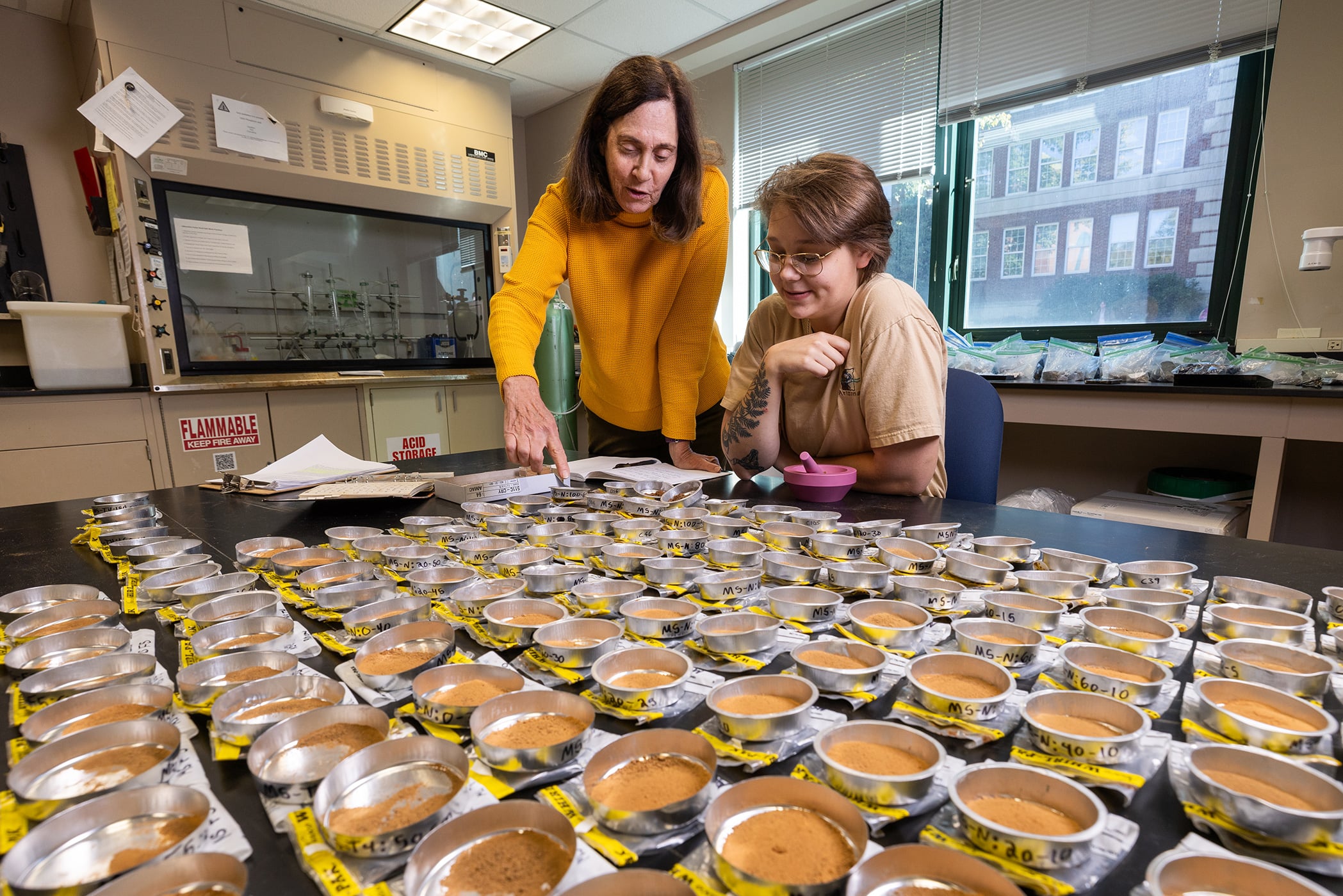
App State professor Dr. Ellen Cowan, left, and undergraduate student Khloe Springsteen examine soil samples collected from beneath the plow zone near the footprint of the palisade at Fort Defiance in Lenoir. With the fort’s footprint now pinpointed, the research of Cowan and her team will inform an augmented reality rendering of the site, created by historians at the American Battlefield Trust as part of the Liberty Trail North Carolina project. Photo by Chase Reynolds
Cowan found the fort’s footprint in a field, less than a foot beneath the sod and just out of reach of plows that could have destroyed it. Having the exact location will now enable historians at the American Battlefield Trust to move ahead with a commissioned digital rendering of the site as part of the larger Liberty Trail North Carolina project, which offers AR tours of important Revolutionary War sites to commemorate the 250th anniversary of the signing of the Declaration of Independence. Future visitors will be able to use their phones to see an AR rendering of the fort exactly where it stood, with the current landscape as a backdrop.
Cowan excavated the footprint of the Lenoir fort in early October and is spearheading the related soil analysis. With the help of undergraduate student Khloe Springsteen and a group of community and university volunteers, Cowan located traces of a blockhouse, cabin and palisade wall at the site. The team knew where to look because they previously conducted shallow geophysical surveys, including an electrical resistivity transect provided by GES department professor Dr. Scott T. Marshall to reveal where bedrock was likely cut down, indicating a cellar had been dug beneath a cabin along the palisade wall. The transect registered variations in the way electricity flowed through different materials, forming an image of the subsurface.
“There were many such fort sites built in Western North Carolina in the 1700s, but their locations often remain unknown, erased by changing land uses or buried under parking lots,” Cowan said. “Fort Defiance is unique because the area has not been built on and the disturbance has been minimal.”
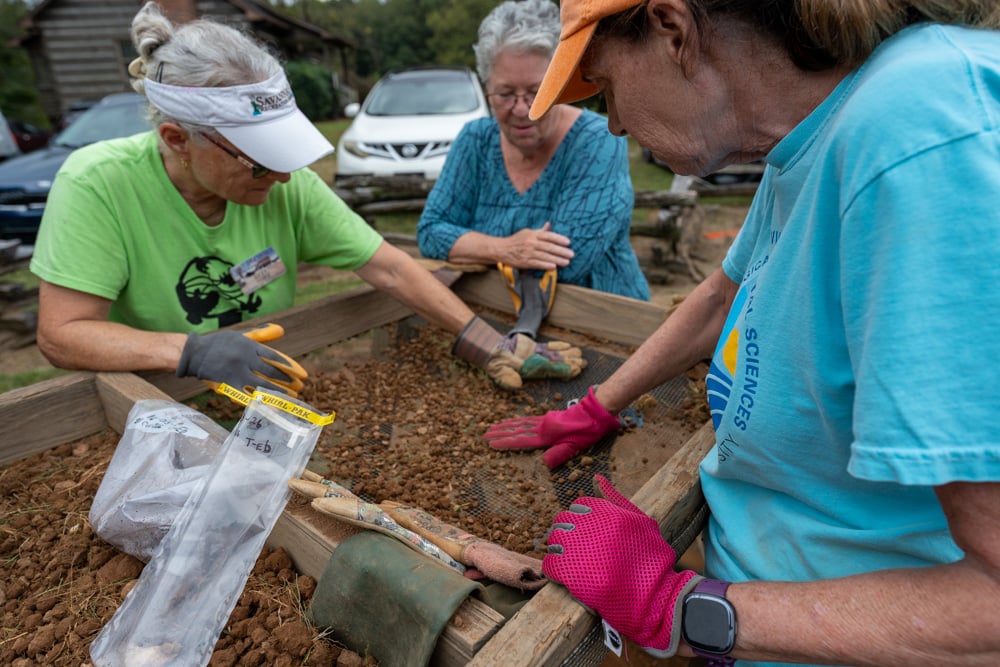
Members of the Fort Defiance Board of Directors, Nell Fisher, left, and Tina Triplett, center, and App State professor Dr. Ellen Cowan screen plowed soil for artifacts at the excavation of the Fort Defiance footprint in Lenoir. Photo by Dr. Beth Davison
The researchers also discovered stains and impressions left by logs, showing the construction methods of different parts of the 80-by-100-foot fort, which is a certified site on the Overmountain Victory National Historic Trail. The 330-mile trail was plied by Patriot militia forces to fight victoriously at the Battle of Kings Mountain in 1780, and the fort is believed to have served as a stopover on the march. Patriot Capt. William Lenoir would go on to build a plantation on the property.
Springteen, an App State senior geology major from Wake Forest, is running lab tests on soil samples from the site to examine their magnetic susceptibility, showing how human activity altered the magnetism of soils near the fort walls through burning, adding organic matter and other disturbances. Supported by an undergraduate research assistantship from App State, she plans to present her findings in a senior thesis, conference presentation and journal paper co-authored with Cowan.
“We are helping archaeologists with future excavations by showing them how we found subsurface targets without even digging,” she explained. “Archaeologists can go into an excavation with a lot more information than they usually have, which can save time, money and manpower. We also help historians by correcting or validating historical claims.”
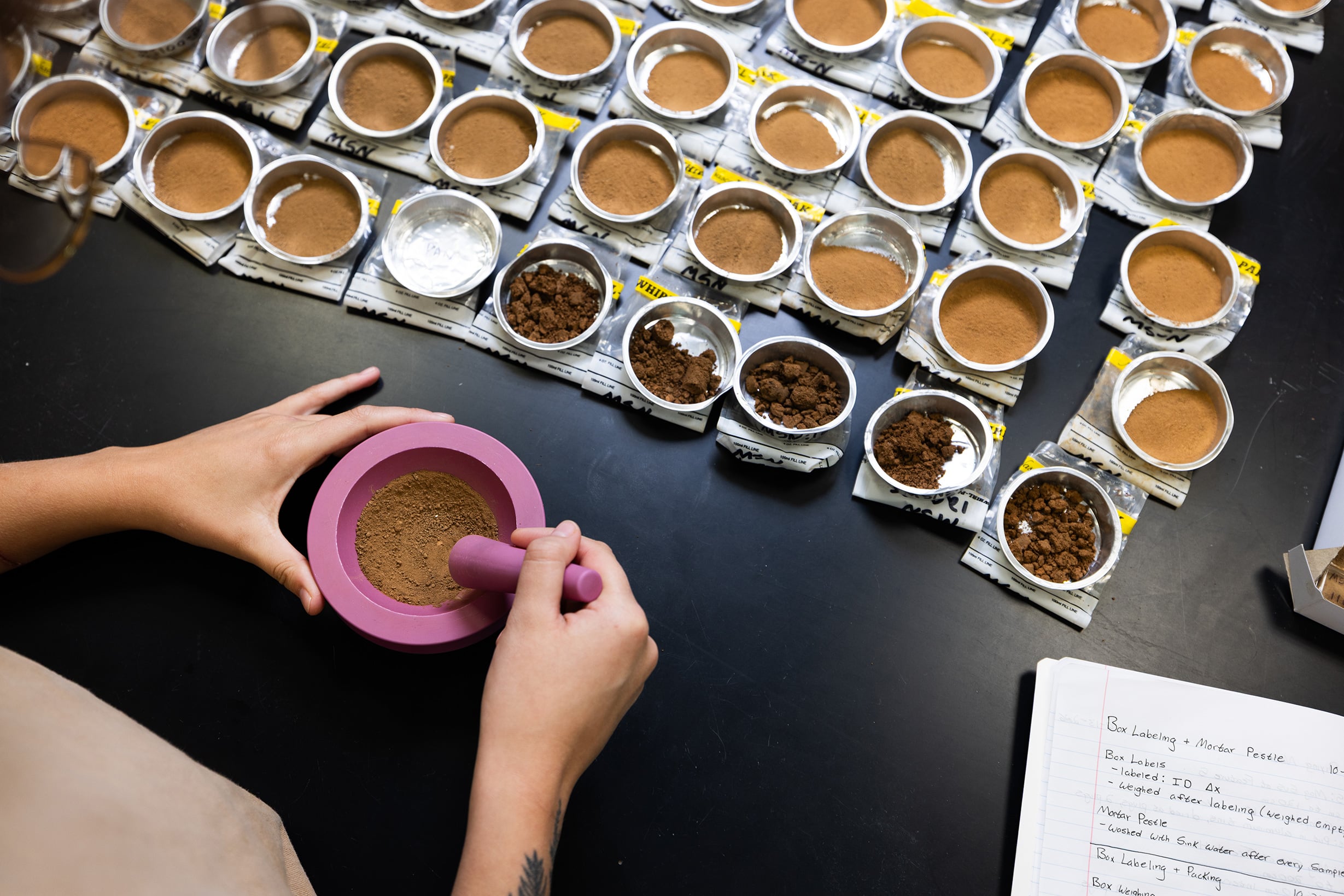
App State geology major Khloe Springsteen prepares soil samples for magnetic susceptibility measurements to determine how human activity altered the environment near the palisade footprint excavated in October at Lenoir’s Fort Defiance. Photo by Chase Reynolds
Collaboration across disciplines and communities
App State faculty and student researchers across departments have been searching for missing pieces of the site’s history since the 2023–24 academic year, when incomplete surveys using ground-penetrating radar revealed hard lines with right angles beneath a field, offering clues to the fort’s location. The current research team used those coordinates to run further scans, confirm the structure’s location and finally strip off the plow zone, or top layer of soil, to observe the fort footprint.
App State alumnus Tucker Terrell ’25 used the noninvasive radar survey method in 2025 to discover an unmarked graveyard on the property with 105 graves of enslaved people. Cowan has since reported the burial ground to the North Carolina Office of State Archaeology, helping establish an official place where descendants can visit and honor their ancestors.
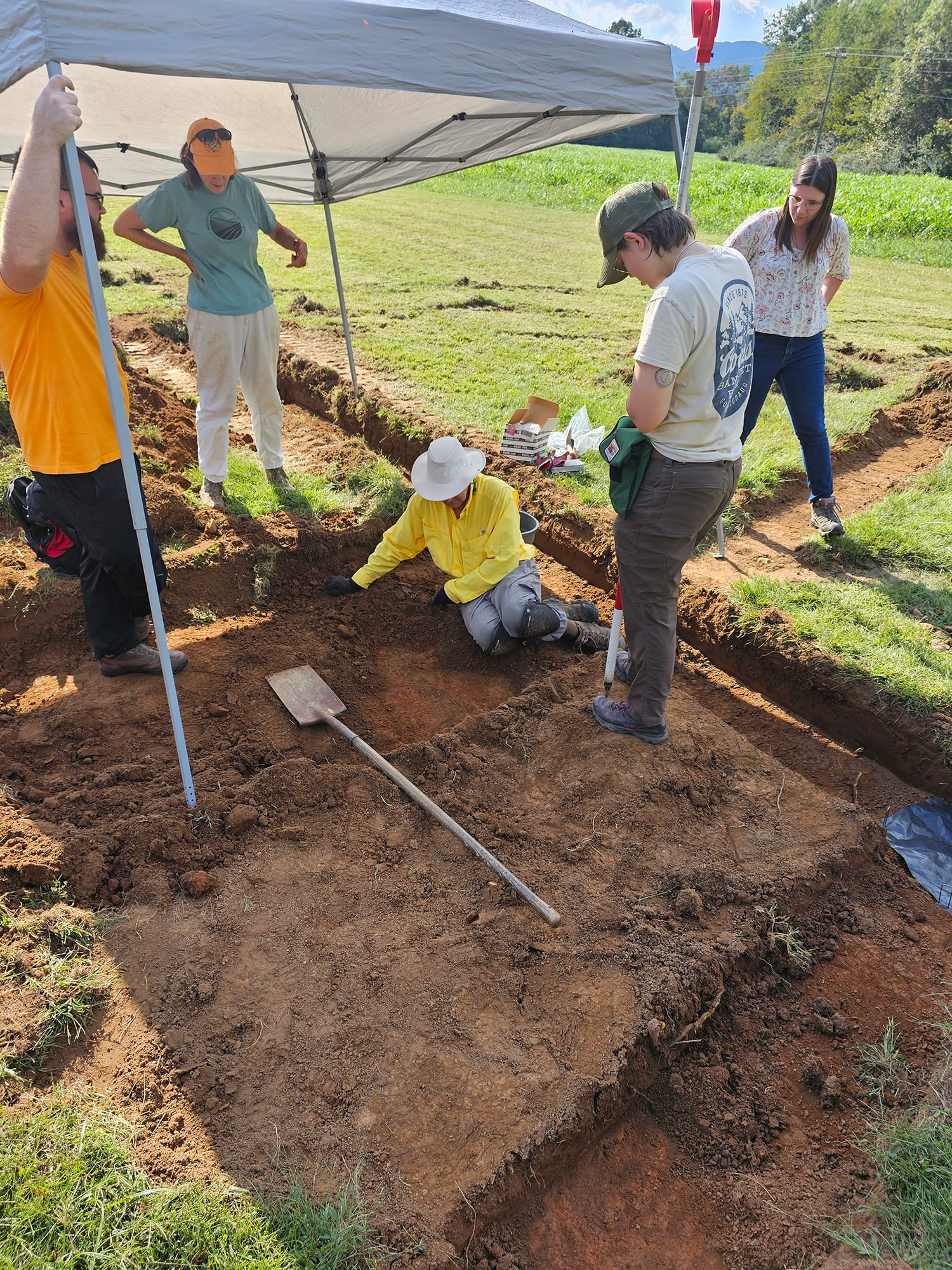
Pictured, from left to right: Joey Anderson, project manager with Seramur & Associates, PC, App State professor Dr. Ellen Cowan, Keith Seramur, president of Seramur & Associates, PC, App State student researcher Khloe Springsteen and Fort Defiance Site Director Cassandra Douglas examine the fort’s excavated palisade footprint below the plow zone. Photo by Cory Dalton/Seramur & Associates PC
Dr. Beth Davison, who has visually documented the Fort Defiance work, has applied for a supporting grant with Monuments Across Appalachian Places, with a goal of honoring and memorializing the enslaved individuals who lived and labored at the site. The grant would pay for a student-involved redesign and expansion of the existing “The Other Faces of Fort Defiance” exhibition, adding multimedia installations, permanent display cases and additional exhibition items.
“It would also establish an interpretive walkway leading to a newly erected monument commemorating the previously unmarked burial sites,” explained Davison, professor in the Department of Interdisciplinary Studies and co-director of AppDocs, an App State initiative to document mountain culture and history.
Dr. Andrea Burns, director of App State’s applied and public history program, has collaborated with Fort Defiance since 2024. Her fall 2027 course Interpretation in Museums will enlist graduate students in the research, writing and designing of “The Other Faces of Fort Defiance” exhibits.
Interest in the site has extended into the community. Area families and Fort Defiance staff and directors pitched in to help with surveys and screening of the excavated soil. The work was funded by a grant from the Overmountain Victory Trail Association and assisted by Boone geoscience consulting firm Seramur & Associates PC.
Sandra Watts, president of the board of directors for Fort Defiance, said Cowan’s efforts have transformed common understanding of life at Fort Defiance from the mid-18th century forward and preserved evidence that otherwise may have been lost.
“Through her work and her team’s excavations, we can now begin to answer the question visitors ask most: ‘Where is the fort?’” Watts said. “Their discoveries provide tangible evidence of life on the site, turning speculation into a fuller understanding of Fort Defiance’s history and helping us tell a more complete and inclusive story of the people who lived and worked on this land.”
About the Department of Geological and Environmental Sciences
Located in Western North Carolina, Appalachian State University provides the perfect setting to study geological and environmental sciences. The Department of Geological and Environmental Sciences provides students with a solid foundation on which to prepare for graduate school or build successful careers as scientists, consultants and secondary education teachers. The department offers five degree options in geology and three degree options in environmental science. Learn more about App State's Department of Geological and Environmental Sciences at https://earth.appstate.edu.
About the College of Arts and Sciences
The College of Arts and Sciences (CAS) at Appalachian State University is home to 17 academic departments, two centers and one residential college. These units span the humanities and the social, mathematical and natural sciences. CAS aims to develop a distinctive identity built upon our university's strengths, traditions and locations. The college’s values lie not only in service to the university and local community, but through inspiring, training, educating and sustaining the development of its students as global citizens. More than 6,800 student majors are enrolled in the college. As the college is also largely responsible for implementing App State’s general education curriculum, it is heavily involved in the education of all students at the university, including those pursuing majors in other colleges. Learn more at https://cas.appstate.edu.
About Appalachian State University
As a premier public institution, Appalachian State University prepares students to lead purposeful lives. App State is one of 17 campuses in the University of North Carolina System, with a national reputation for innovative teaching and opening access to a high-quality, cost-effective education. The university enrolls more than 21,000 students, has a low student-to-faculty ratio and offers more than 150 undergraduate and 80 graduate majors at its Boone and Hickory campuses and through App State Online. Learn more at https://www.appstate.edu.