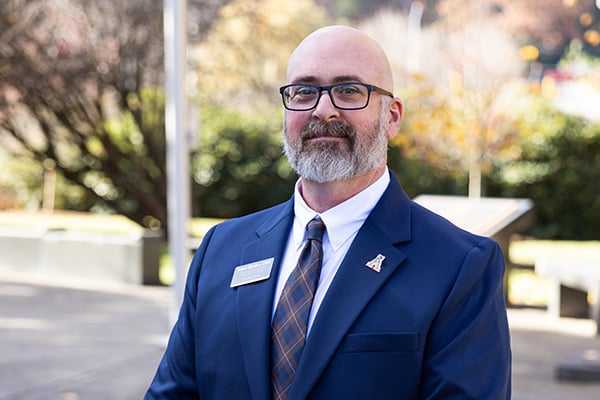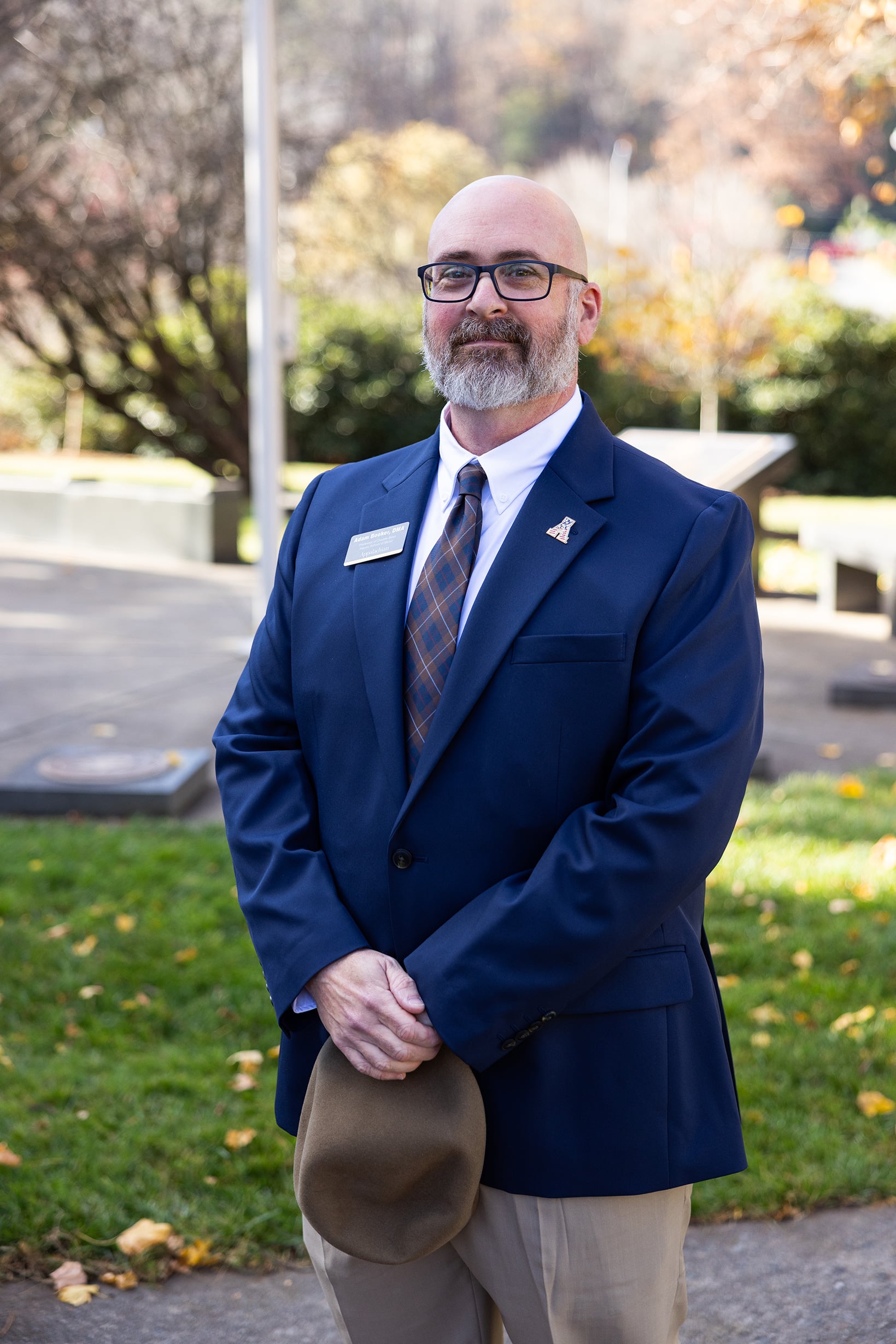
Dr. Adam Booker, a U.S. Navy veteran and professor of double bass in App State’s Hayes School of Music, spoke at the university’s 2026 Veterans Day Ceremony, reflecting on his time in service and how those experiences continue to shape his leadership in music. Photo by Chase Reynolds
BOONE, N.C. — When people picture the U.S. Navy, they might think of ships, aircraft or SEALs. For Dr. Adam Booker that vision also includes a band in dress blues marching down the street playing Sousa.
Booker spent four years as a Navy bassist. He saw how a performance could bring the Navy to people who might otherwise have little contact with it. For him, playing bass was both a way to make a living and a way to serve.
Earlier today, Appalachian State University honored veterans and members of the military community during its annual Veterans Day Ceremony, held at the Veterans Memorial on the university’s Boone campus. Booker, a professor of double bass in App State’s Hayes School of Music, was the event’s featured speaker.
“It’s OK to take pride in your service, whatever your role,” Booker said in an interview. “Whether you were a cook, a musician or a SEAL, you did something that not everybody does.”
His time in the Navy strengthened his discipline as a performer and helped make his return to higher education possible. It also shaped how he sees the young adults he now teaches.
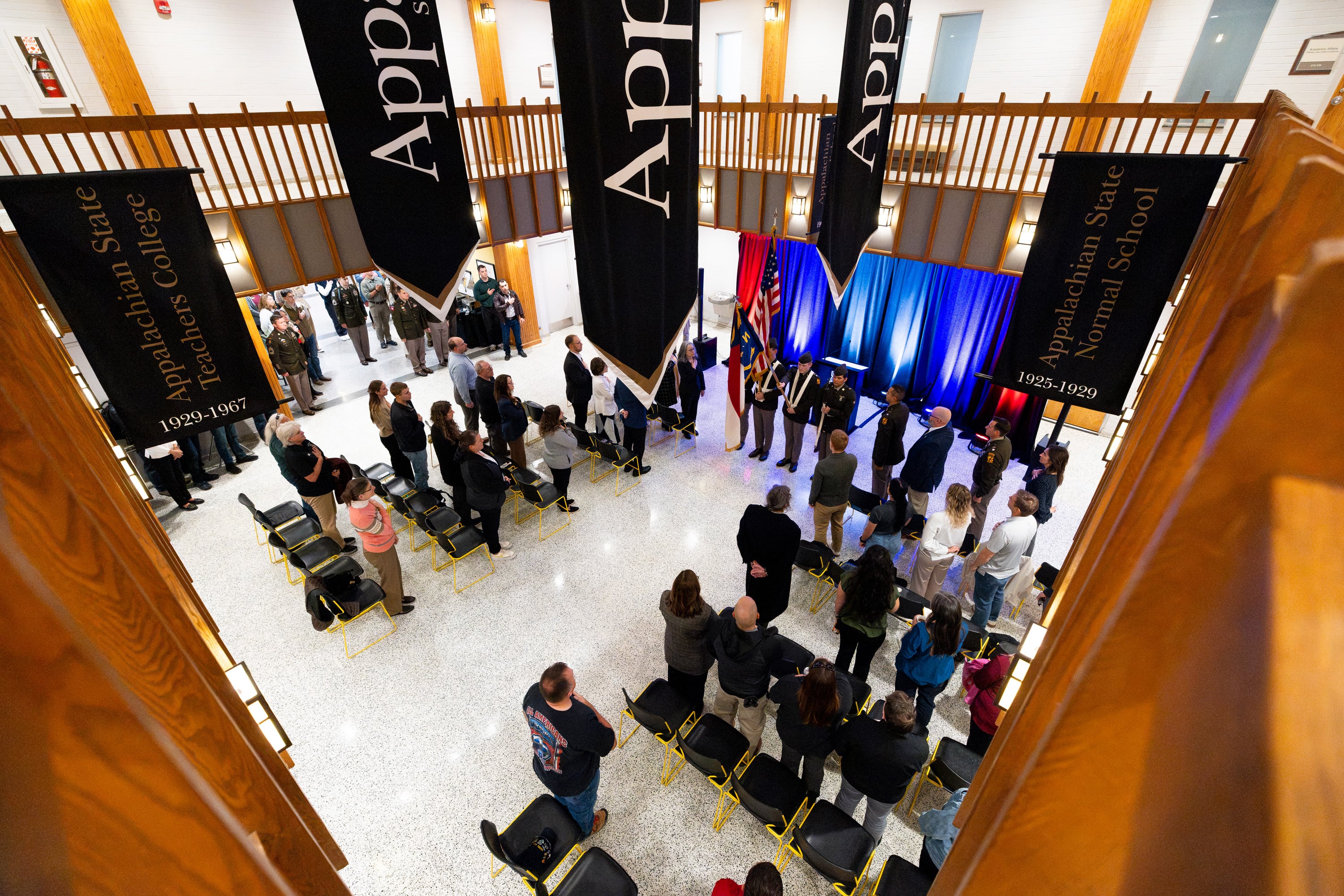
Captured from above, App State military veterans, active-duty service members, students, faculty and staff gather in the B.B. Dougherty Administration Building on the Boone campus as part of the university’s 2026 Veterans Day Ceremony. Photo by Kyla Willoughby. The appearance of U.S. Department of Defense (DoD) or Military-themed visual information does not imply or constitute endorsement by the DoD.
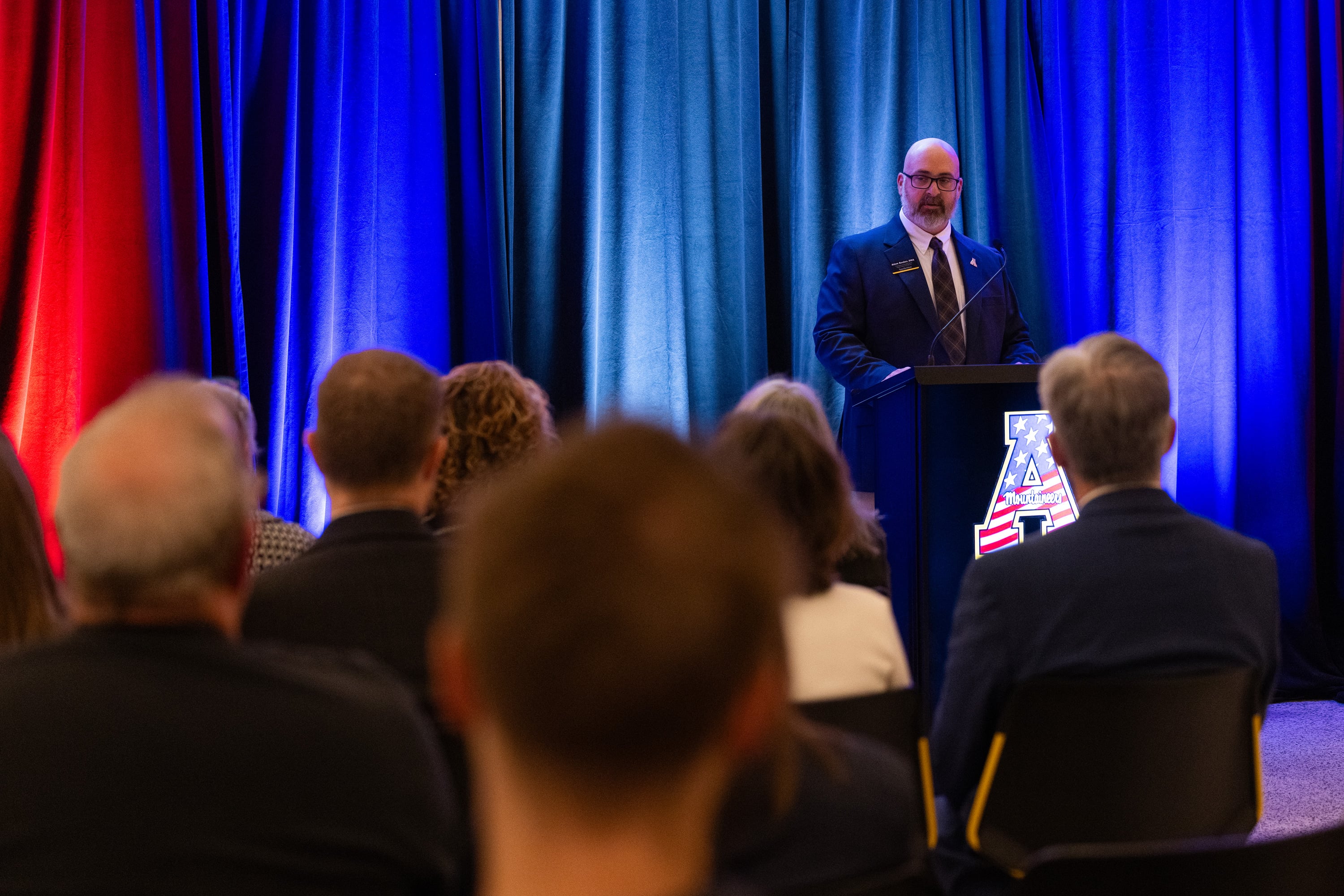
U.S. Navy veteran and App State professor Dr. Adam Booker addresses attendees during App State’s 2026 Veterans Day Ceremony, held in the B.B. Dougherty Administration Building on App State’s Boone campus. Photo by Chase Reynolds
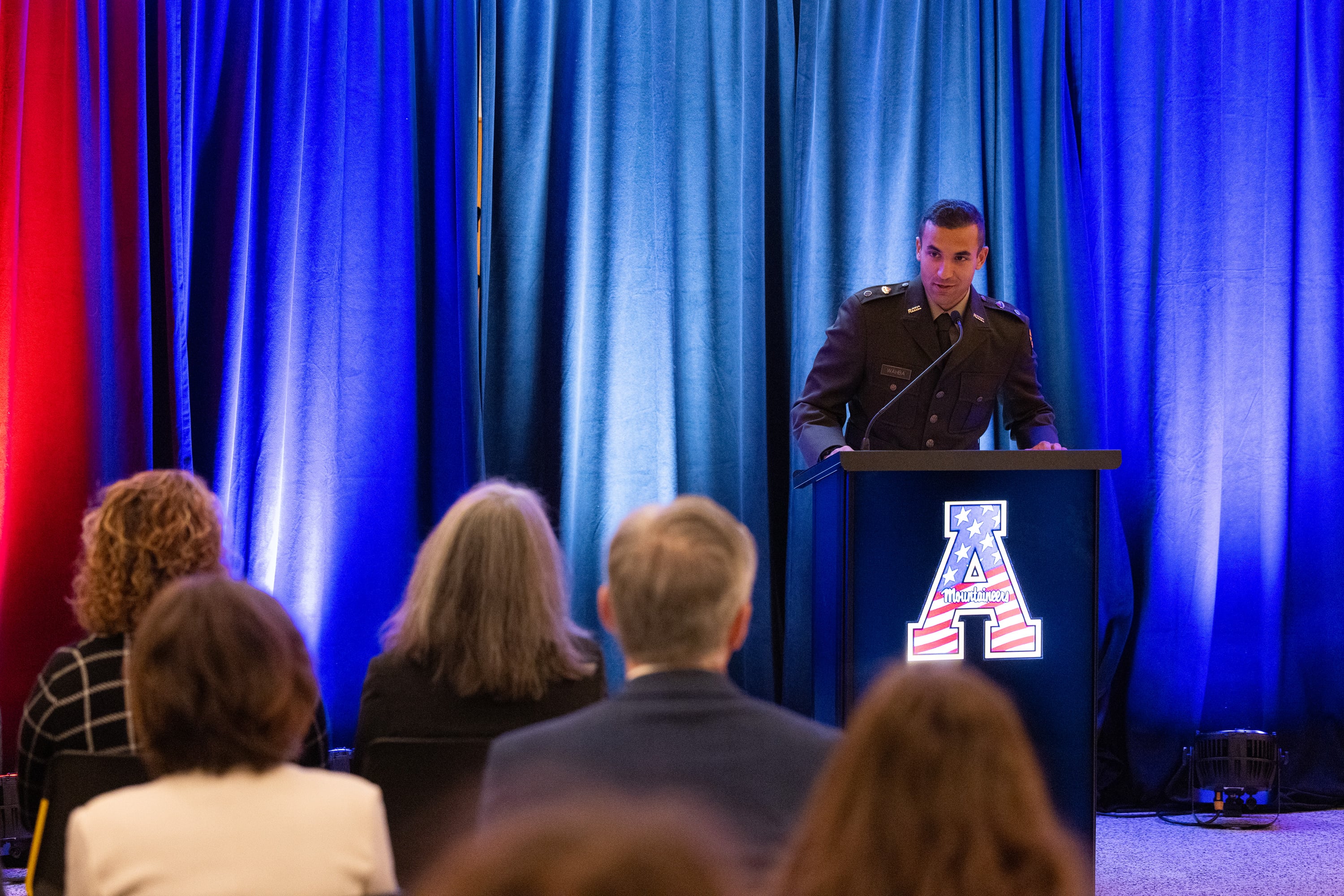
App State Reserve Officers’ Training Corps (ROTC) Cadet and National Guardsman Youssef Wahba, a senior political science major from Youngsville, speaks at App State’s 2026 Veterans Day Ceremony, reflecting on the meaning of gratitude and the importance of honoring active and former service members. The university’s Veterans Day Ceremony was held in the B.B. Dougherty Administration Building on App State’s Boone campus. Photo by Chase Reynolds. The appearance of U.S. Department of Defense (DoD) or Military-themed visual information does not imply or constitute endorsement by the DoD.
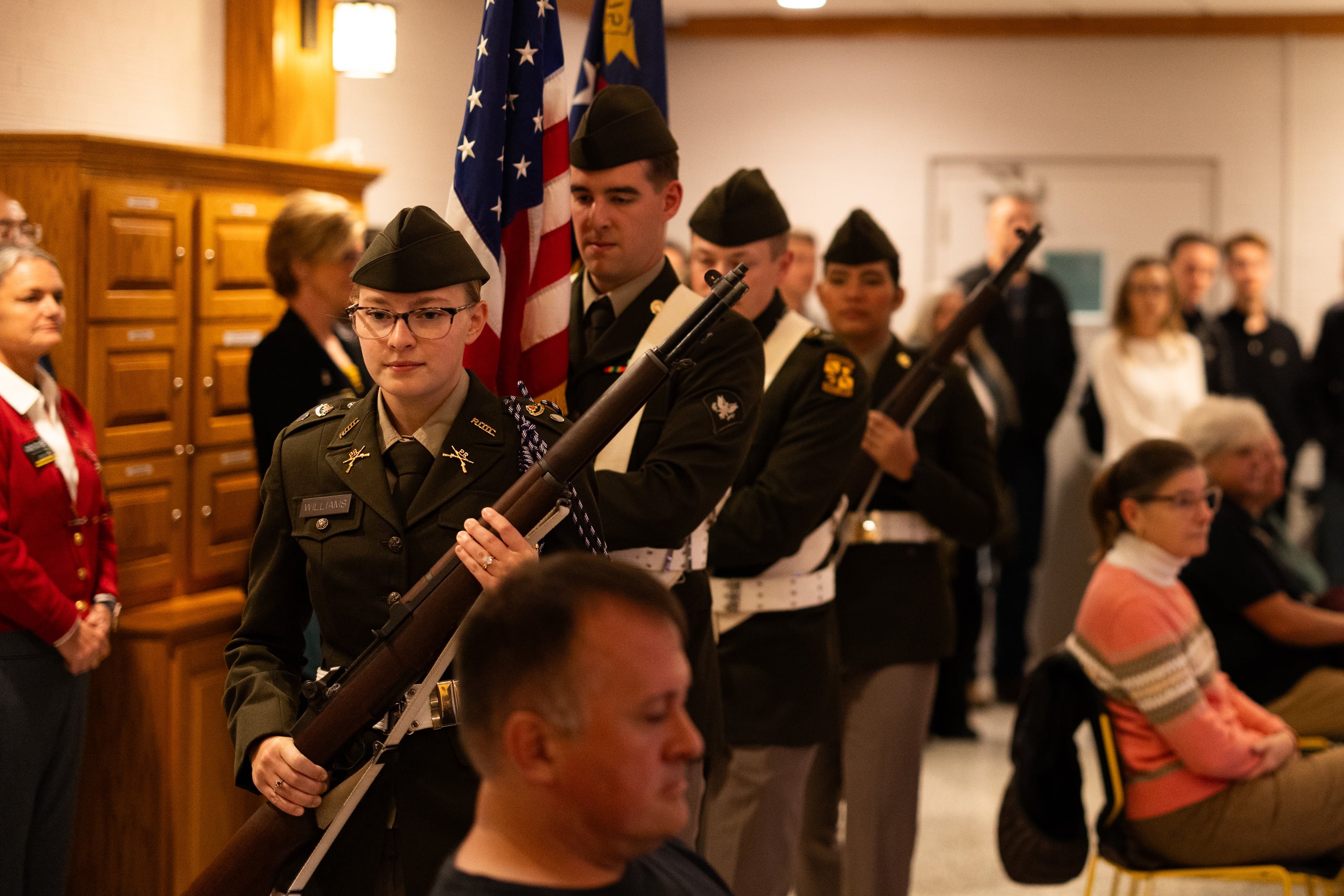
Members of App State ROTC’s Pershing Rifles present the colors to open the university’s 2026 Veterans Day Ceremony, held in the B.B. Dougherty Administration Building on App State’s Boone campus. Photo by Chase Reynolds. The appearance of U.S. Department of Defense (DoD) or Military-themed visual information does not imply or constitute endorsement by the DoD.
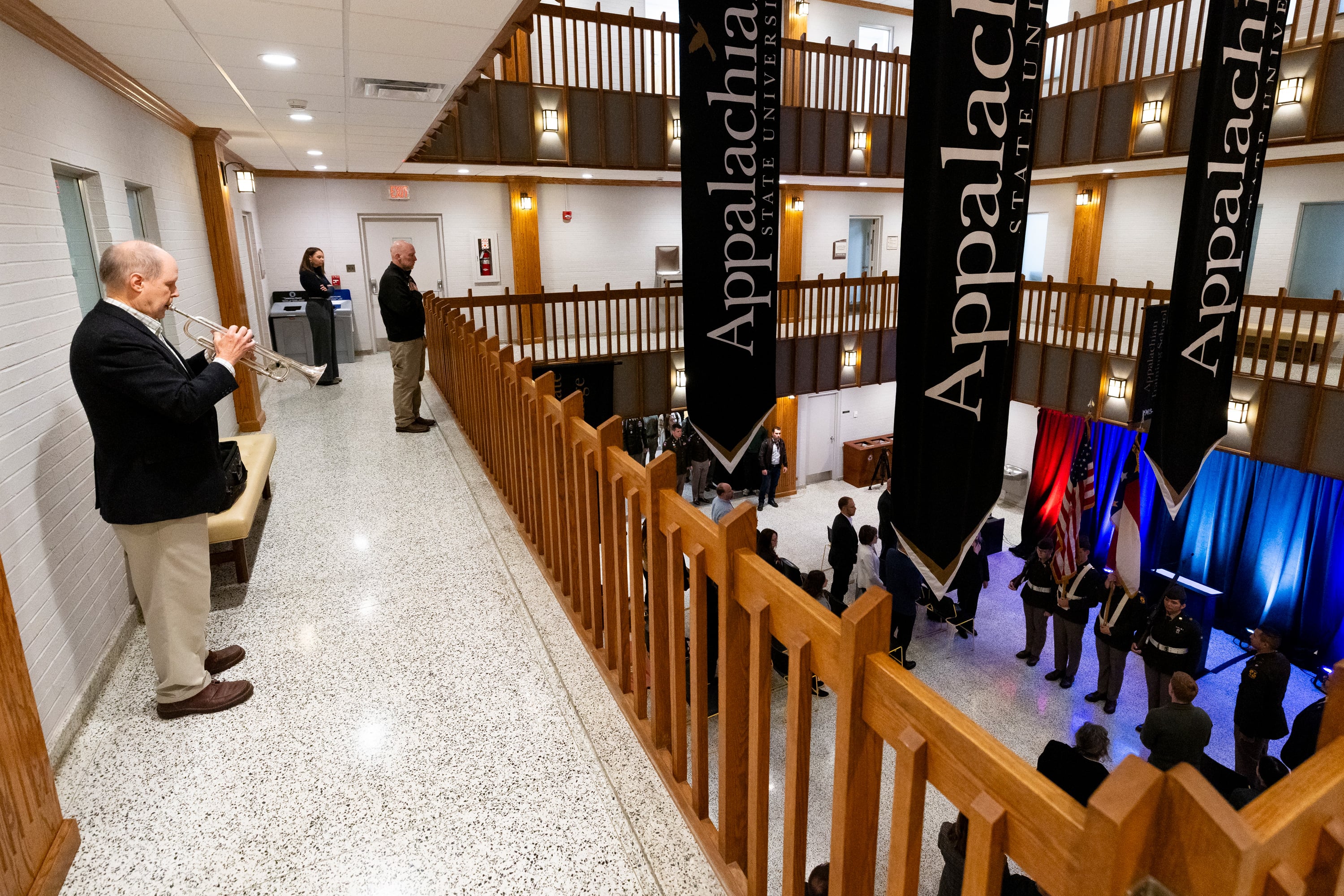
Brent Bingham, adjunct instructor of trumpet in App State’s Hayes School of Music, far left, performs the national anthem during the university’s 2026 Veterans Day Ceremony, held in the B.B. Dougherty Administration Building on App State’s Boone campus. Photo by Kyla Willoughby. The appearance of U.S. Department of Defense (DoD) or Military-themed visual information does not imply or constitute endorsement by the DoD.
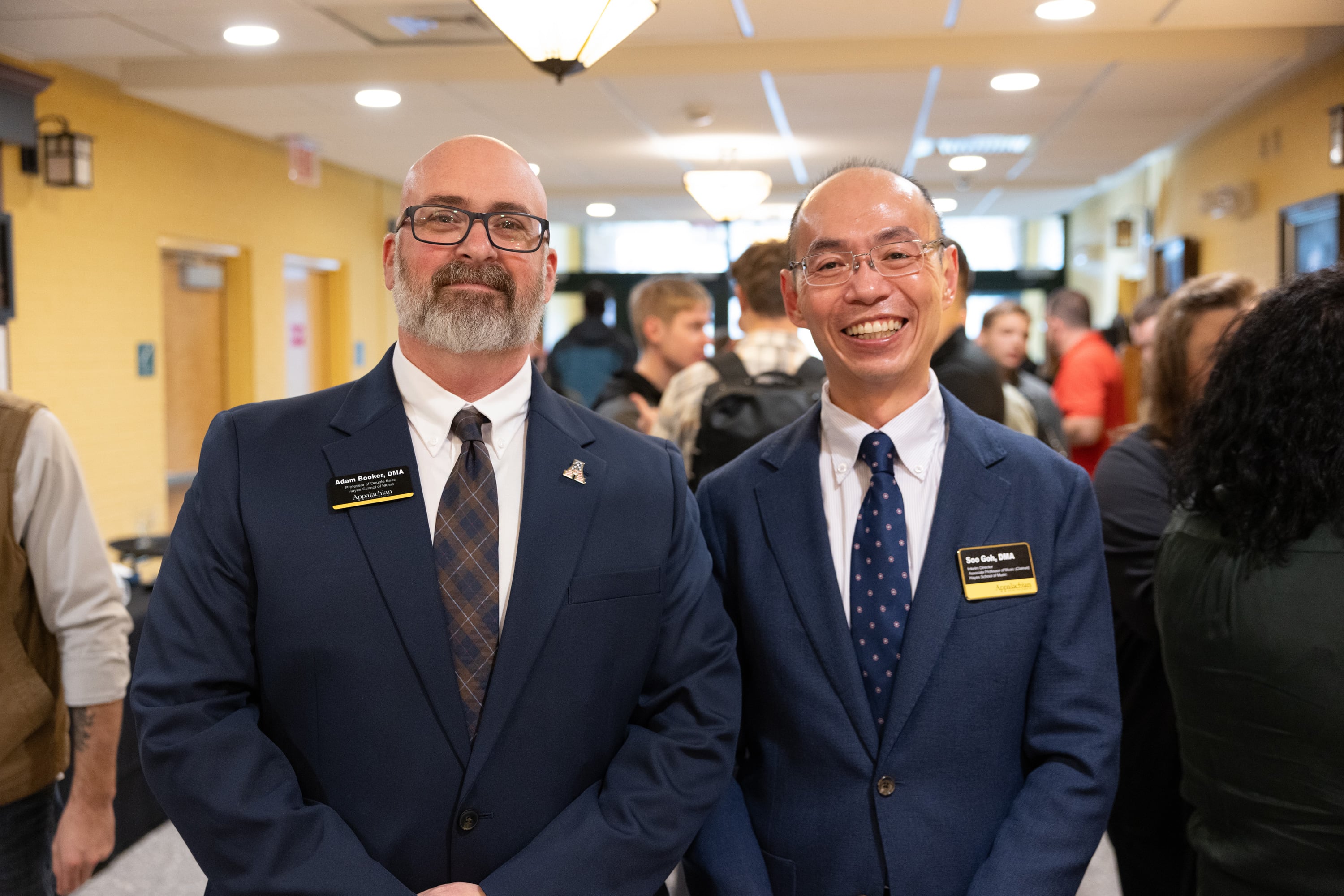
Dr. Adam Booker, a U.S. Navy veteran and App State professor of double bass, left in foreground, with Dr. Soo Goh, interim director of App State’s Hayes School of Music, at the university’s 2026 Veterans Day Ceremony, held in the B.B. Dougherty Administration Building on App State’s Boone campus. Photo by Chase Reynolds





Serving through music
Booker’s introduction to military music began at home. His father led the Jazz Ambassadors, the U.S. Army’s official touring big band, retiring after 21 years of service. Booker began studying bass with an Army musician when he was about 12.
By 19, he was touring the country with a band based in Austin, Texas. He attempted college twice but was already making a living as a musician. Yet when the gigs became scarce, he had a family and a mortgage and needed a steadier income.
The Navy was offering bass players a guaranteed first assignment, Booker said, and New Orleans was among the options. For Booker, it was a chance to serve while immersing himself in the city’s jazz scene.
Stationed in New Orleans, Booker served from July 2001 through June 2005 as a Musician 3rd Class, performing with jazz bands, rock bands and ceremonial groups for military ceremonies, school visits, festivals and parades. For marching assignments, he also played percussion. Off duty, he spent his evenings learning from and performing alongside other musicians.
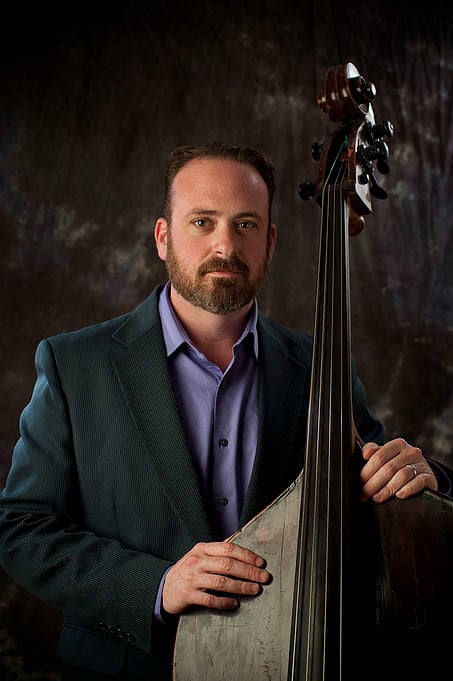
Dr. Adam Booker, a U.S. Navy veteran and professor of double bass in App State’s Hayes School of Music. Photo courtesy of Dr. Adam Booker
“As soon as I finished my duties for the day, I was across the river playing jazz until three or four in the morning,” he said. “It was the perfect education.”
Some performances carried a different responsibility. Booker finished boot camp just three days before the Sept. 11, 2001, terrorist attacks. In the uncertainty that followed, he and his fellow musicians served as “morale leaders,” representing the Navy and offering reassurance through their public presence.
He remembers that responsibility coming into focus during a Mardi Gras parade in 2002. Looking out over the crowd on Canal Street, he was conscious of the fear that remained after the attacks — and proud to represent his country.
“We got to stand tall in our uniforms and say, ‘Nope, we’re America. You can’t defeat us like that.’ It was a really good feeling.”
Booker recalled performing when the USS Cole returned to sea in April 2002 after undergoing repairs in Pascagoula, Mississippi. A terrorist attack had damaged the ship in October 2000, killing 17 sailors. He also recalled participating in the 2004 keel-laying ceremony for the future USS New York, whose bow incorporated steel recovered from the World Trade Center.
“That one was pretty heavy,” he shared. “That one tugged at the heartstrings.”
His favorite performances, though, were ship homecomings, when the band welcomed sailors back to families waiting on the pier.
“These sailors have been out to sea for six months to a year, and they get to see their families on the pier for the first time in a long time,” Booker said. “Those were my favorite gigs.”
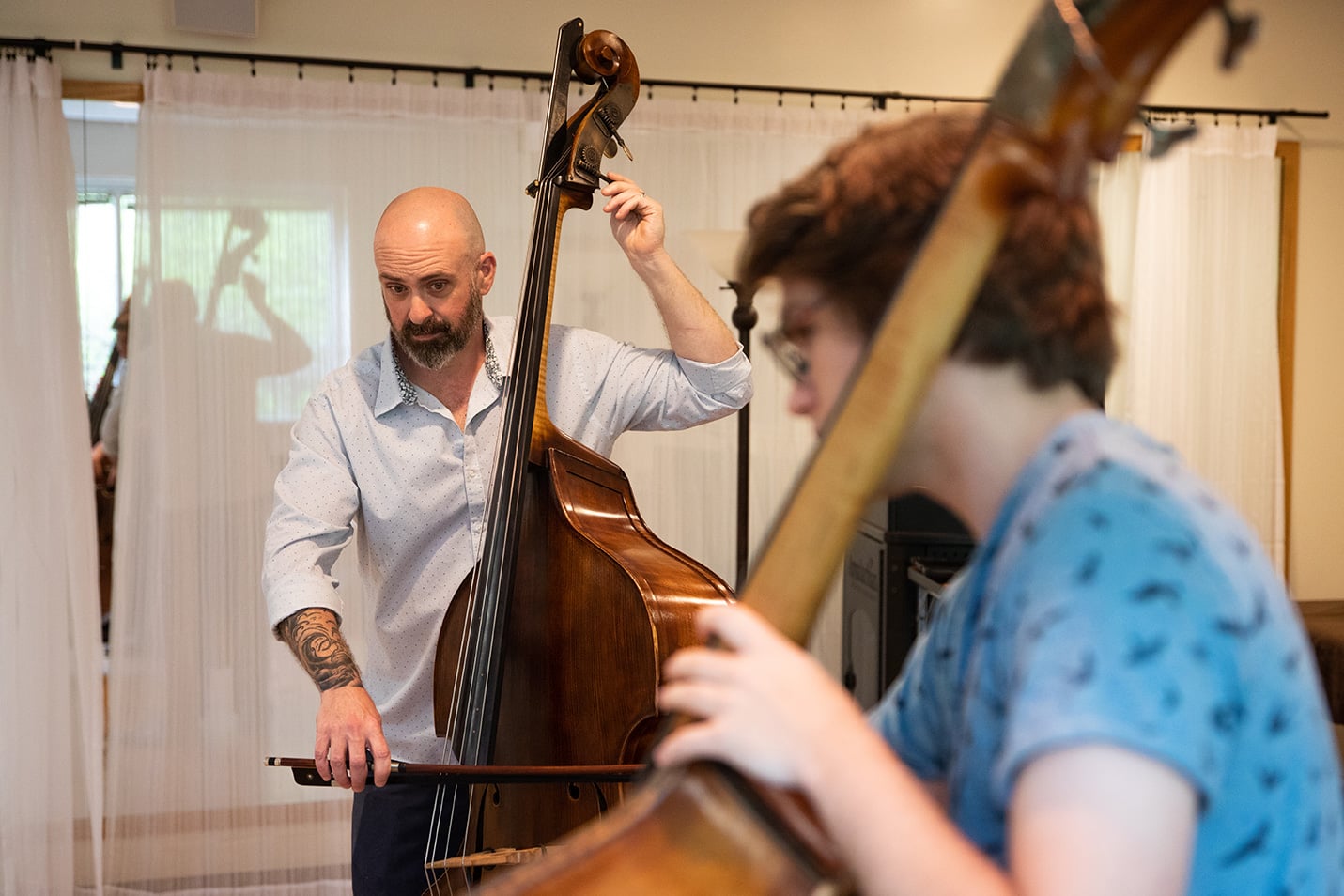
Appalachian State University double bass professor Dr. Adam Booker, left, instructs student members of the university’s bass studio in 2024. Photo by Chase Reynolds
Returning to higher education
By the time Booker finished boot camp, he felt more confident in his ability to handle difficult situations. Once he joined the band, his fellow musicians pushed him to improve, and his commanding officer showed him what leadership could look like by working alongside his sailors to solve problems.
Along with musical experience, Booker gained habits that supported his development as a performer. Being on time, preparing for an assignment and staying until the work was finished were expectations he learned to carry into his practice and performances.
“You’ve got to practice and you have to hold yourself accountable to that practice time,” he said. “You have to hold yourself accountable to the bands you play in, the groups, the teams you work with.”
After leaving the Navy, Booker returned to Texas State University, the institution he had left twice. This time, he earned both his bachelor’s and master’s degrees. He later earned his doctorate at the University of Texas at Austin.
Booker credits the GI Bill with paying for the remainder of his undergraduate education, all of his master’s degree and nearly all of his doctorate. His initial goal was to teach part time while pursuing his jazz career. As he progressed through graduate school and considered the education benefits available to him, a doctorate became possible.
He went on to teach at the University of Minnesota Duluth before joining App State’s faculty.

App State professor Dr. Adam Booker is pictured in his U.S. Navy uniform. Photo courtesy of Dr. Adam Booker. The appearance of U.S. Department of Defense (DoD) or Military-themed visual information does not imply or constitute endorsement by the DoD.
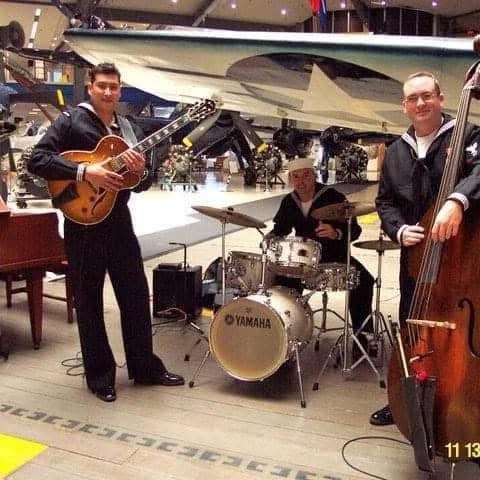
App State professor Dr. Adam Booker, far right, served as a U.S. Navy bassist from 2001 to 2005, performing with jazz, rock and ceremonial ensembles. Photo courtesy of Dr. Adam Booker. The appearance of U.S. Department of Defense (DoD) or Military-themed visual information does not imply or constitute endorsement by the DoD.
Helping students find their direction
Today, Booker teaches primarily through individual lessons and directs Jazz Ensemble II. When asked about his favorite part of his work, his answer is immediate: the students.
As a 23-year-old in boot camp, Booker assumed he was more mature than the younger recruits around him. That changed when he considered what one of them was training to do — operate Navy weapons. Someone he had been quick to dismiss would soon be trusted with work that could have life or death consequences, and they were just one of many recruits who would carry that kind of responsibility. That realization changed the way Booker thought about what young adults were capable of.
“I know that with proper training and discipline, they’re capable of doing amazing things,” Booker said. “So I treat my students that way.”
Booker saw the Navy develop leaders at every level by giving people responsibility early in their service — an approach he still firmly believes in.
Booker sees the same principle at work in a band. One musician may carry the melody while another sets the pace or supports the harmony. Whatever part they play, each musician leads by taking responsibility for their own work and listening to the people around them.
In rehearsal, Booker helps students build the skills to hold their own in an ensemble and trusts them to put those skills to work. That trust extends beyond rehearsal. He gives students room to define success for themselves, whether they pursue a career in music or follow a different interest.
“What matters to me is whether they’re happy with what they’re doing,” he said.
His Navy experience also gives him a practical perspective to share with students considering their careers. He is open about his service and has helped direct several students toward military music programs.
For Veterans Day, Booker hopes people recognize the commitment involved in serving and understand that veterans carry different experiences with them. He enjoyed his four years in the Navy, but he knows others whose experiences were painful and who choose not to participate in observances.
“Not all those wounds are visible,” he said.
Veterans may remember their time in uniform very differently, but Booker sees Veterans Day as a chance to recognize the commitment they made when they chose to serve. For him, that recognition can be as simple as a sincere thank-you.
“I think it’s great,” he said, “that we can all simply come together and acknowledge that service.”



About the Hayes School of Music
The Hayes School of Music prepares young musicians for professional lives as performers, composers, music educators, music therapists, conductors and music industry professionals, ensuring the next generation of musical leadership for the state, region and nation. Noted for quality instruction by national and internationally recognized faculty musicians, the school offers four undergraduate degree programs and three graduate-level programs. Learn more at https://music.appstate.edu.
About Appalachian State University
As a premier public institution, Appalachian State University prepares students to lead purposeful lives. App State is one of 17 campuses in the University of North Carolina System, with a national reputation for innovative teaching and opening access to a high-quality, cost-effective education. The university enrolls more than 21,000 students, has a low student-to-faculty ratio and offers more than 150 undergraduate and 80 graduate majors at its Boone and Hickory campuses and through App State Online. Learn more at https://www.appstate.edu.