BOONE, N.C. — Appalachian State University researchers continue to learn from the damage, lessons and opportunities brought about by Hurricane Helene. Drawing from community input, multiple university projects spanning energy systems, data coordination, community health and the arts are developing real solutions to problems surfaced and made worse by the storm.

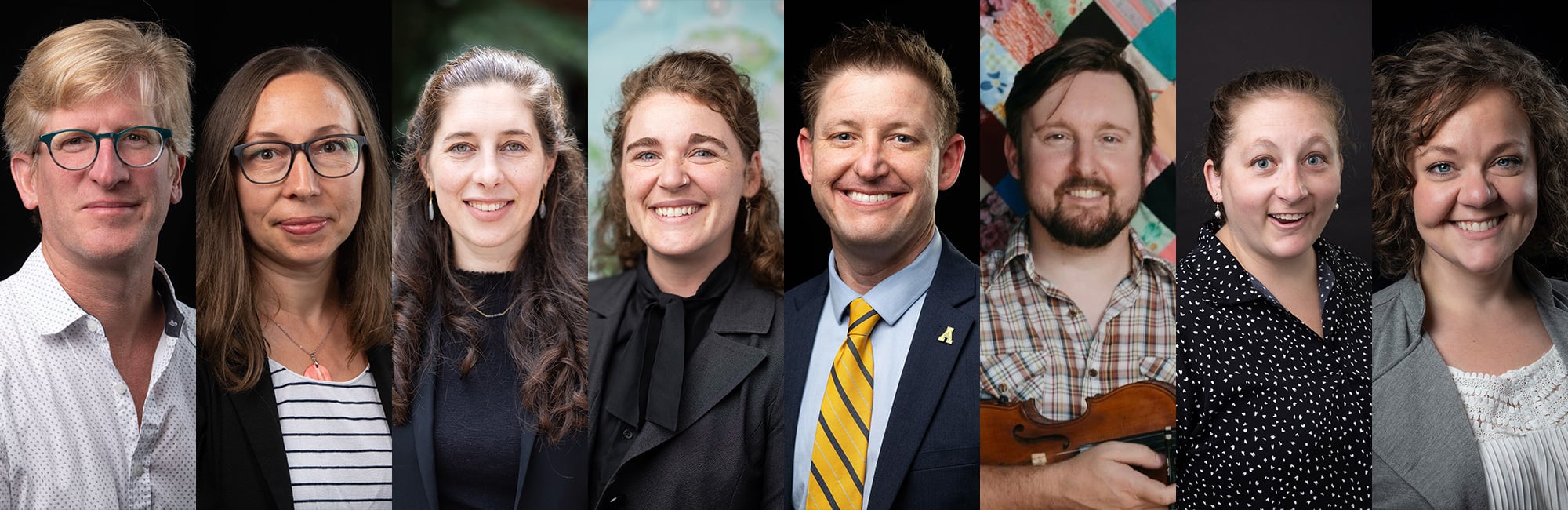
Dr. Katie Shoaf, associate director of grants resources and services in App State’s Office of Research and Innovation. Photo by Chase Reynolds
The projects — funded by the North Carolina Collaboratory and App State’s Office of Research and Innovation (ORI) — are aligned under ORI’s Western North Carolina Research for Recovery and Resilience (WNC R3) initiative.
“These projects are striving to improve the resilience of communities and infrastructures in Western North Carolina so that we are not just building back, we are laying the groundwork for increased quality of life and disaster preparedness in the region and beyond,” said Dr. Katie Shoaf, associate director of the Office of Research and Innovation’s Grants Resources and Services unit, who serves as principal investigator coordinating the NC Collaboratory-funded initiatives.
Keep reading to learn more about how App State researchers are advancing resilience across the region two years after Helene.
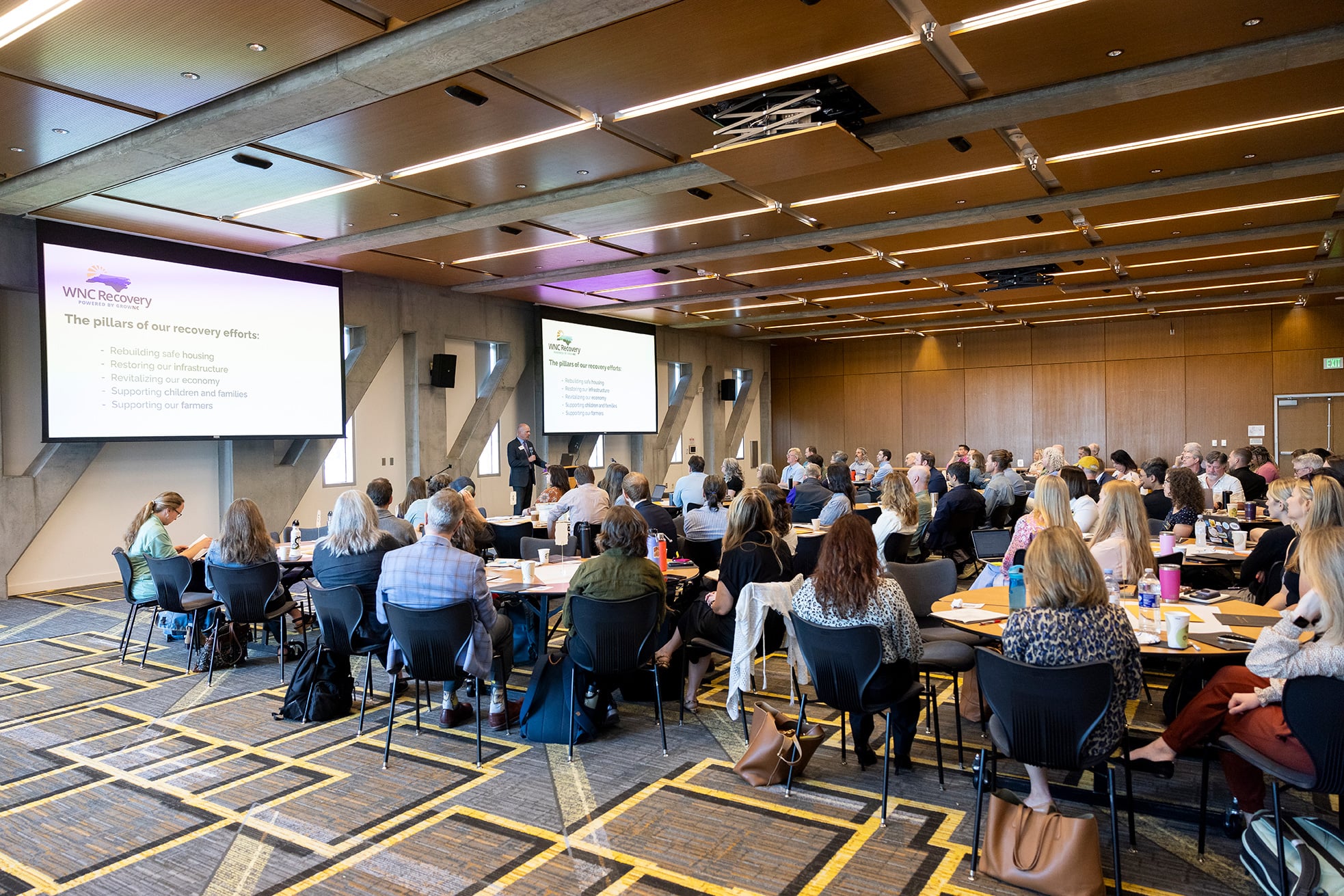
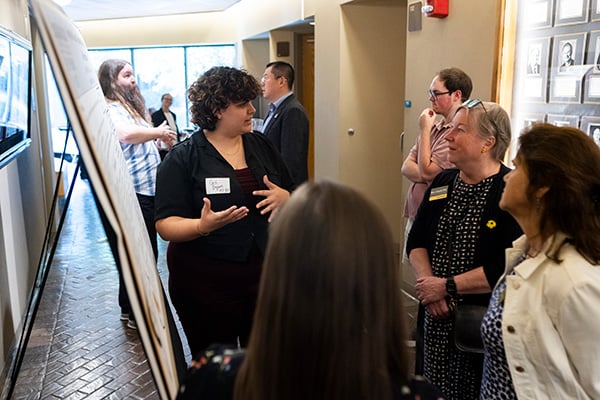
Scott Elliott, deputy director for engagement in the Governor’s Recovery Office for Western North Carolina, addresses the aftermath of Hurricane Helene at the WNC Research for Recovery and Resilience Workshop on the Boone campus in April 2025, convened by App State Vice Chancellor of Research and Innovation Christine Ogilvie Hendren to set priorities for community-driven research in housing, infrastructure, health, education, environment and economic revitalization and more — work that continues across disciplines two years after the hurricane. Photo by Kyla Willoughby
Developing resilient energy systems ahead of future storms
When Helene-impacted residents crowded into schools for shelter and support, it underscored the vital role of public facilities in times of disaster. App State is engaging counties, towns and schools across the region in coordinated efforts to armor key sites with microgrids and resilient power systems ahead of future disasters.

Dr. Jamie Russell, director of App State’s Appalachian Energy Center. Photo by Chase Reynolds
Dr. Jamie Russell, director of the Appalachian Energy Center and a professor in the Department of Sustainable Technology and the Built Environment, is leading the effort alongside student researcher Mary Grace McMillan, a senior geography major from Waxhaw. Together, they are conducting targeted, on-the-ground technical and cost assessments at half a dozen sites across the High Country, examining photovoltaic, battery storage and backup power generation options.
“There is a huge need for technical assistance in rural places with less resources. It’s a win-win if we can help with that,” said Russell. “It’s legwork that smaller rural governments often lack the resources to accomplish, and it’s the type of groundwork that moves such projects out of the abstract while paving the way for community buy-in and grant funding.”
In the town of Sparta, for example, stakeholders are keen to ensure a community center in the Emerson Black Building stands strong against flooding, ice storms and earthquakes. Community members would also like to open educational space for tiny home construction and workforce development.
The collaboration includes public schools, Wilkes Community College’s Alleghany Center for Development and Community Education and county government — and is similar to other energy-centered efforts Russell is leading in Mitchell, Yancey, Avery, Watauga, Ashe and Wilkes counties.
McMillan said her research has given her technical insight into how microgrid systems operate and allowed her to apply knowledge to modeling and optimization efforts. She is developing a map of vulnerability using power outage data, conferring directly with community members on their needs, assessing natural hazards and developing site maps.
“It’s been a great experience to work with stakeholders and understand how energy resilience can support these communities,” she said.
Coordinating data to strengthen regional resilience strategies

Grace Plummer, managing director of App State’s Research Institute for Environment, Energy and Economics. Photo by Chase Reynolds
In Western North Carolina, critical information about severe weather impacts, flooding, landslides, vulnerabilities and infrastructure systems is often fragmented across multiple agencies and jurisdictions. To address these gaps, Grace Plummer, managing director of App State’s Research Institute for Environment, Energy and Economics, is leading a new faculty research working group with a goal of assessing how data integration can strengthen decision-making in small mountain communities.
“Hurricane Helene exposed significant gaps in how Western North Carolina communities access and use data to inform infrastructure and resilience decisions,” Plummer said. “This makes coordinated long-term planning difficult, particularly for small and rural communities.”
Key steps ahead for the initiative include:
- engaging planners, emergency managers, state agencies and other stakeholders to identify important challenges to decision-making;
- a structured review of the region’s key resilience-related datasets; and
- preliminary identification of gaps, redundancies and barriers to data sharing and use.
“The project will establish a faculty working group to test methods, build relationships and develop an initial framework for how improved regional data coordination could support infrastructure investment, hazard mitigation and policy decisions,” Plummer explained.
She added, “Focusing on the realities faced by small, rural jurisdictions, this effort will help inform how future resilience strategies and data coordination efforts can be accessible, scalable and grounded in real-world needs.”
Assessing community health needs post-Helene
Helene’s effects swept through schools, hospitals and workplaces, with a significant toll on emergency responders and caregivers. A new community health needs assessment developed by App State researchers focuses on the region’s caregivers and how they navigated school disruptions, healthcare access challenges and childcare needs — as well as the exhaustion and burnout associated with sustained disaster recovery.
With community input, the project team, led by Sophie Ryan, Dr. Maggie Sugg and Dr. Adam Hege, has tested and piloted the caregiver needs survey and is now recruiting eligible caregiver participants across the region.
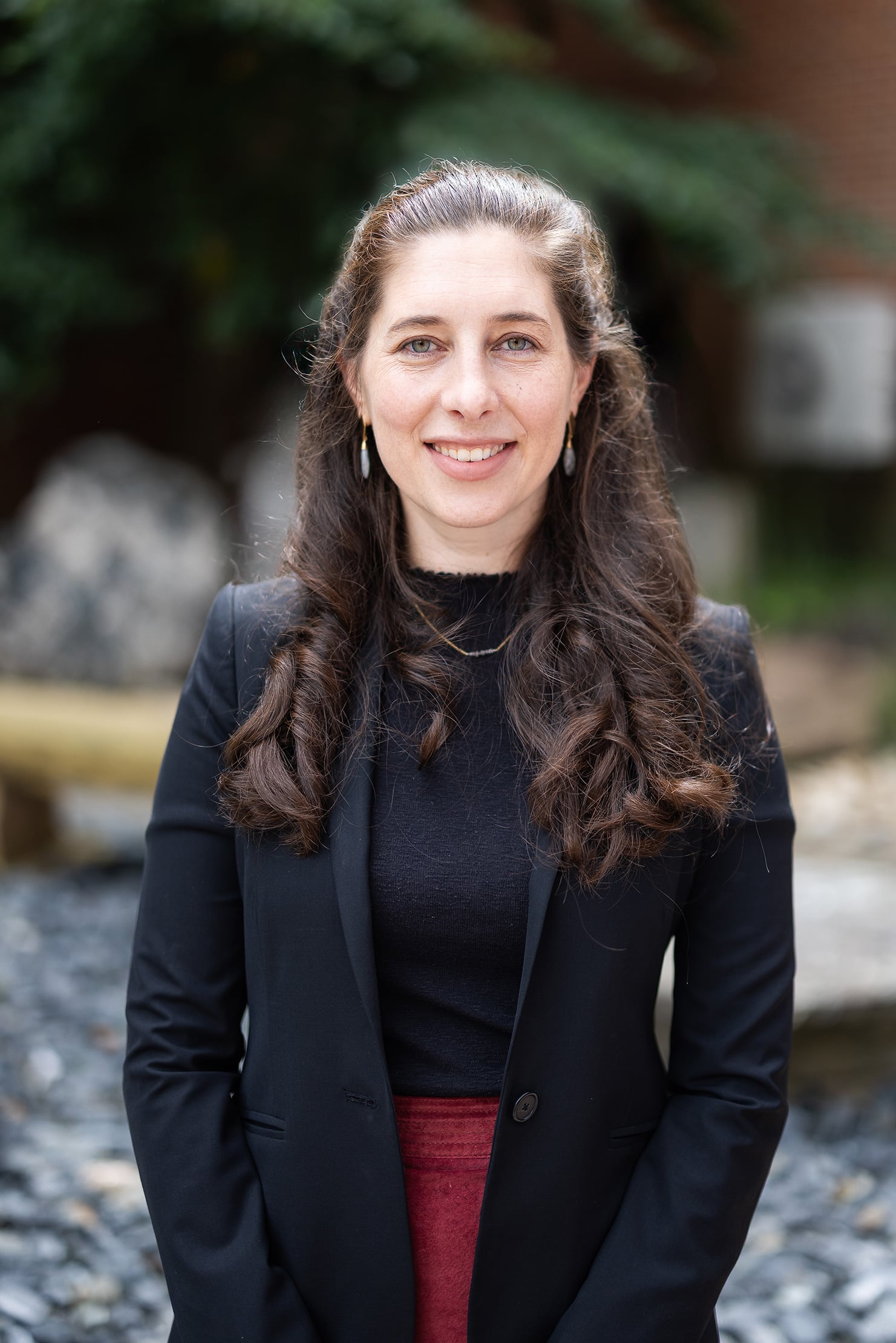
Dr. Maggie Sugg, professor in App State’s Department of Geography and Planning. Photo by Chase Reynolds
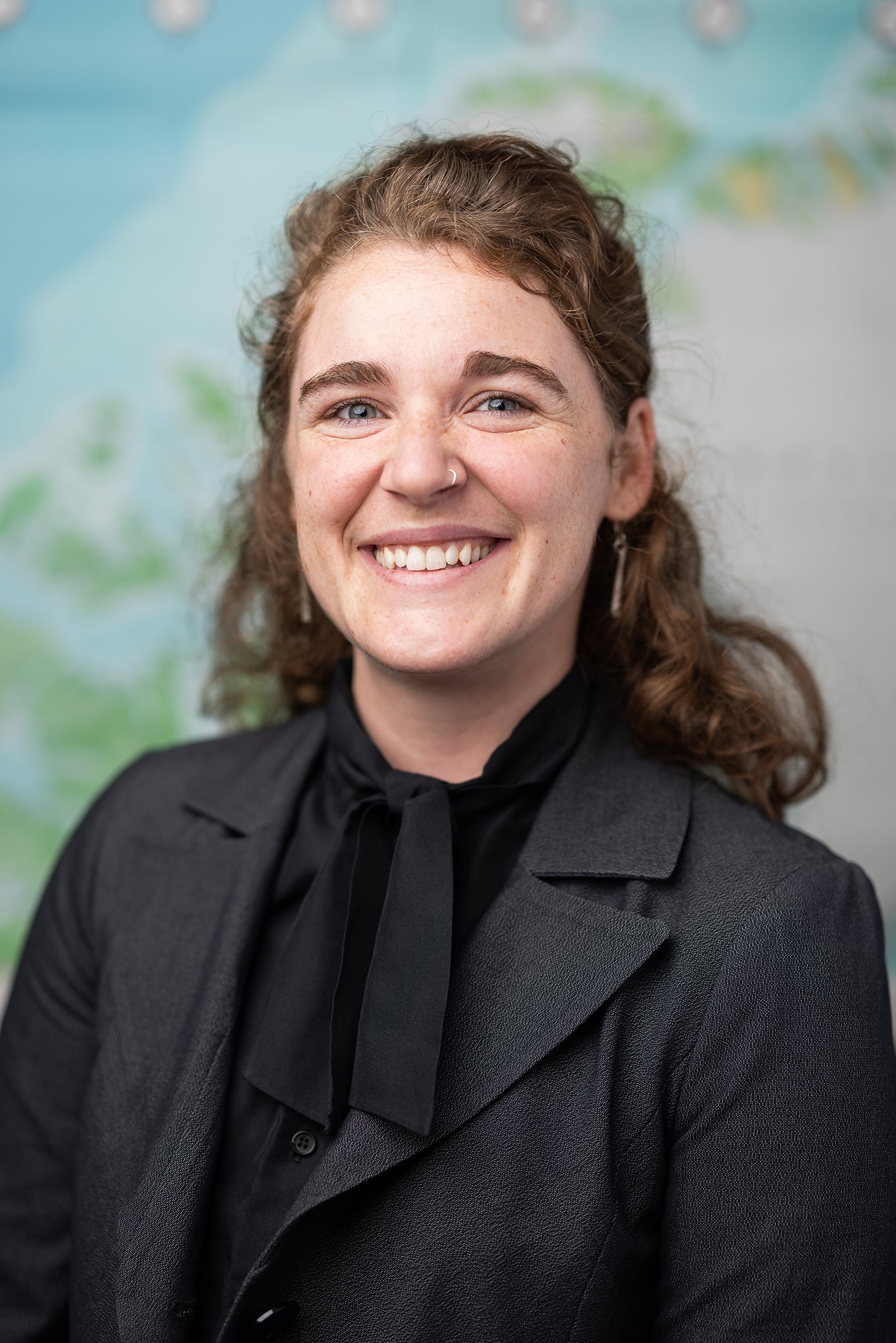
Sophie Ryan, research fellow in App State’s Department of Geography and Planning. Photo by Chase Reynolds
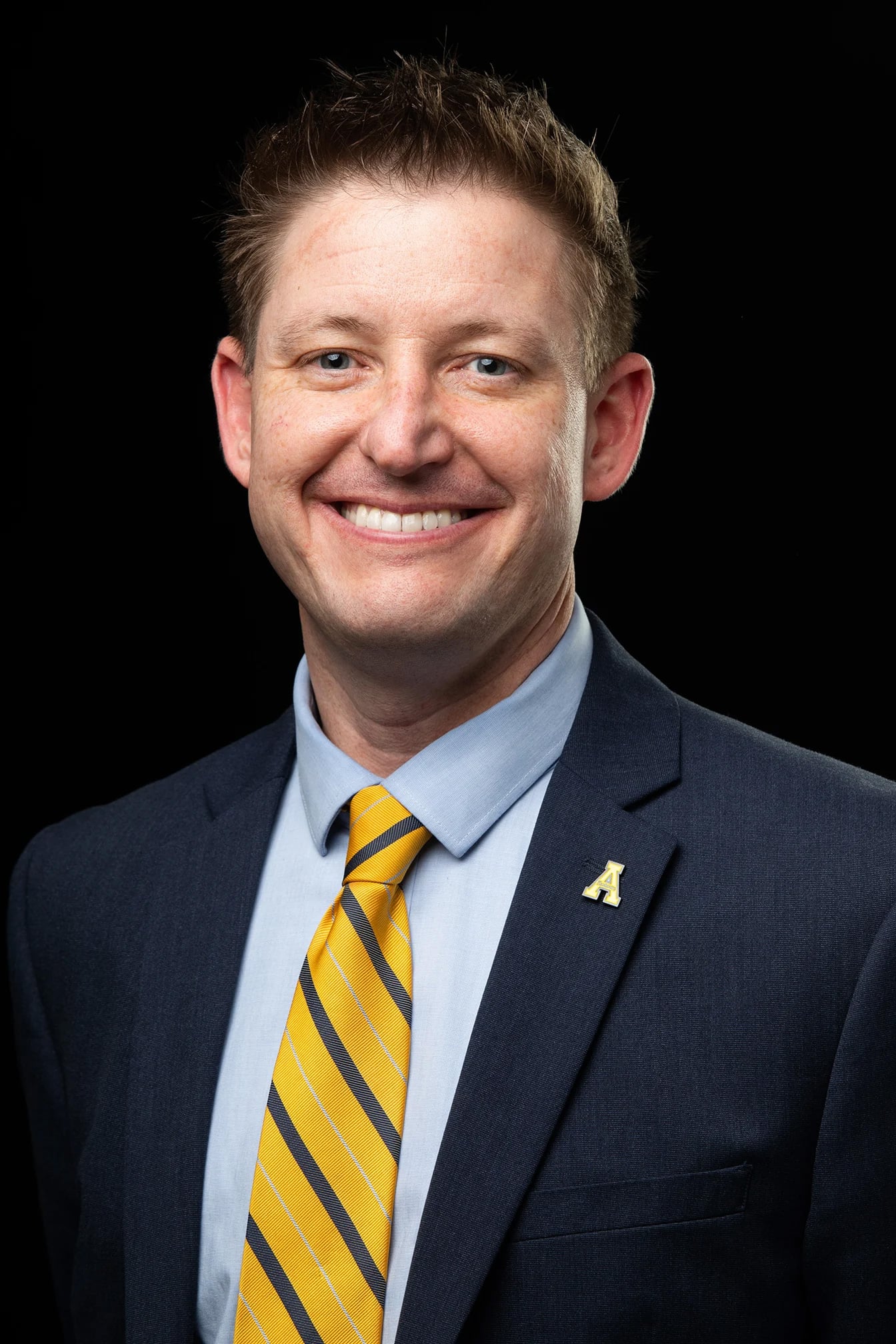
Dr. Adam Hege, associate dean of research and faculty development in App State’s Beaver College of Health Sciences. Photo by Chase Reynolds
“Our findings will document caregivers’ lived experiences following Helene and help identify actionable, tangible solutions to better support caregivers and families with school-aged children, not only in the immediate aftermath of a disaster but throughout long-term recovery,” explained Ryan, research fellow in App State’s Department of Geography and Planning.
She added, “This assessment is particularly important given ongoing stressors compounding with Helene’s recovery, including winter weather school closures and the permanent closure of childcare centers in the region.”
Hege is associate dean of research and faculty development in the Beaver College of Health Sciences, and Sugg serves as professor and honors program director in the geography and planning department.
Preserving stories of community resilience through the arts

Trevor McKenzie ’10 ’12, director of App State’s Center for Appalachian Studies. Photo submitted
To ensure local accounts of overcoming Helene are captured before they vanish, Trevor McKenzie ’10 ’12, director of the Center for Appalachian Studies, spearheaded a summer 2026 internship initiative in partnership with the Lost Province Center for Cultural Arts in Lansing. Intern Nina Nicholson ’25, an Appalachian studies graduate student from Mountain City, Tennessee, carried out key aspects of the project, helping collect community narratives and support regional arts programming.
The internship strengthened the ongoing partnership between the centers, McKenzie said. During her internship, Nicholson:
- collected community oral histories for the Buddy Holler studio’s Ashe County local history documentation project;
- provided logistics, promotion and operational support for the Fly Around Music Festival, founded as a relief event post-Helene;
- handled marketing for Lost Province’s classes and workshops; and
- helped develop plans for the center’s classes and workshops.
“Nina was invaluable in helping coordinate and promote Lost Province’s classes, programs and festival,” McKenzie said. “These community-campus partnerships are vital to Appalachian studies and provide pathways for students into meaningful roles that both sustain and reimagine opportunities for cultural arts within mountain communities.”
Lost Province’s return to promoting and providing space for traditional arts, after serving as a relief station during Helene, illustrates how regional culture remains vital for building “a resilient future for Appalachia’s communities in the 21st century,” said McKenzie.
Fostering healing through storytelling in Western NC classrooms
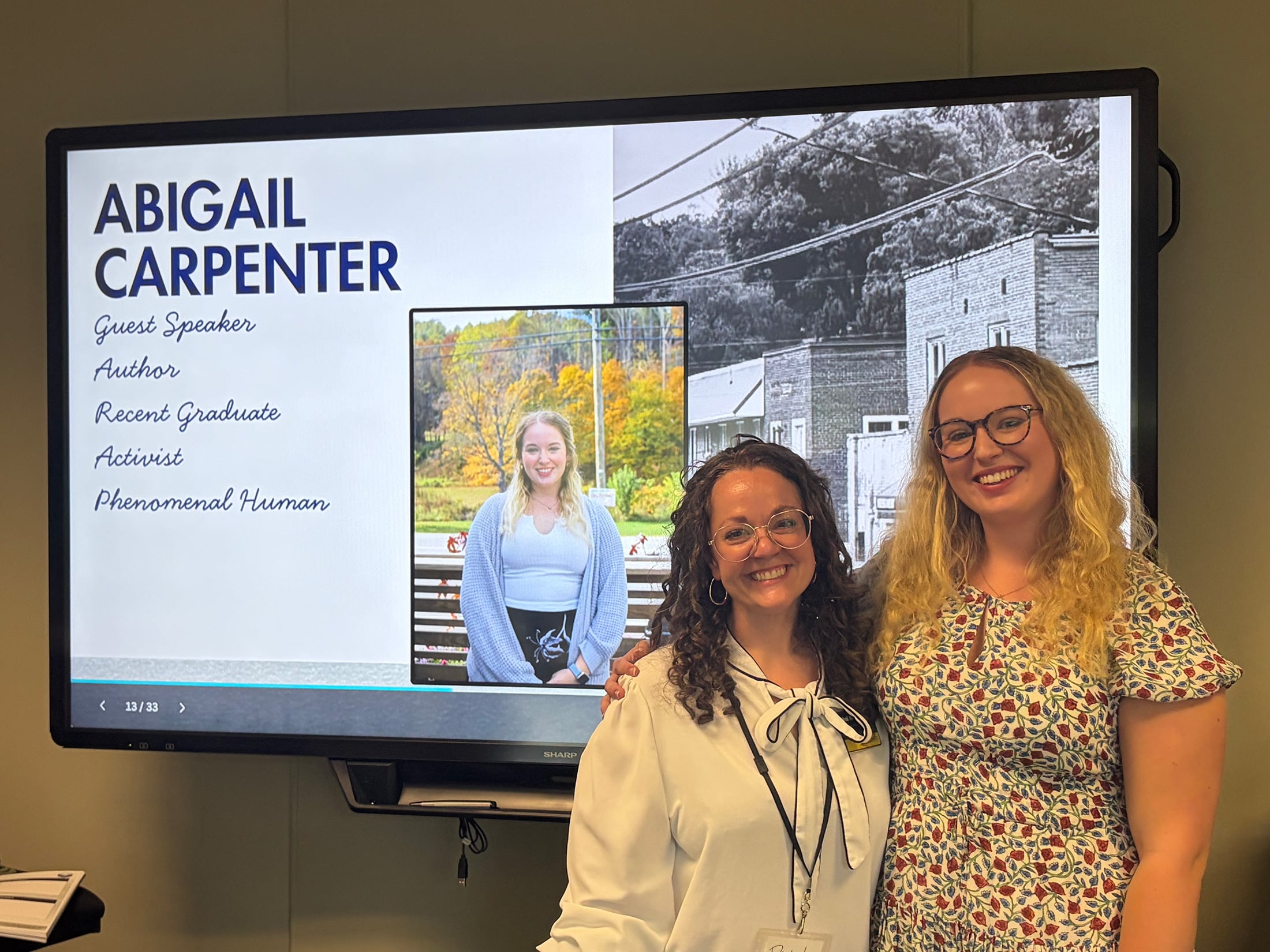
Rachel Nave-Lewis, assistant director of curriculum and instructional design in App State’s Office of Rural Promise, left, is pictured at a writing training for teachers with guest speaker Abigail Carpenter, a recent graduate of Yale University, as part of her “Echoes from the Mountains: Strengthening Student Resilience After Hurricane Helene” project. A resident of Lansing, Carpenter felt the impact of Hurricane Helene and witnessed the devastation through the lens of someone who was unable to contact her family while watching the news coverage from Connecticut. Carpenter spoke of the power of writing and collecting community members’ voices to share their stories of loss, hope and resilience. Photo courtesy of Rachel Nave-Lewis
Led by Rachel Nave-Lewis and Dr. Kathryn Watson, both from the Office of Rural Promise, “Echoes from the Mountains: Strengthening Student Resilience After Hurricane Helene” taps the power of storytelling to foster post-disaster healing. The initiative has engaged 40 Western North Carolina teachers across Ashe, Buncombe, Burke, Henderson, Madison, McDowell, Transylvania and Watauga counties who have shared stories from their own experiences, creating a foundation for engaging their students in related writing and research activities.
“Echoes from the Mountains is about Appalachian State creating space for Western North Carolina educators and students to tell their own stories,” said Nave-Lewis, assistant director of curriculum and instructional design for Appalachian GEAR UP (Gaining Early Awareness and Readiness for Undergraduate Programs).

Dr. Kathryn Watson, assistant director for research and evaluation in App State’s Office of Rural Promise. Photo by Chase Reynolds

Rachel Nave-Lewis, assistant director of curriculum and instructional design, Office of Rural Promise. Photo by Marie Freeman
Watson, assistant director of research and evaluation for GEAR UP, explained that the project uses research-informed writing, teacher professional learning and storytelling to explore how educators and students make meaning, strengthen belonging and cultivate resilience following Helene.
The project has developed resources for educators, and teachers who have completed the program’s professional learning are now moving the work into their classrooms. Teacher reflection and data collection are in progress, and next steps include development of a writing anthology; a student-, partner- and educator-engaged celebration; and dissemination of project results — with a proposed 2027 phase expanding the research and programming to high school educators and students.
“It’s ultimately about what happened after the storm,” Nave-Lewis said. “It is about educators returning to classrooms while carrying their own experiences of Helene; students finding words for change, belonging, community and hope; and the role schools play in helping communities recover and reconnect.”
What do you think?
Share your feedback on this story.

Ongoing post-Helene projects examine flood forecasting models, backup energy systems, ecological impacts, private well contamination and health solutions

About the Office of Research and Innovation
Appalachian State University’s Office of Research and Innovation supports the scholarly and creative activities of App State faculty, staff, and students by expanding access to and facilitating the management of research opportunities. The office consists of three units: Grants Resources and Services, Sponsored Programs, and Research Protections. Learn more about App State's Office of Research and Innovation at https://research.appstate.edu.
About the Research Institute for Environment, Energy and Economics
Since 2008, Appalachian State University’s Research Institute for Environment, Energy and Economics (RIEEE) has fostered interdisciplinary research on the environment, energy and economics, especially the areas in which these subjects intersect. The institute serves as an umbrella organization for three research centers: the Appalachian Energy Center, Center for Economic Research and Policy Analysis, and Southern Appalachian Environmental Research and Education Center. Additionally, the institute manages and supports App State’s student-led solar vehicle team, Team Sunergy — an exemplary model of the integrative and experiential student learning, leadership and innovation opportunities the institute seeks to foster at App State. Learn more at https://rieee.appstate.edu.
About the Office of Rural Promise
The Office of Rural Promise, housed in Appalachian State University’s Office of Research and Innovation, fosters regional connections and supports growing programs that empower students and educators at North Carolina schools. Leveraging new and existing grant-supported programs, the office builds strategic partnerships to solve big challenges in rural communities; designs and implements services that impact rural students, families and educators; conducts research and evaluates programs; and recommends strategies and policy. It is one of several App State units that strategically support the university’s research and innovation enterprise. Learn more about App State’s Office of Rural Promise at https://ruralpromise.appstate.edu.
About the Center for Appalachian Studies
The Center for Appalachian Studies promotes public programs, community collaboration, civic engagement and scholarship on the Appalachian region. The center is committed to building healthy communities and deepening knowledge of Appalachia’s past, present and future through community-based research and engagement. Learn more at https://appcenter.appstate.edu.
About the College of Fine and Applied Arts
Appalachian State University’s College of Fine and Applied Arts is a dynamic and innovative group of seven academic departments, bringing together a variety of perspectives, experiences and real-world education to provide unique opportunities for student success. The college has more than 3,500 undergraduate and graduate majors. Its departments are Applied Design, Art, Communication, Military Science and Leadership, Sustainable Development, Sustainable Technology and the Built Environment, and Theatre and Dance. Learn more at https://cfaa.appstate.edu.
About Appalachian State University
As a premier public institution, Appalachian State University prepares students to lead purposeful lives. App State is one of 17 campuses in the University of North Carolina System, with a national reputation for innovative teaching and opening access to a high-quality, cost-effective education. The university enrolls more than 21,000 students, has a low student-to-faculty ratio and offers more than 150 undergraduate and 80 graduate majors at its Boone and Hickory campuses and through App State Online. Learn more at https://www.appstate.edu.
Ongoing post-Helene projects examine flood forecasting models, backup energy systems, ecological impacts, private well contamination and health solutions