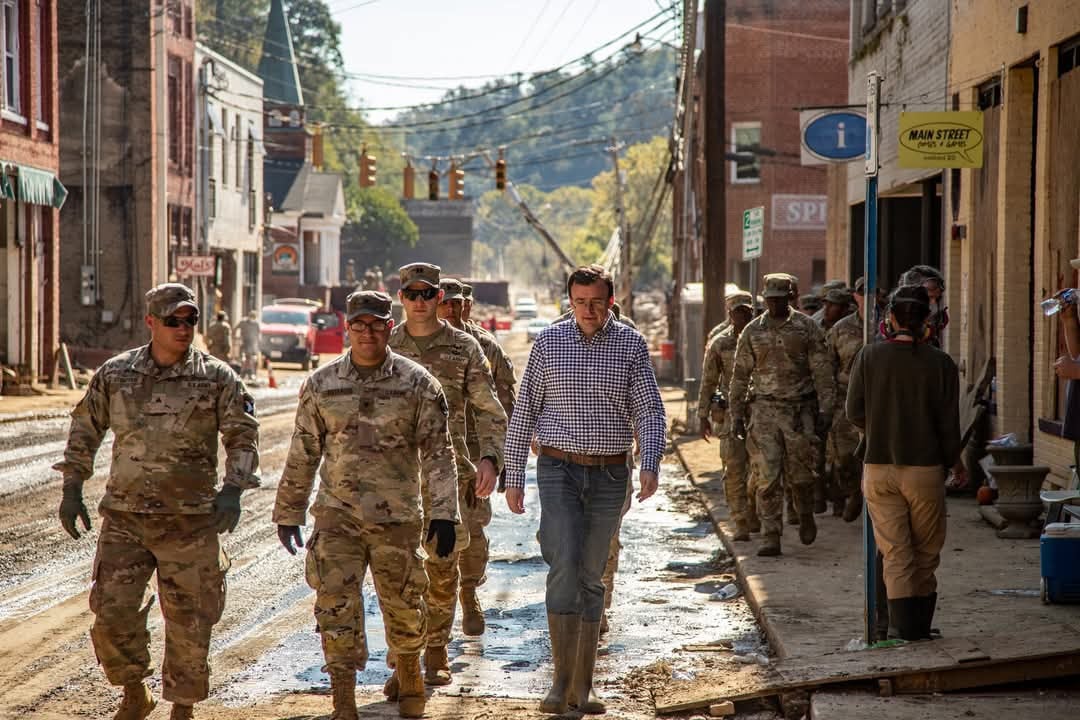
App State alumnus Forrest Gilliam ’08, GROW NC legislative director, second from right in foreground, walks through downtown Marshall with members of the U.S. Army’s 101st Airborne Division (Air Assault) to assess recovery efforts days after Hurricane Helene hit the Western North Carolina region on Sept. 27, 2024. At the time, Gilliam served as Marshall’s town administrator. Photo by AK Hilty
BOONE, N.C. — When Hurricane Helene devastated Western North Carolina in September 2024, the Appalachian State University Community rallied to support the region alongside local partners — from providing immediate assistance to helping with the long process of rebuilding.
Two years later, that work continues across the mountains, and several App State alumni are helping coordinate the state’s long-term recovery efforts as leading members of GROW NC, the Governor’s Recovery Office for Western North Carolina.
Among them is Forrest Gilliam ’08, who serves as GROW NC’s legislative director. A Madison County native and political science graduate of App State, Gilliam has built a career in public service — holding various roles in congressional and state government, including in the governor’s office, county management and town administration.
“Helene was a terrible thing to go through, but the way people reacted has been so encouraging,” said Gilliam. “To have the opportunity to work at the state level to help our region recover is an honor. It’s especially meaningful because I was on the ground during the flood and saw the destruction in my community firsthand. I know some of the people who are still hurting and I’m glad to be a part of the governor’s effort to keep their needs front and center.”
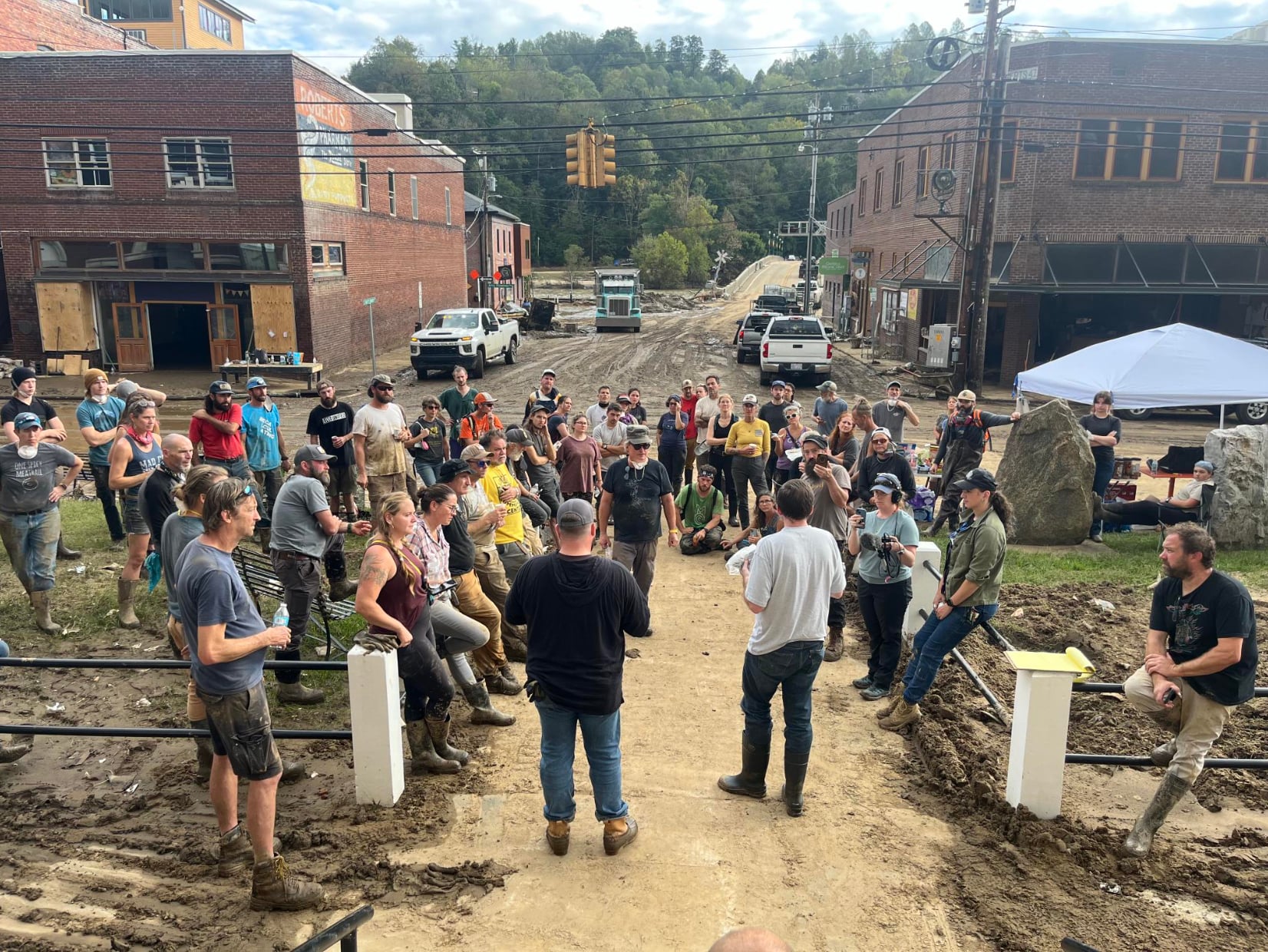
App State alumnus Forrest Gilliam ’08, GROW NC legislative director, second from right in foreground, addresses community members in downtown Marshall following Hurricane Helene. Photo courtesy of GROW NC
The GROW NC team's work is part of a wider recovery effort across the region — to repair homes, clear debris, restore drinking water systems and reopen roads impacted by the storm. Still, some of the most complicated repairs remain, particularly private roads and bridges and local systems that federal programs do not fully cover.
“Our focus has got to be on the individuals and making sure that they’re getting the support they need,” said Gilliam. “Homeowners and business owners depend on these types of infrastructure to support their livelihoods.”
Gilliam is one of several App State alumni helping guide Western North Carolina’s recovery through GROW NC. Other alumni working with GROW NC include:
- Emily Williamson Gangi ’09, chief deputy director, who holds an educational specialist degree in higher education from App State;
- Becca Fisher-Tringale ’21 ’22, program officer, who holds a bachelor's degree in child development-family and child studies and a master's degree in political science from App State;
- Drew Christy ’12, regional recovery coordinator, who holds an App State bachelor's degree in political science; and
- Aaron Barnes, senior communications advisor, who earned a graduate certificate in strategic communication from App State in 2019.
Working closely with Gov. Josh Stein, the GROW NC team and North Carolina’s federal delegation on Helene recovery has been the Governor’s Advisory Committee on WNC Recovery, which is co-chaired by Sen. Kevin Corbin ’83, who holds a bachelor’s degree in marketing and business management from the university. Additional App State alumni and staff on the committee include:
- NC Sen. Ralph Hise ’00, who holds an App State bachelor’s degree in statistics and is a 2022 recipient of the university’s Distinguished Alumni Award
- David Jackson ’00, president and CEO of the Boone Area Chamber of Commerce, who holds an App State bachelor’s degree in communication-electronic media/broadcasting
- Dr. James Beeler ’90, executive director of App State’s Office of Rural Promise, who holds an App State master’s degree in history, education
- Todd McNeill ’06, executive director of the North Carolina Association of Regional Councils of Governments, who holds an App State bachelor’s degree in communication, public relations
- Melissa Patton ’08, executive director of Carolina Land and Lakes, who holds an App State master’s degree in public administration
- Charlie Wallin, former director of retail dining at App State, who retired from the university this summer
“As Appalachian State alumni who have been called to public service, many of us share a deep connection to these mountains and a responsibility to the communities that shaped us,” said Corbin. “I’ve appreciated the governor, his administration and leaders from across the region coming together through GROW NC to listen to our communities and build a stronger, more resilient future for Western North Carolina.”
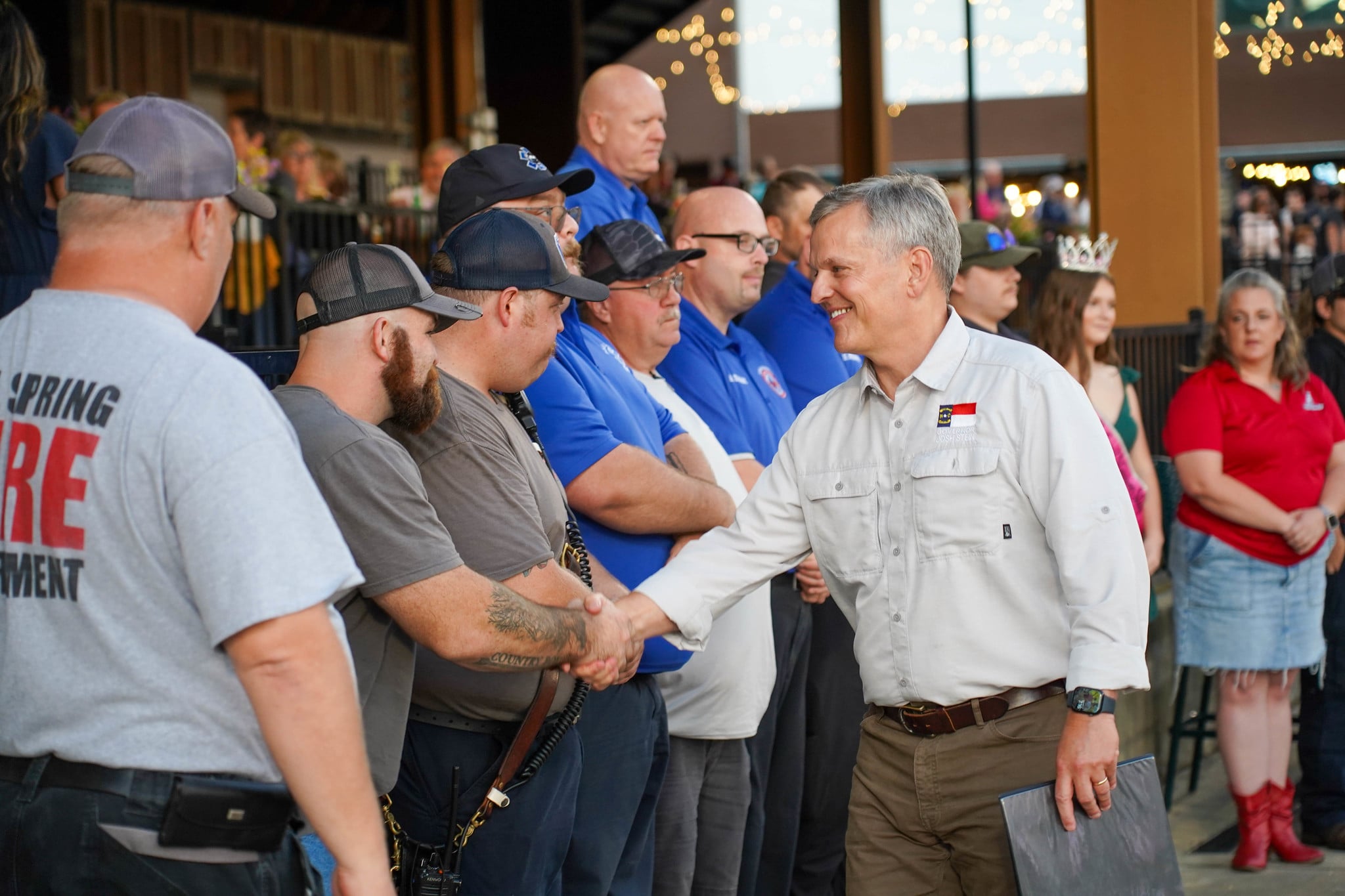
North Carolina Gov. Josh Stein, right in foreground, thanks first responders for their service at an event in Mill Spring one year after Hurricane Helene. Photo courtesy of GROW NC
Recovery 2 years later, and beyond
Two years after Helene, recovery continues across Western North Carolina as communities work to secure funding, navigate government processes and rebuild homes, businesses and public infrastructure.
According to GROW NC’s fourth-quarter report for the 2026 fiscal year, dated Aug. 14, Helene caused more than $59.6 billion in damage and recovery needs across the state — more than three times the impact of Hurricane Florence in 2018. Approximately $14.4 billion in state and federal aid has been directed to Western North Carolina recovery, including funding for housing, businesses, education, childcare and more.
One example is Hot Springs, where a nearly $2.4 million state grant supported the town’s purchase of land for its new wastewater treatment plant, which is being relocated to higher ground after Helene.
“To see that project come together was really rewarding,” Gilliam said. “But what people don’t know about recovery is that things like this can take several years. We have more construction going on in the region right now than we’ve probably ever had in our lifetime.”
Looking ahead, Gilliam hopes the recovery makes it possible for residents to remain in the region, even as rebuilding regulations and housing shortages create challenges for those whose homes were lost or damaged.
“We’re doing all we can to make it as easy as possible for people to stay here, so that we can preserve the great quality of life that our residents have always known,” he said.
Gilliam said the response of communities across the region gives him reason for optimism, pointing to communities such as Marshall, Chimney Rock, Hot Springs, Lansing, Spruce Pine and many others that quickly committed to rebuilding.
“Residents in many communities that were impacted all came together and said ‘we’re not going anywhere,’ and that’s powerful,” he said.
From student leader to public servant
Gilliam’s path into public service began as a middle school student, when he helped advocate for state funding for a new public library in his hometown. His passion for public service continued through high school and at App State, where he served two terms as student body president — a role that gave him firsthand experience navigating the university community and working with the Board of Trustees and administrators, including former App State Chancellor Dr. Kenneth E. Peacock.
“Being in student government was such an incredible experience,” Gilliam said. “To be exposed to decision-making and to have a vision for growth and change, while also trying to preserve what makes App State unique — it was an honor. I was able to learn, make mistakes and build confidence, and that has benefited my career tremendously.”
Gilliam continues to serve App State as a member of the College of Arts and Sciences Advancement Council and returns to Boone regularly, calling it his “second home.”
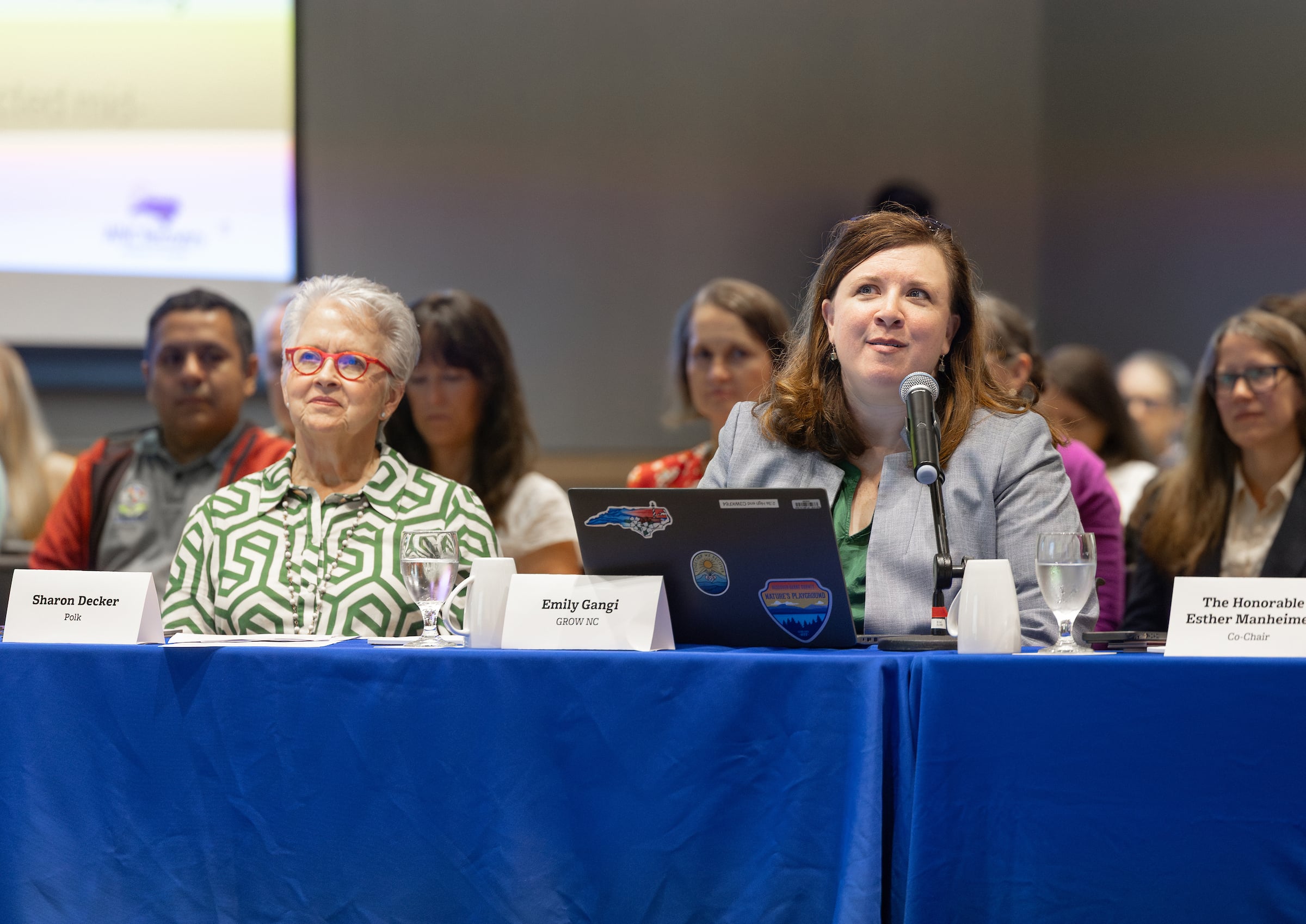
Emily Williamson Gangi ’09, GROW NC’s chief deputy director, right in foreground, offers recovery updates during the July 2025 meeting of the Governor’s Advisory Committee on WNC Recovery, held at UNC Asheville. Photo courtesy of GROW NC
A Mountaineer network in action
Mountaineers are contributing widely across the GROW NC office, bringing experience in operations, communications, community engagement and more to the long-term effort.
As GROW NC’s chief deputy director, Gangi is applying her App State graduate training in higher education administration to the state’s largest recovery effort.
“We’re basically the nerve center for state government in the recovery process,” she said.
For all Mountaineers working through GROW NC, the recovery is both a professional and personal responsibility. As Gilliam puts it, the goal is to help Western North Carolina rebuild, recover and remain a place people can call home.
“App State folks are always ready to get things done and figure things out, and we prove we’ll earn our way wherever we go,” he said. “The Mountaineer work ethic especially meant a great deal during Helene.”
What do you think?
Share your feedback on this story.

About Appalachian State University
As a premier public institution, Appalachian State University prepares students to lead purposeful lives. App State is one of 17 campuses in the University of North Carolina System, with a national reputation for innovative teaching and opening access to a high-quality, cost-effective education. The university enrolls more than 21,000 students, has a low student-to-faculty ratio and offers more than 150 undergraduate and 80 graduate majors at its Boone and Hickory campuses and through App State Online. Learn more at https://www.appstate.edu.