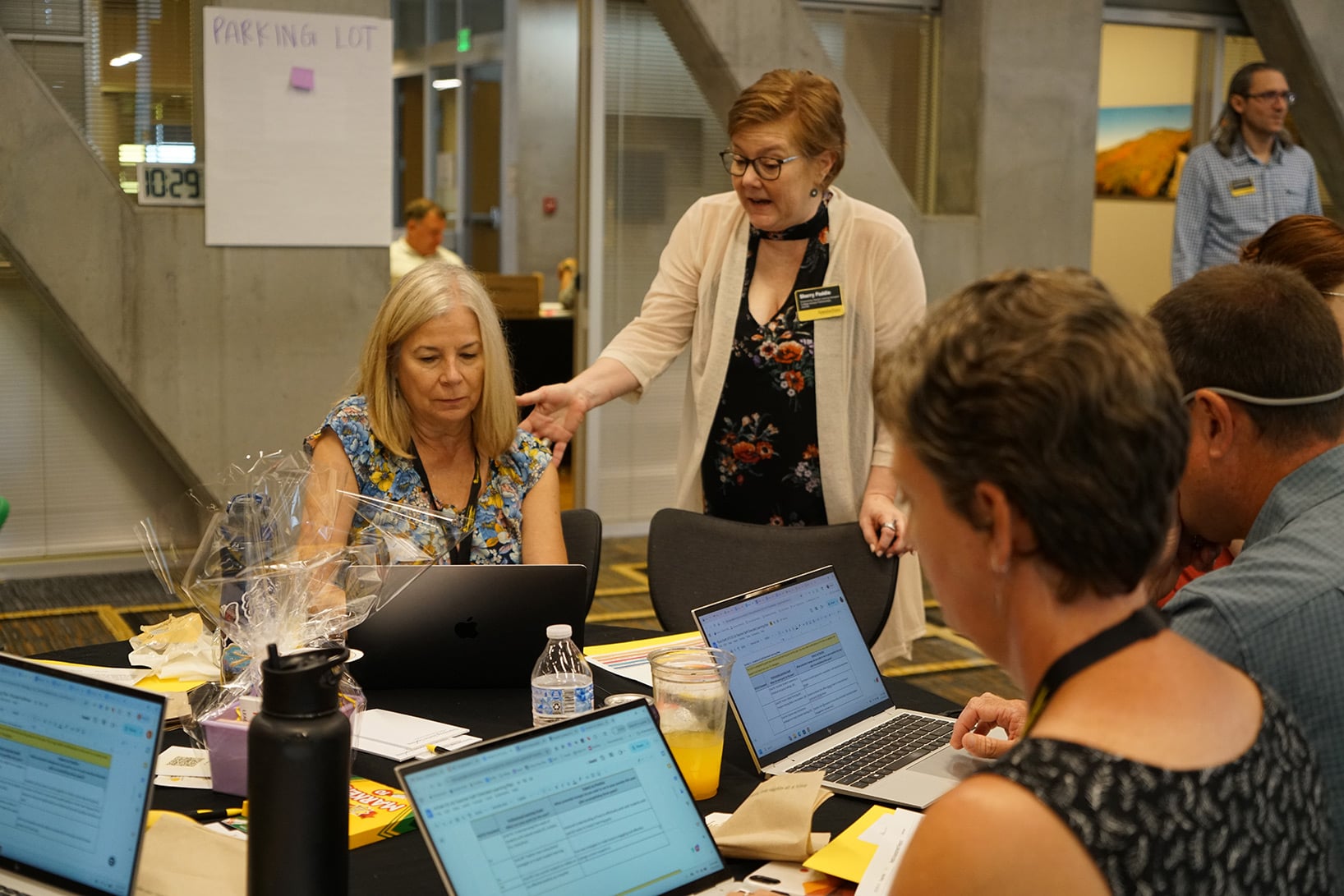
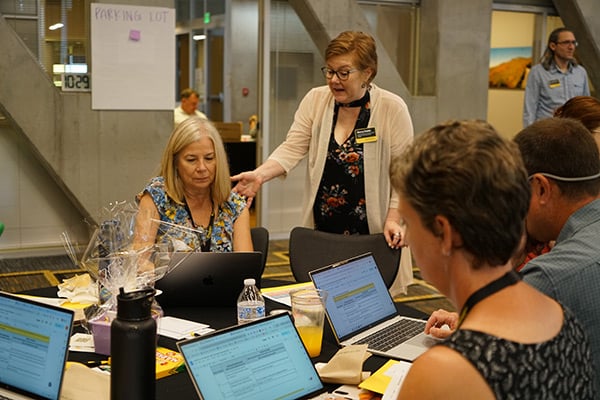
Former App State Empowering Teacher Learning (ETL) Navigator Sherry Paddie, center, instructs an ETL participant on how to access her Digital Promise microcredential library at the ETL Summer Convening held at App State in July 2025. Every ETL participant receives individualized support as they complete the program, which will expand statewide as part of App State’s ETL SPARK (Empowering Teacher Learning: Strengthening Professional learning to Advance Reading Knowledge) initiative. Funded by a $10 million federal grant awarded to App State’s Office of Rural Promise, ETL SPARK provides targeted support to middle school literacy educators. Photo courtesy of App State’s Office of Rural Promise
BOONE, N.C. — Appalachian State University’s Office of Rural Promise (ORP) has secured a $10 million grant from the U.S. Department of Education to launch ETL SPARK (Empowering Teacher Learning: Strengthening Professional learning to Advance Reading Knowledge). App State will partner with school districts across North Carolina as part of the five-year research initiative to study how teacher-directed professional learning in middle grades literacy can elevate classroom instruction and empower educators.
North Carolina has made major investments in elementary literacy, but ongoing, individualized professional development for middle grades literacy remains limited, leaving little room for autonomy or responsiveness to local contexts, explained Dr. James Beeler, executive director of the Office of Rural Promise.
ETL SPARK aims to address these gaps by:
- Strengthening middle grades literacy instruction through teacher‑directed professional learning
- Increasing relevance and autonomy in professional learning
- Supporting teacher retention by building confidence, competence and community
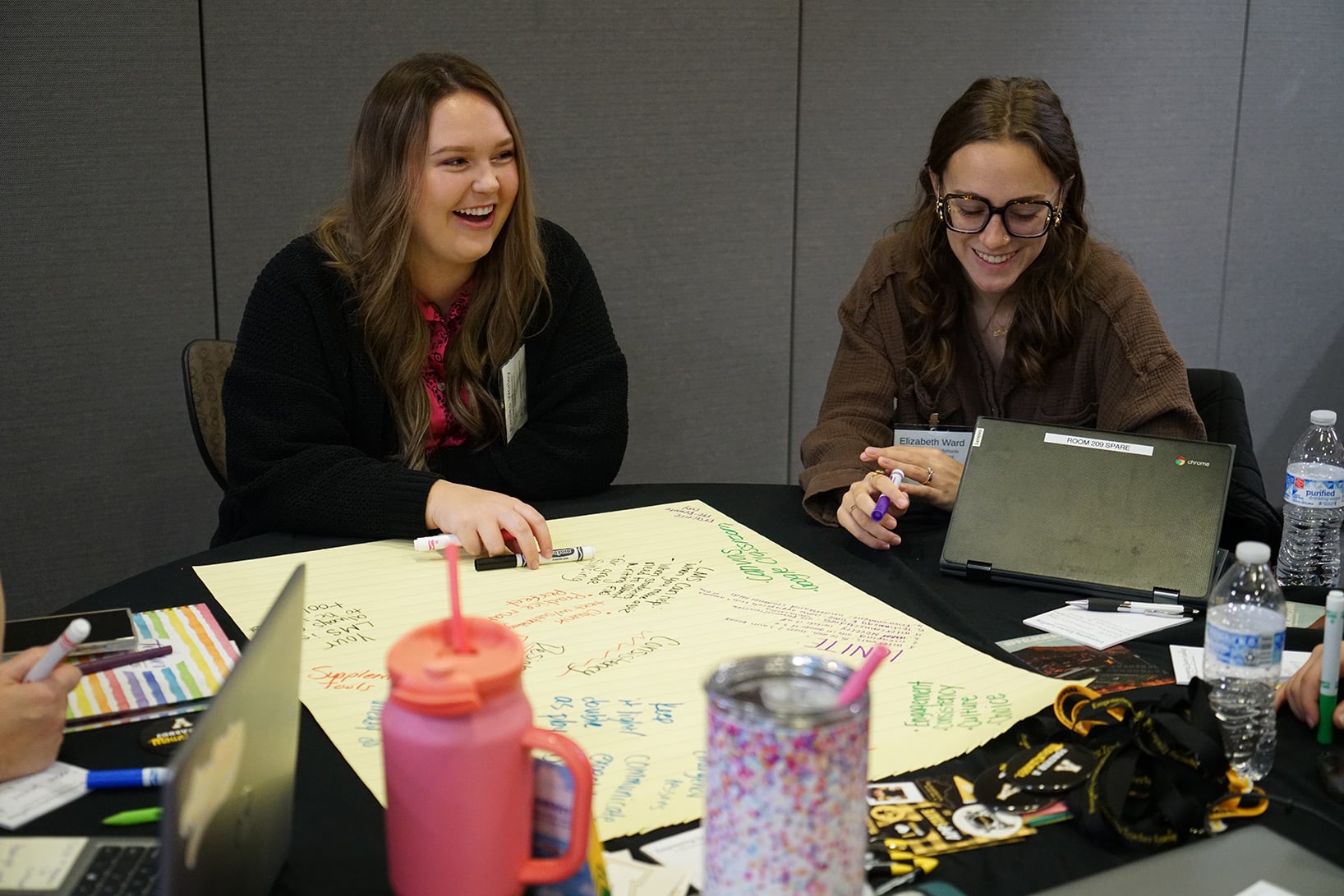
Empowering Teacher Learning (ETL) participants Emilee Worley, a teacher at Mountain View Elementary School, left, and Elizabeth Ward, a teacher at Blowing Rock School, work on a brainstorming activity at the Empowering Teacher Learning (ETL) Transform Remote Learning Workshop held at App State in November 2025. Giving rural educators access to cutting-edge professional development is a core principle of the university’s ETL program. Photo courtesy of App State’s Office of Rural Promise
The program builds on ORP’s recently completed Empowering Teacher Learning (ETL) model, a five-year, $12 million federally funded project launched in 2021 in middle schools across Western North Carolina. Focused on teacher-directed, competency-based professional learning, the ETL model demonstrated that this approach can strengthen instructional quality, create clearer pathways for educators to earn microcredentials and support teacher retention.
“We are excited to bring the Office of Rural Promise’s work to more communities across the state — supporting educators, strengthening literacy for students in the middle grades and creating meaningful opportunities for educators to shape their own professional learning,” said Beeler. “When we invest in educators and honor their voice and expertise, we help create brighter futures for every student.”
Through ETL SPARK, teachers set individualized professional learning goals and choose how to pursue them, giving educators voice, choice and agency in shaping their growth, based on the needs identified for their classrooms. Also, school administrators gain a user-friendly, comprehensive system for implementing individualized professional development aligned with school‑level priorities, and teachers are supported throughout the program by an assigned educational navigator.
“ETL SPARK reflects App State’s mission to serve communities through outreach, partnership and research, ensuring educators across the state have access to meaningful, high-quality support,” Beeler added.
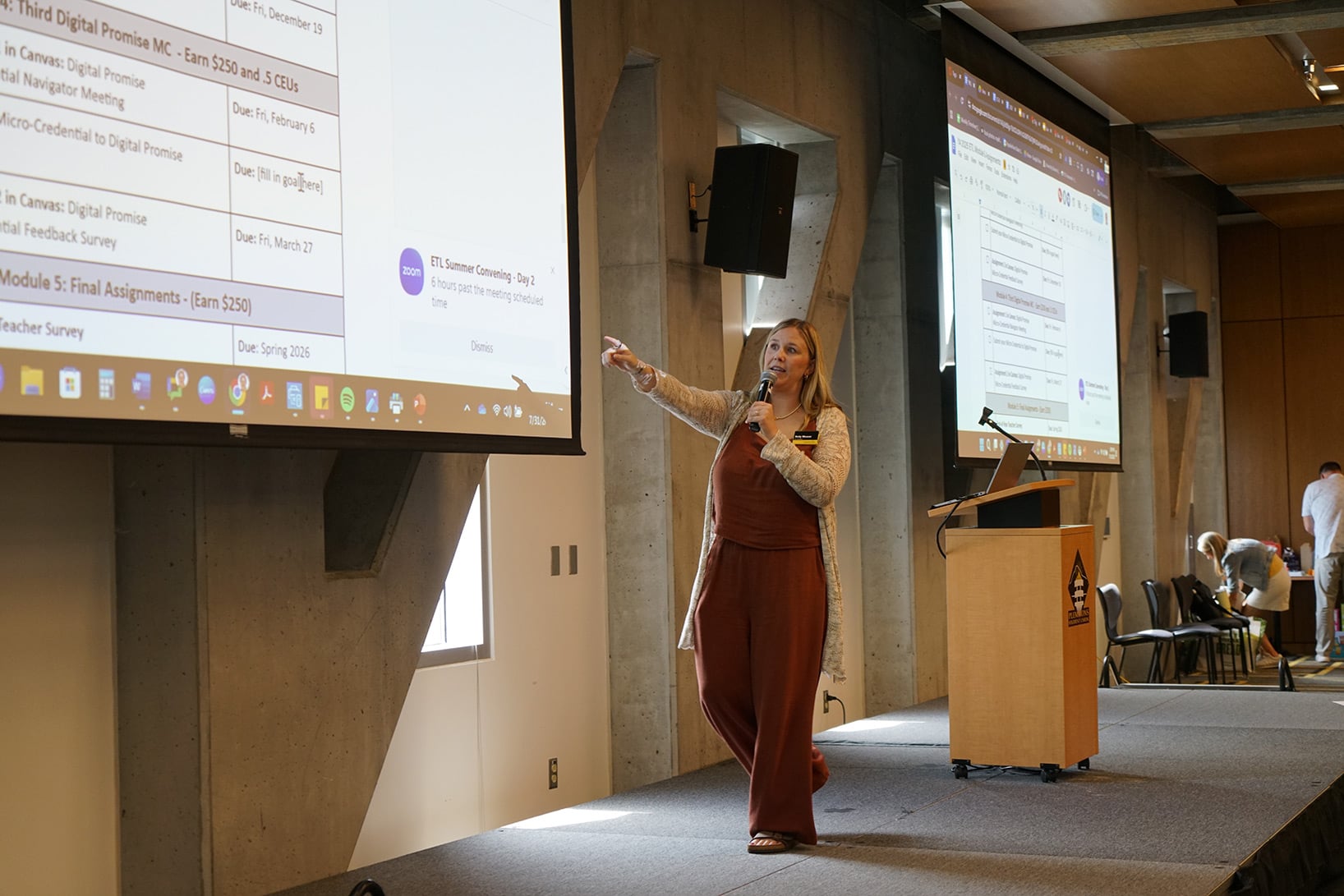
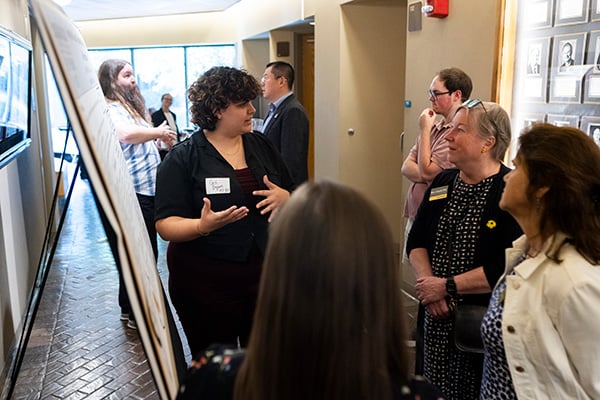
Holly Weaver, former assistant director of outreach for Empowering Teacher Learning (ETL), presents at the 2025 ETL Summer Convening held at App State’s Boone campus. These annual convenings provide ETL participants a chance to network in person and share their experiences with their fellow educators. Photo courtesy of App State’s Office of Rural Promise
Expanding a promising model
App State’s ETL SPARK program expands the original project in three key ways:
- Statewide reach — from Western North Carolina to districts across the state
- Broader district participation — including rural, suburban and urban partners
- Focused literacy impact — shifting from general professional learning to strategies that improve student literacy in the middle grades
During the earlier phase of the project, participating teachers showed significant improvements in instructional quality after just one year, with gains sustained over time — measured using the Classroom Assessment Scoring System (CLASS), a tool for analyzing the quality of teacher-child interactions in the classroom.
Teachers described the model as flexible, relevant, rigorous and empowering, calling it a welcome change from traditional professional learning experiences, according to Dr. Jui-Teng Li, associate director of research and evaluation for the Office of Rural Promise. Li shared that schools also reported encouraging declines in teacher turnover, underscoring the connection between teacher confidence and retention. When teachers feel empowered and confident in their role, students benefit, Li noted.
Some of the foundational research findings from ORP’s ETL project include:
- 71% of schools with ETL intervention reported an increase in eighth grade math end-of-grade scores after one year.
- ETL schools experienced an average four-point increase in eighth grade math scores after two years of intervention.
- Chronic absenteeism decreased in ETL schools across two years of intervention.
- Teachers supported by ETL demonstrated sustained growth in self-directed learning efficacy across two years of intervention.

Dr. James Beeler, executive director of App State’s Office of Rural Promise. Photo by Chase Reynolds

Dr. Jui-Teng Li, associate director of research and evaluation in App State’s Office of Rural Promise. Photo by Chase Reynolds
ETL SPARK partners
The ETL SPARK program will be supported by several collaborators, including:
- Digital Promise, a global nonprofit advancing innovation in teaching and learning, which will provide access to a library of more than 700 competency‑based microcredentials aligned to teacher‑selected goals;
- the National Council for Community and Education Partnerships, which will serve as the external evaluator for the ETL SPARK program; and
- the North Carolina Department of Public Instruction, which will ensure microcredentials earned through ETL SPARK count toward teacher relicensure requirements.
ORP will begin recruiting districts statewide in the coming months. ETL SPARK will launch its first group of participants once district partners are confirmed. Any districts interested in bringing this professional learning model to their schools are encouraged to reach out to ORP’s Kelley Wilson, ETL SPARK program director, at [email protected].
What do you think?
Share your feedback on this story.


About the Office of Rural Promise
The Office of Rural Promise, housed in Appalachian State University’s Office of Research and Innovation, fosters regional connections and supports growing programs that empower students and educators at North Carolina schools. Leveraging new and existing grant-supported programs, the office builds strategic partnerships to solve big challenges in rural communities; designs and implements services that impact rural students, families and educators; conducts research and evaluates programs; and recommends strategies and policy. It is one of several App State units that strategically support the university’s research and innovation enterprise. Learn more about App State’s Office of Rural Promise at https://ruralpromise.appstate.edu.
About Appalachian State University
As a premier public institution, Appalachian State University prepares students to lead purposeful lives. App State is one of 17 campuses in the University of North Carolina System, with a national reputation for innovative teaching and opening access to a high-quality, cost-effective education. The university enrolls more than 21,000 students, has a low student-to-faculty ratio and offers more than 150 undergraduate and 80 graduate majors at its Boone and Hickory campuses and through App State Online. Learn more at https://www.appstate.edu.

![NC universities ranked by free-speech advocacy group [faculty and staff featured]](/_images/_posts/2026/09/free-speech-advocacy-600x400.jpg)