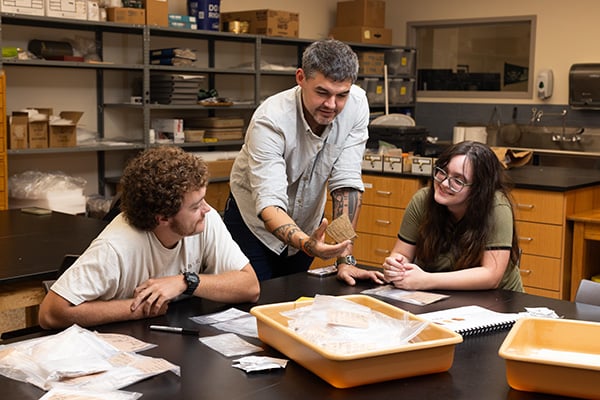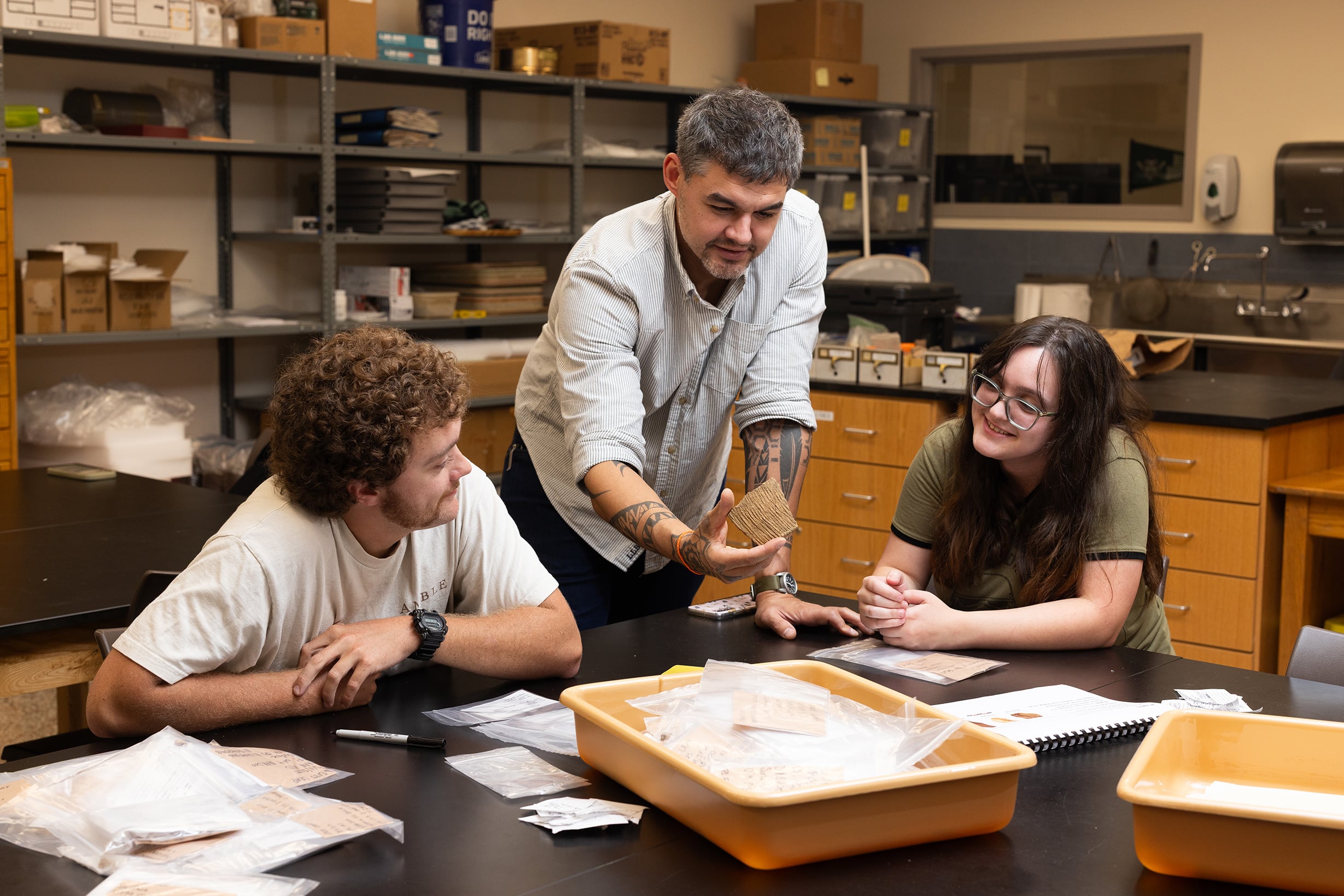
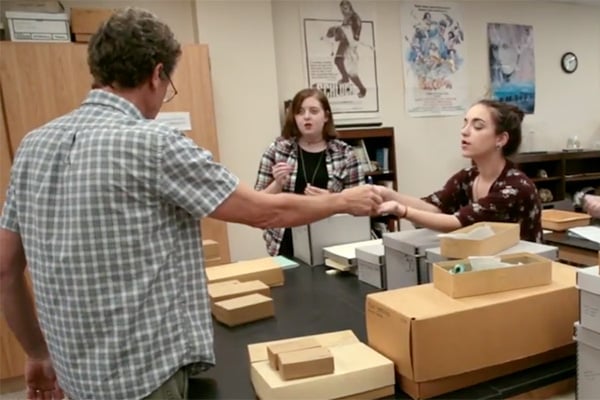
App State student researchers Shaun Pell, a senior from China Grove, left, and Kiya King, a senior from Granite Falls, right, discuss an ancient pottery sherd with Dr. Seth Grooms, assistant professor of anthropology and co-founder of the Lumbee River Archaeology Project. Photo by Chase Reynolds
BOONE, N.C. — Artifacts that have endured for thousands of years in the soil of North Carolina’s Inner Coastal Plain have become a bridge between Lumbee Tribe members, Appalachian State University student researchers and their shared commitment to preserving ancestral places.
Now in its third year, the National Geographic Society-funded Lumbee River Archaeology Project (LRAP) is led by Dr. Seth Grooms, assistant professor in App State’s Department of Anthropology, and powered by student researchers and tribe members working side by side to support cultural heritage initiatives of the Tribal Historic Preservation Office (THPO) using archaeology to document ancestral sites.
“The goal is to train App State students and Lumbee citizens in archaeological methods while increasing the tribe’s capacity for heritage management initiatives,” explained Grooms, a Lumbee Tribe member who co-founded LRAP in partnership with the Lumbee Tribal Government.
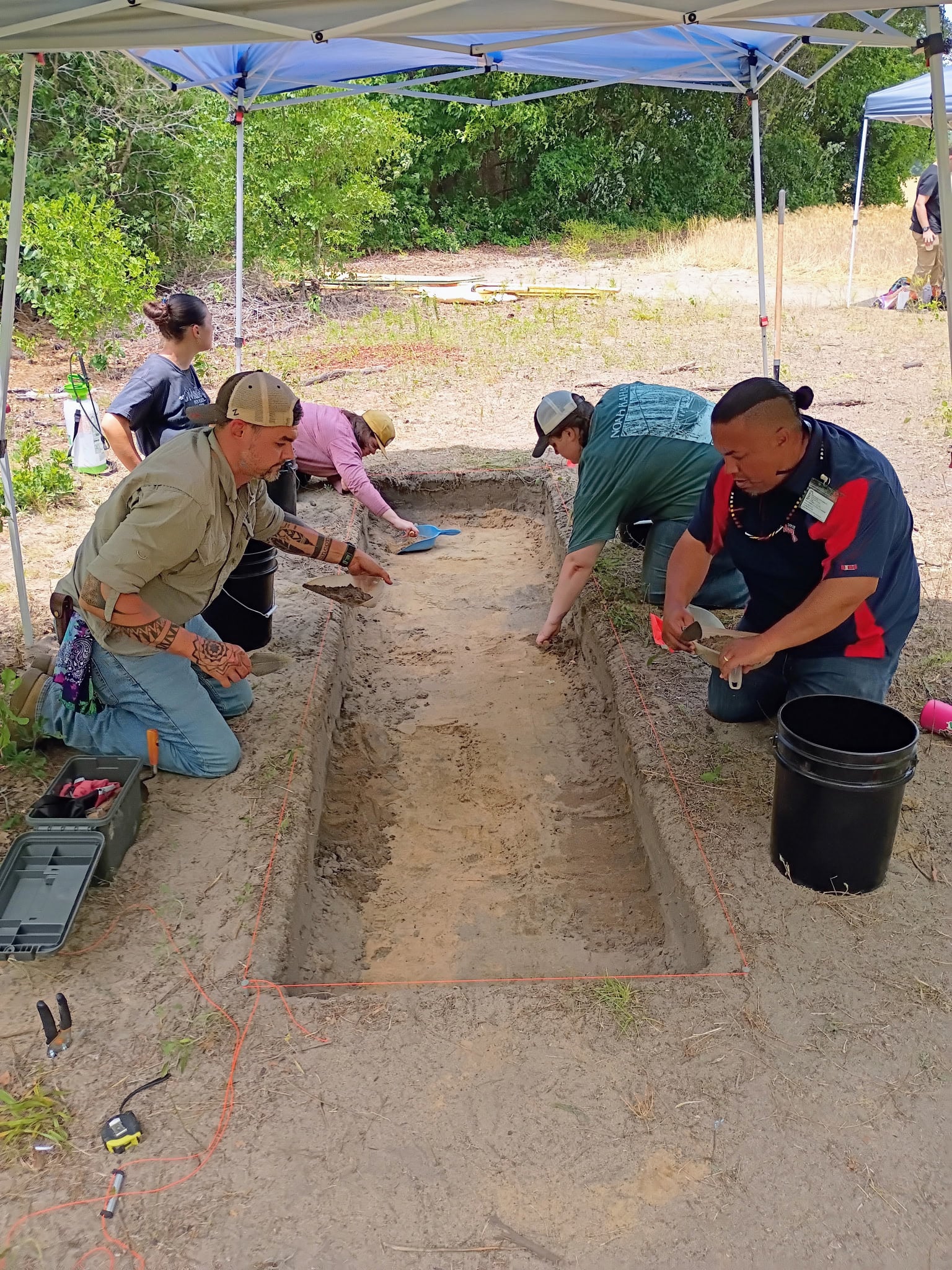
Clockwise from left, Dr. Seth Grooms, App State seniors and anthropology majors Talia Debenedette, Cayden Herring and Brianna Cameron, and Harlen Chavis Jr., Tribal Historic Preservation Officer of the Lumbee Tribe, work at a dig site in Robeson County during a summer 2026 App State archaeology field school coordinated with tribe members. Photo submitted
A dozen undergraduate researchers made the trip to Robeson County this summer for an archaeology field school, where they unearthed artifacts they are now studying in Grooms’ Boone lab. Transitioning from hands-in-the-dirt excavation to lab analysis, the student team works under Grooms’ supervision to examine the microscopic features of pottery sherds, stone tool fragments and projectile points, studying material thickness, markings and suspected vessel size, shape and composition. They work closely with Harlen Chavis Jr., the Lumbee THPO, sharing their findings as they go.
The digs have yielded artifacts as old as 6,500 years, some of which the tribe has loaned to Grooms for study. Radiocarbon dating and microscopy analysis at App State yield clues to material, age and origin, and soil samples offer insights to ancient activities on the land. While less than 1% of Robeson County has been surveyed by archaeologists, work so far reveals human activity spanning 14,000 years, according to Grooms.
App State anthropology major Katie Walker assisted with surveys of farmland owned by Lumbee Tribe members and systematically combed layers of earth for signs of ancient settlements. The collective joy and excitement of discovery spanning students, faculty, tribal officials and community members “was a beautiful moment of connection for all of us and for those who came before us,” she recalled.
“I call it the moment time collapses — when we can hold an item in our hands and feel the weight it had for someone so long ago and still has for us now. There’s no other feeling like it in the world,” said Walker, a senior from Roanoke, Virginia.
Several students remained in the area after the field school, and some returned and continued to forge connections with tribe members.
“Students who participate in LRAP routinely form friendships with Lumbees and become passionate about the area, the people and the culture,” Grooms said. “They make personal trips to Robeson County, the cultural and governmental heart of the Lumbee Nation, and meet up with their Lumbee friends and attend powwows and Lumbee Homecoming. It means a lot to me to see those relationships.”
Grooms and a small group of student researchers will return to Robeson County in November with ground-penetrating radar to learn more about ancestral sites using noninvasive methods.
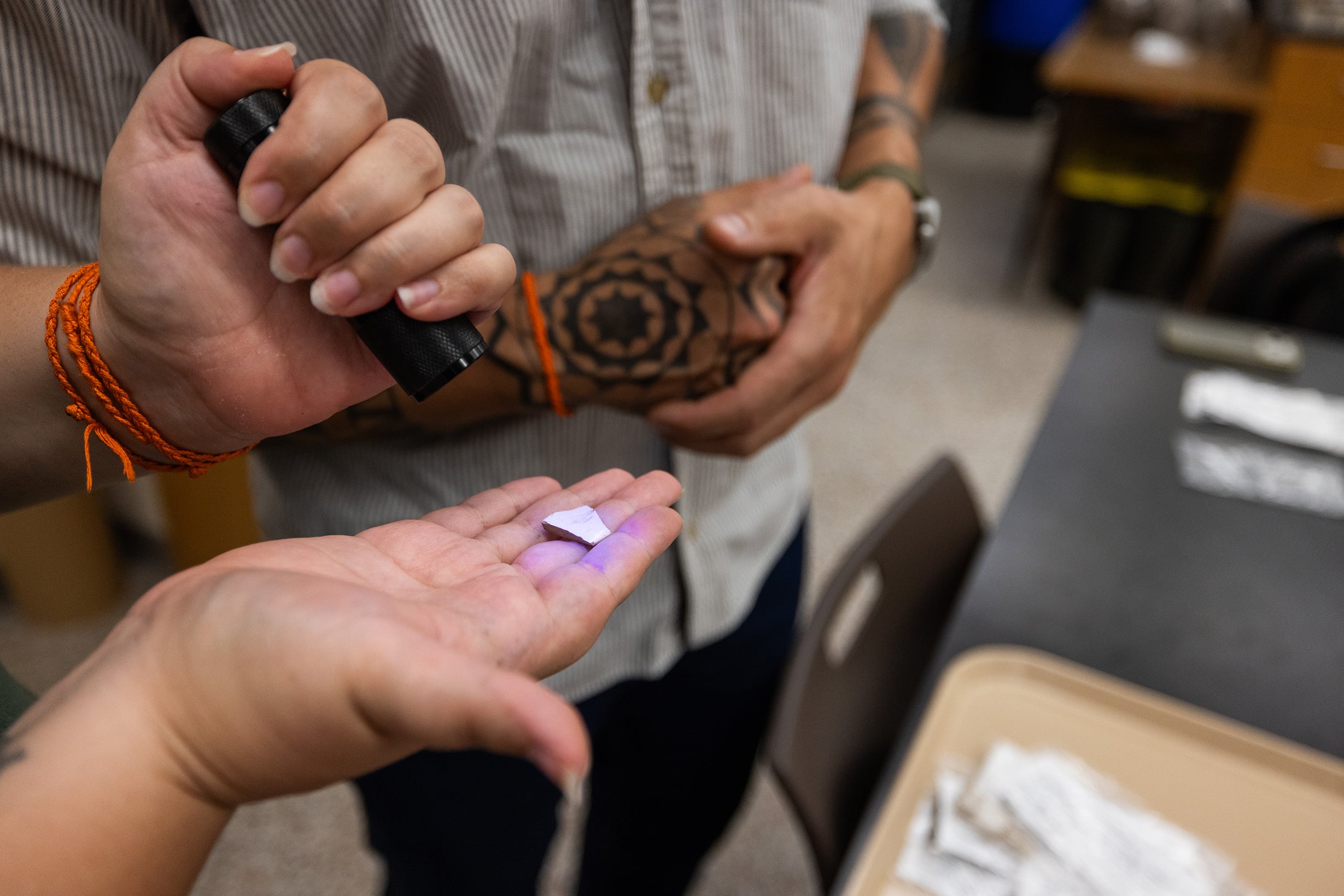
Anthropology major Katie Walker and Dr. Seth Grooms examine colonial pottery under a blacklight, which can give clues about the artifact’s age by revealing composition, alterations, hidden details and other indicators. Photo by Chase Reynolds
Partnerships for history, land and people
Grooms formulates research questions in coordination with tribal leadership and works with THPO to follow up on reported findings and identify promising sites for further study.
“We can use that site as the basis for a field school, and in coordination with THPO, we can excavate it in a scientific, responsible manner and help document and preserve ancestral sites throughout tribal territory,” Grooms explained.
LRAP studies the lifeways of precontact North Carolina, focused on settlement patterns, subsistence and land use practices, histories of occupation, the extent of cultural diversity, trade networks and pottery techniques, Grooms said. Their work encompasses soil science to bolster sustainable farming practices and the application of prescribed burns to reduce wildfires while fostering food-rich indigenous species. The initiative is collaborating with the Museum of the Southeast American Indian and the University of North Carolina Pembroke, whose students joined the field school this summer.
“Everything we find is a valuable contribution to the archaeological knowledge of North Carolina, as very little professional work has been done in the area,” Grooms said. “Our research is also contributing to existing Lumbee government initiatives, including youth programming, cultural classes, history education and sustainable farming practices.”
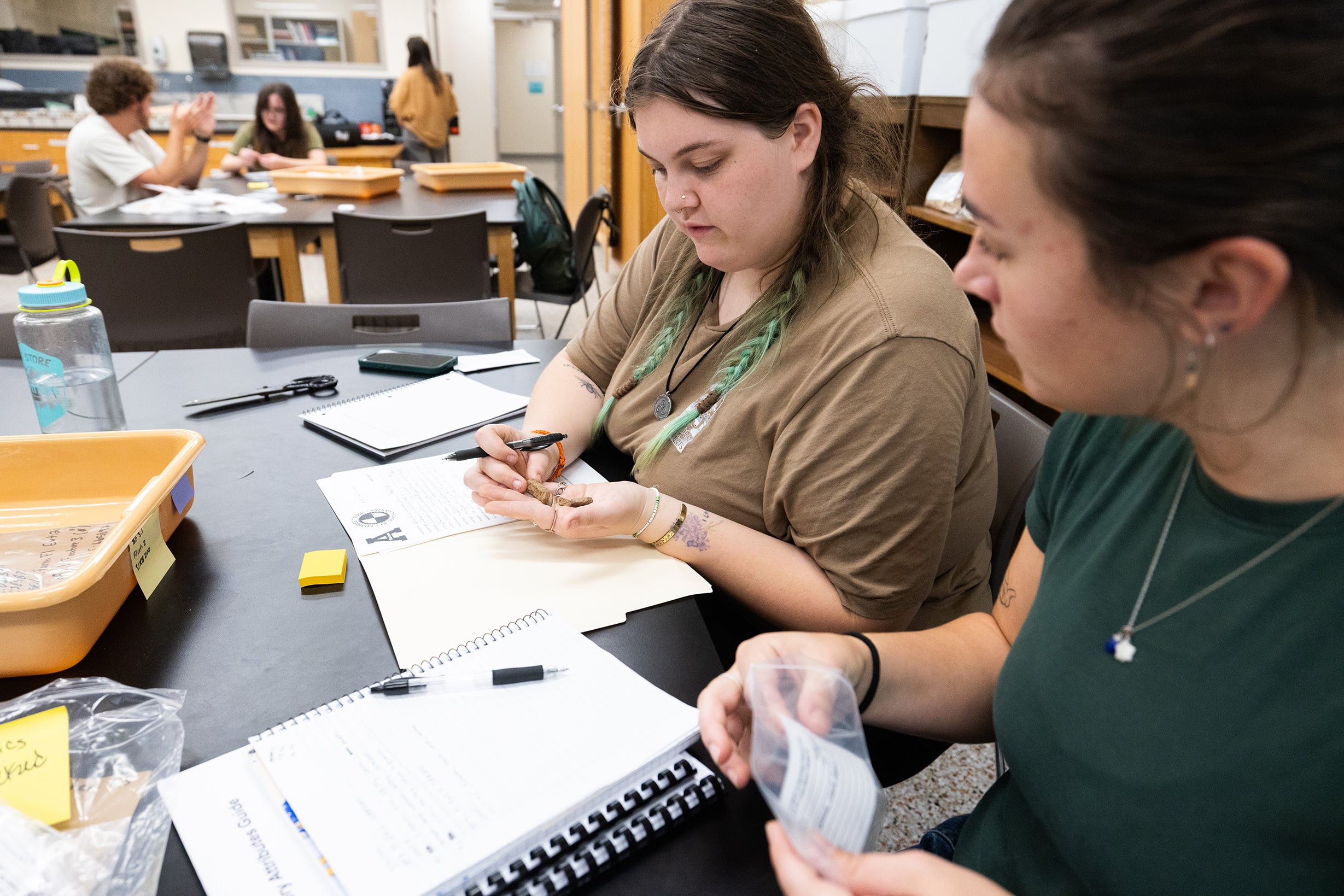
App State seniors Brianna Cameron, of Wake Forest, left in foreground, and Talia Debenedette, of Durham, right in foreground, examine ancient pottery, noting color, surface treatment, temper and vessel portion in Dr. Seth Groom’s archaeological methods lab at App State’s Boone campus. Photo by Chase Reynolds
A high-value student experience
App State junior anthropology major Sam Thacker spent the summer working at the field school as a teaching assistant, absorbing lessons in techniques for documenting and preserving ancestral sites, as well as in community engagement and ethical research.
“Archaeology shouldn’t just be about excavating and studying artifacts,” Thacker said. “It is — and always has been — about humanity and culture, and having a field experience that allowed me to create such strong relationships with so many different people really solidifies that point for me.”
Zachry Houser ’26 graduated with an App State Bachelor of Science in anthropology upon finishing the field school. Tasked with mapping and excavation, he drew particular meaning from the initiative’s interaction with the land and tribal members.
Houser recalled that when the research group breached a sand dune and uncovered an ancient fire feature, he glimpsed charred history and marked the moment as an unforgettable highlight of his summer.
“Dr. Grooms’ devotion to reinforcing respectful conduct, communicating with tribal leaders and members, having local people visit us while we worked and having us explain what we’re doing in the moment were all massively impactful,” Houser said. “It was educational not only for us but for the people who inherit the history of that land.”
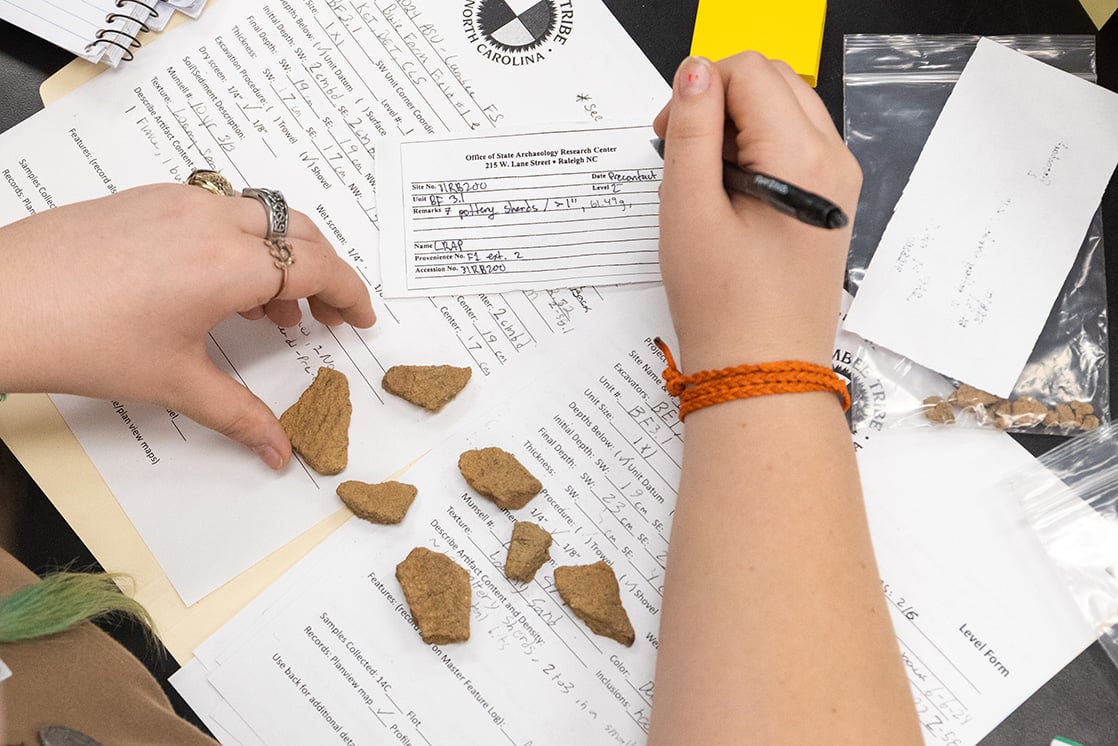
App State student researcher Brianna Cameron completes a catalog card documenting pottery findings from Lumbee tribal lands in Robeson County. Photo by Chase Reynolds
Forging community ties
Lumbee landowner Jeff Hunt lives on acreage tucked around the rim of a bay and knows the ancient significance of its freshwater access, clay deposits and vantage points for hunting and fishing.
“The bay rims were prime real estate for our tribe and made us thrive as a people,” he said.
LRAP’s work in his soil helps confirm Lumbee oral traditions and the tribe’s historical record, Hunt added.
When a day’s work at the digs was finished and students were tired and sweaty from the heat, the LRAP team gathered in the Hunt family kitchen.
“The biggest ‘I love you’ from a Lumbee will always be us taking the time to prepare and share a home-cooked meal with you,” he said. “It never feels like work because the kitchen is full of stories, lessons, laughter and a pure joy rarely found in modern kitchens. That’s the part of our culture you can’t understand unless you experience it.”
A U.S. Marine Corps veteran of Operation Iraqi Freedom and first-generation college graduate, Grooms has worked at cultural sites across the country. He drew inspiration for the LRAP model while working with the Crow Tribe in 2016. Grooms helped train Crow citizens in archaeological methods, which led to their employment with the Crow THPO. The Crow project showed Grooms that archaeologists could do good work alongside Native communities that honored their sovereignty while also using archaeology to document and preserve ancestral places.
“This project helps to teach us the importance of regional history to the people with a stake in it,” Walker concluded. “Some people might say this is just one county in one state, but for the friends we’ve made and for us, it’s a whole universe of stories and people — both in the past and now.”
About the Department of Anthropology
The Department of Anthropology offers a comparative and holistic approach to the study of the human experience. The anthropological perspective provides a broad understanding of the origins as well as the meaning of physical and cultural diversity in the world — past, present and future. Learn more about App State’s Department of Anthropology at https://anthro.appstate.edu.
About the College of Arts and Sciences
The College of Arts and Sciences (CAS) at Appalachian State University is home to 17 academic departments, two centers and one residential college. These units span the humanities and the social, mathematical and natural sciences. CAS aims to develop a distinctive identity built upon our university's strengths, traditions and locations. The college’s values lie not only in service to the university and local community, but through inspiring, training, educating and sustaining the development of its students as global citizens. More than 6,800 student majors are enrolled in the college. As the college is also largely responsible for implementing App State’s general education curriculum, it is heavily involved in the education of all students at the university, including those pursuing majors in other colleges. Learn more at https://cas.appstate.edu.
About Appalachian State University
As a premier public institution, Appalachian State University prepares students to lead purposeful lives. App State is one of 17 campuses in the University of North Carolina System, with a national reputation for innovative teaching and opening access to a high-quality, cost-effective education. The university enrolls more than 21,000 students, has a low student-to-faculty ratio and offers more than 150 undergraduate and 80 graduate majors at its Boone and Hickory campuses and through App State Online. Learn more at https://www.appstate.edu.