App State music therapy graduate student Haley Kruse, a board-certified music therapist from Gilbert, Arizona, right, engages a young child in music therapy at App State’s Thomas O. Eller Preschool Language Classroom, inviting the child to interact with her guitar. Photo by Chase Reynolds
BOONE, N.C. — Young voices are finding the rhythm of language this semester at Appalachian State, where a new clinical partnership integrates music therapy directly into the Thomas O. Eller Preschool Language Classroom (PLC). Complementing the speech therapy offered through the clinic, the music therapy focuses on using music to increase engagement and help improve the retention of language skills among young children with language delays, including children with autism.
Launched by the music therapy program in App State’s Hayes School of Music, in collaboration with the Beaver College of Health Sciences, the interdisciplinary pilot program centers on the work of Haley Kruse, of Gilbert, Arizona — a board-certified music therapist and graduate student in App State’s graduate music therapy program. Kruse is the first music therapy student to be placed as a graduate assistant in the clinic, which has long served as a training hub for students in the university’s speech-language pathology program.
“Undergraduate music therapy students have been placed at PLC for their clinical training for years, which sparked a lot of great ideas about what could happen with more intentional, structured collaboration,” said Dr. Laura Brown, associate professor of music therapy and director of the bachelor’s music therapy program. “The timing was finally right to bring in a graduate-level, board-certified music therapist, and our confidence in Haley — who is passionate about supporting individuals of all ages with disabilities — made her the clear choice to lead that effort.”

App State speech-language pathology graduate students Peyton Arrowood, of Rutherfordton, left, and Ellie Bowen, of Hendersonville, work with a young child at the university’s Thomas O. Eller Preschool Language Classroom, guiding the child through a speech therapy exercise. Photo by Chase Reynolds
Kruse explained that music therapy works by using a client’s preferred music and their preferred way of interacting to address clinical goals aimed at improving overall health and wellness, which can include reducing anxiety, bolstering communication skills, promoting physical development or rehabilitation, enhancing memory and/or managing stress.
“Music supports communication goals by anchoring children’s focus during their speech therapy sessions, facilitating joint attention between the therapist and the child,” explained PLC Coordinator and speech-language pathologist Megan Kilby. “This shared focus — the two-way exchange of words and gestures — is crucial for communication, as it provides the context necessary for a child to attach meaning to these interactions, helping them develop expressive language and social engagement.”
She added, “Music is so catchy. Coupling rhythms of music and song alongside speech serves as an important avenue for cementing language in young minds, especially for our clients with autism.”
The effectiveness of the new partnership is already evident in the positive feedback from local families.
“We’ve already had parents request more music therapy because of this collaboration, because it’s been such a positive experience for the children. It’s exciting,” said Brown, who shared that children needing additional services are referred to App State’s Music Therapy Clinic, which, alongside PLC, is part of Beaver College’s Appalachian Institute for Health and Wellness (App Well).
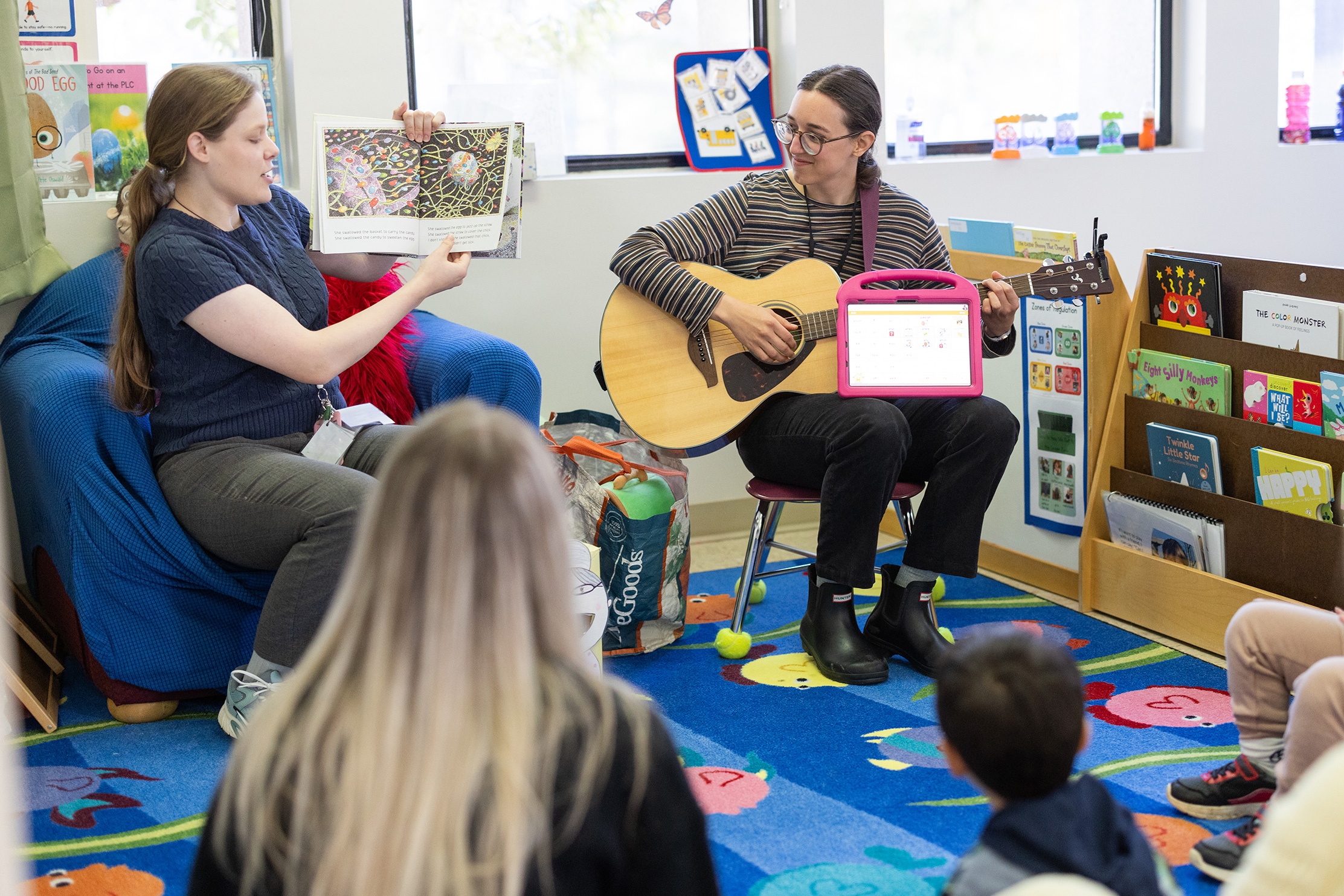
App State music therapy graduate student Haley Kruse, a board-certified music therapist from Gilbert, Arizona, right in background, and Catherine Mitkus ’23, a teacher in App State’s Thomas O. Eller Preschool Language Classroom, left in background, collaborate on a music therapy activity for young children at the Preschool Language Classroom. Mitkus is pictured reading a story to the children while Kruse plays her guitar. Photo by Chase Reynolds
Therapy that resonates
App State’s Preschool Language Classroom — a half-day program provided through Beaver College’s Charles E. and Geneva S. Scott Scottish Rite Communication Disorders Clinic — helps children between 2.5 and 5 years of age develop their communication skills to the fullest potential. In addition to serving local families, the clinic is a practicum training site for App State speech-language pathology graduate students to gain clinical experience working with young children who have a variety of communication skills and needs, including those with communication delays or disorders.
Twice a week, Kruse leads music therapy sessions for groups of five to eight children during “circle time.” She also performs 30-minute co-treatment sessions alongside an App State speech-language pathology graduate student.
The students’ cross-disciplinary collaboration creates a peer-assisted learning environment that enriches the clinical experience for all involved, shared Brown, allowing both groups to practice the kind of integrated care they will administer in professional health care settings.
During her first few visits to the clinic, Kruse assesses each child’s needs and abilities across several key areas of development, including social, emotional, communication, cognitive and motor skills. She pairs these findings with the children’s personal interests, such as their favorite music and media, to formulate clinical goals and guide her music-based therapy sessions.
Guitar, piano and voice are the main instruments used by music therapists, with clinicians often bringing in percussion or other melodic instruments, such as egg shakers and xylophones, to use with clients. For example, the children can be playing with percussive instruments while Kruse plays the guitar.
“The children are excited to engage with the instruments I bring in,” Kruse said, adding that “music provides a unique sense of agency for our clients. By leaning into their curiosity and excitement, I can help create a space where they can lead the process, using the joy of a new instrument to foster connections with the peers around them.”
For children on the autism spectrum and those with language delays, standard recorded music can often present an “auditory overload,” Brown said — being too fast and too wordy.
“That’s where the musical expertise of the music therapist comes into play,” Brown explained. “Haley is writing original songs for specific therapeutic goals. She’s thinking about tempos that are appropriate for her clients. It’s the specificity and the individuality that really make music therapy successful for clients.”
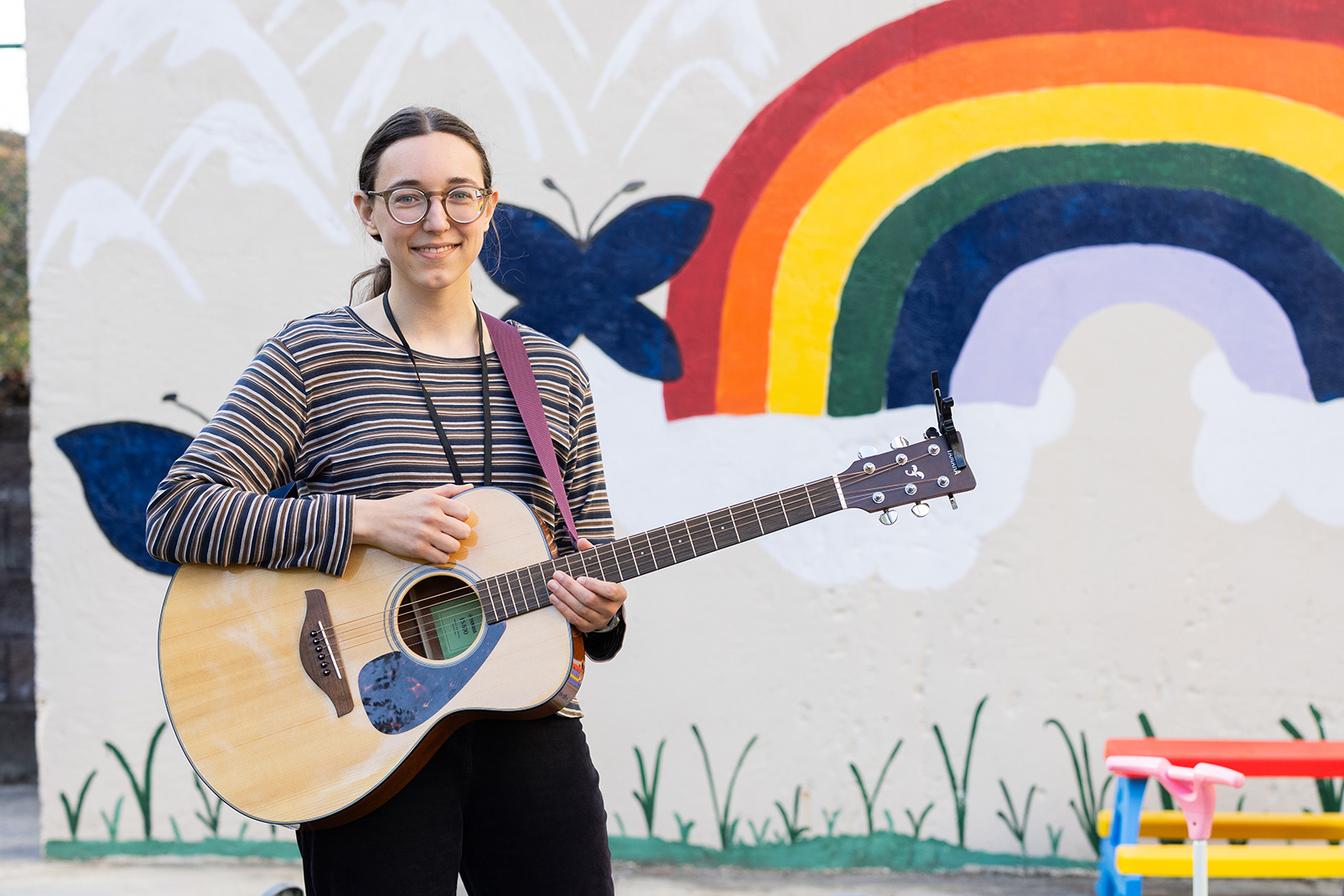
Haley Kruse, of Gilbert, Arizona — a board-certified music therapist and graduate student in App State’s graduate music therapy program — is pictured in front of a mural at the university’s Thomas O. Eller Preschool Language Classroom, holding her guitar. Photo by Chase Reynolds
A ‘web of impact’ — research and future growth
Brown said she views Kruse’s placement at the clinic as the first step in a “large web of impact” — in terms of planned research resulting from the project.
To move beyond the pilot phase, Brown has applied for a University Research Council (URC) grant to fund an entry-level research study of the clinical process, which would allow Kruse and her speech-language pathology counterparts to document and improve the process for future clients. Awarded through App State’s Office of Research and Innovation, URC grants support faculty research activities with awards of up to $5,000.
“We want to build on this graduate assistantship to have more tangible documentation and to explore outcomes for the children taking part in the experience,” Brown said, noting that the grant-funded study would provide the foundation to expand clinical placements for more graduate music therapy students in the future.
The success of this initial study is expected to lay the groundwork for a broader research project between Brown and Kilby. While the current phase focuses on the mechanics of collaboration, the next stage will examine the specific clinical outcomes for the children receiving integrated music and speech therapy services.
To learn more about App State’s Preschool Language Classroom, visit https://cdclinic.appstate.edu/programs/preschool-language-classroom.
What do you think?
Share your feedback on this story.
About the Hayes School of Music
The Hayes School of Music prepares young musicians for professional lives as performers, composers, music educators, music therapists, conductors and music industry professionals, ensuring the next generation of musical leadership for the state, region and nation. Noted for quality instruction by national and internationally recognized faculty musicians, the school offers four undergraduate degree programs and three graduate-level programs. Learn more at https://music.appstate.edu.
About Appalachian State University
As a premier public institution, Appalachian State University prepares students to lead purposeful lives. App State is one of 17 campuses in the University of North Carolina System, with a national reputation for innovative teaching and opening access to a high-quality, cost-effective education. The university enrolls more than 21,000 students, has a low student-to-faculty ratio and offers more than 150 undergraduate and 80 graduate majors at its Boone and Hickory campuses and through App State Online. Learn more at https://www.appstate.edu.
![The Catawba Valley has a healthcare provider shortage. App State has a program to help [faculty featured]](/_images/_posts/2026/10/healthcare-provider-shortage-600x400.jpg)
![Science Says I’ve Been Jumping My Bike Wrong For 30 Years [faculty featured]](/_images/_posts/2026/09/jumping-my-bike-600x400.jpg)