
From left to right, App State Director of Sustainability and Energy Management Mike Kapp, former U.S. Environmental Protection Agency Administrator Michael S. Regan and former N.C. House Rep. John Szoka participate in a panel discussion during App State’s 2026 Appalachian Energy Summit on June 3, held at the Schaefer Center for the Performing Arts on App State’s Boone campus. Photo by Chase Reynolds
BOONE, N.C. — Through decades of energy efficiency and conservation efforts, Appalachian State University and its state partners have avoided $2.27 billion in energy costs since 2002, according to the North Carolina State Energy Office. The savings span the University of North Carolina System, North Carolina community colleges and other state agencies.
The milestone was announced during App State’s 2026 Appalachian Energy Summit, held June 3–5 on the Boone campus. The annual event has gathered faculty, staff and students from colleges and universities, along with government and industry leaders, to share research and develop processes and systems for improving energy efficiency and sustainable practices across the UNC System, the state and beyond.
“Reaching this multi-billion-dollar milestone demonstrates what is possible when state partners commit to long-term resource stewardship,” said Mike Kapp, director of sustainability and energy management at App State. “We are proud that the Appalachian Energy Summit continues to be an important hub for innovators, collaborators and ideas, such as passive building strategies, that are evolving North Carolina’s energy future.”

Participants socialize and network during App State’s 2026 Appalachian Energy Summit, held June 3–5 on the Boone campus. The annual event brings together faculty, staff and students from colleges and universities, along with government and industry leaders, to share research and develop processes and systems for improving energy efficiency and sustainable practices across the UNC System, the state and beyond. Photo by Chase Reynolds
When the summit was first launched 14 years ago, App State initiated the goal of helping the state avoid $1 billion in energy costs by 2020, later expanding that target to $2 billion by 2025.
The overall energy savings reported this year are lower than last year’s due to a prior miscalculation that took place amid the reorganization of several state agencies, the State Energy Office shared.
According to App State Energy Manager Jonathan Pierson, the university has achieved $81.1 million in avoided energy costs and $19.8 million in avoided water use costs since 2002–03, for a combined total of more than $100 million in utility savings.
He added that App State has also reduced energy use per square foot by 51% — known as energy usage intensity (EUI) — surpassing the state goal of a 40% reduction in state-owned buildings by 2025, measured from baseline 2002–03 fiscal year levels.
As highlighted in the latest State Energy Office annual report: The UNC System experienced a 29% reduction in EUI from the 2002–03 baseline, despite a 68% increase in square footage over the same time frame.
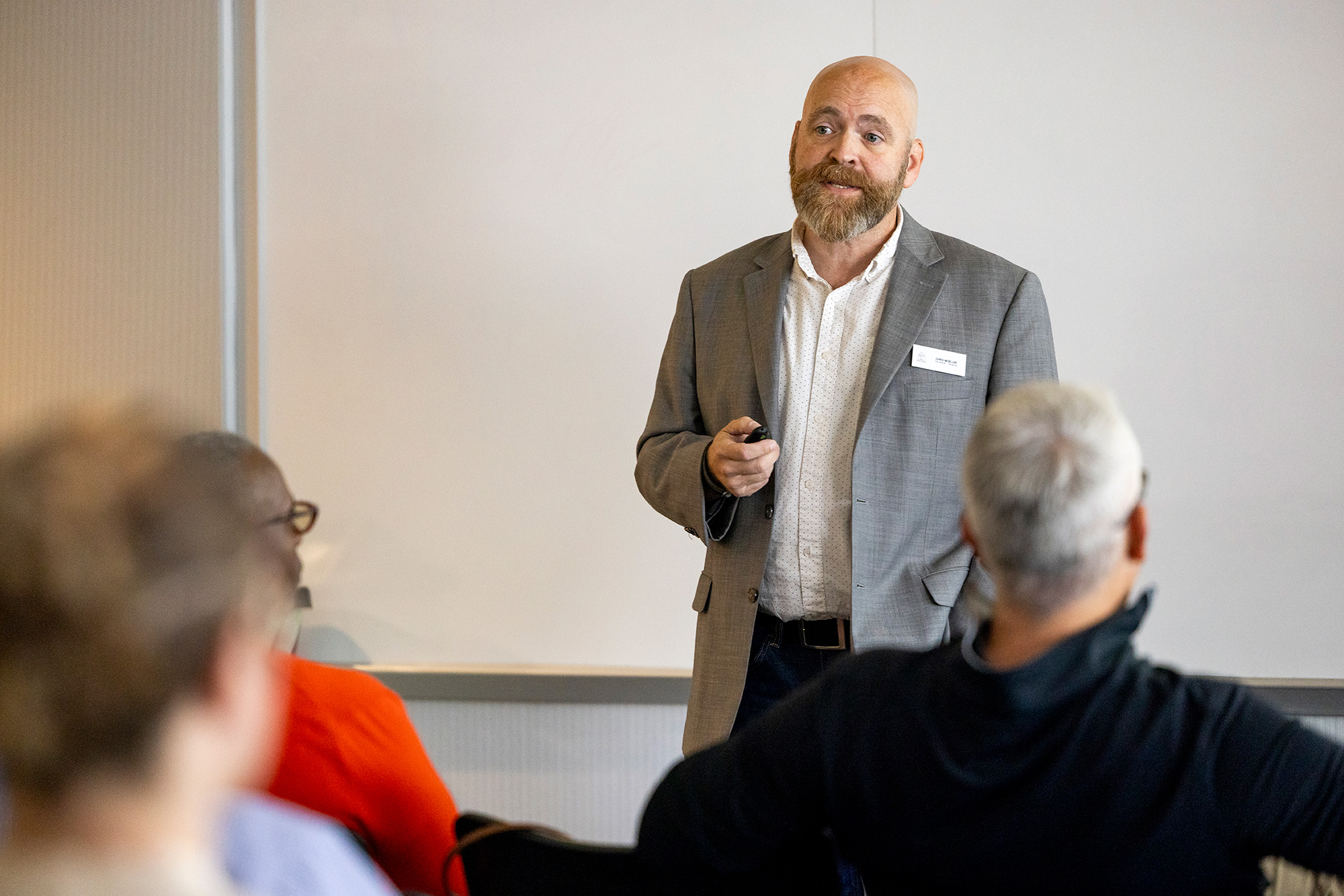
Chris Moeller, CEO of Orion Growth and creator of the pathway communities model — a new approach to housing focused on stability, resilience and upward mobility — speaks during a session at App State’s 2026 Appalachian Energy Summit. Photo by Kyla Willoughby
Sharing ideas and shaping solutions
Throughout the summit, over 25 speakers — including App State faculty, staff, students and alumni — shared research, best practices and emerging solutions related to energy efficiency, housing and community planning, high-performance building design, waste reduction and transportation.
Michael S. Regan, former administrator of the U.S. Environmental Protection Agency, delivered the summit’s keynote address, highlighting disaster resilience efforts after Hurricane Helene, the opportunities of high-performance buildings and App State’s tradition of resource stewardship. He served as the agency’s 16th administrator from 2021 to 2024. Regan also participated in a panel discussion with Kapp and former N.C. House Rep. John Szoka.
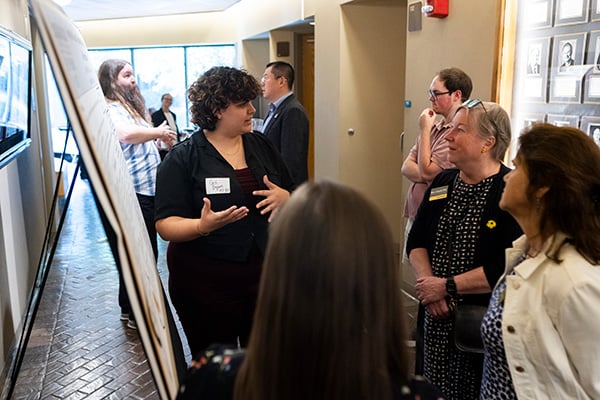
The summit also featured a student poster competition, where undergraduate and graduate students from across the state presented energy-related research. Cash prizes were awarded to the top undergraduate and graduate poster presentations.
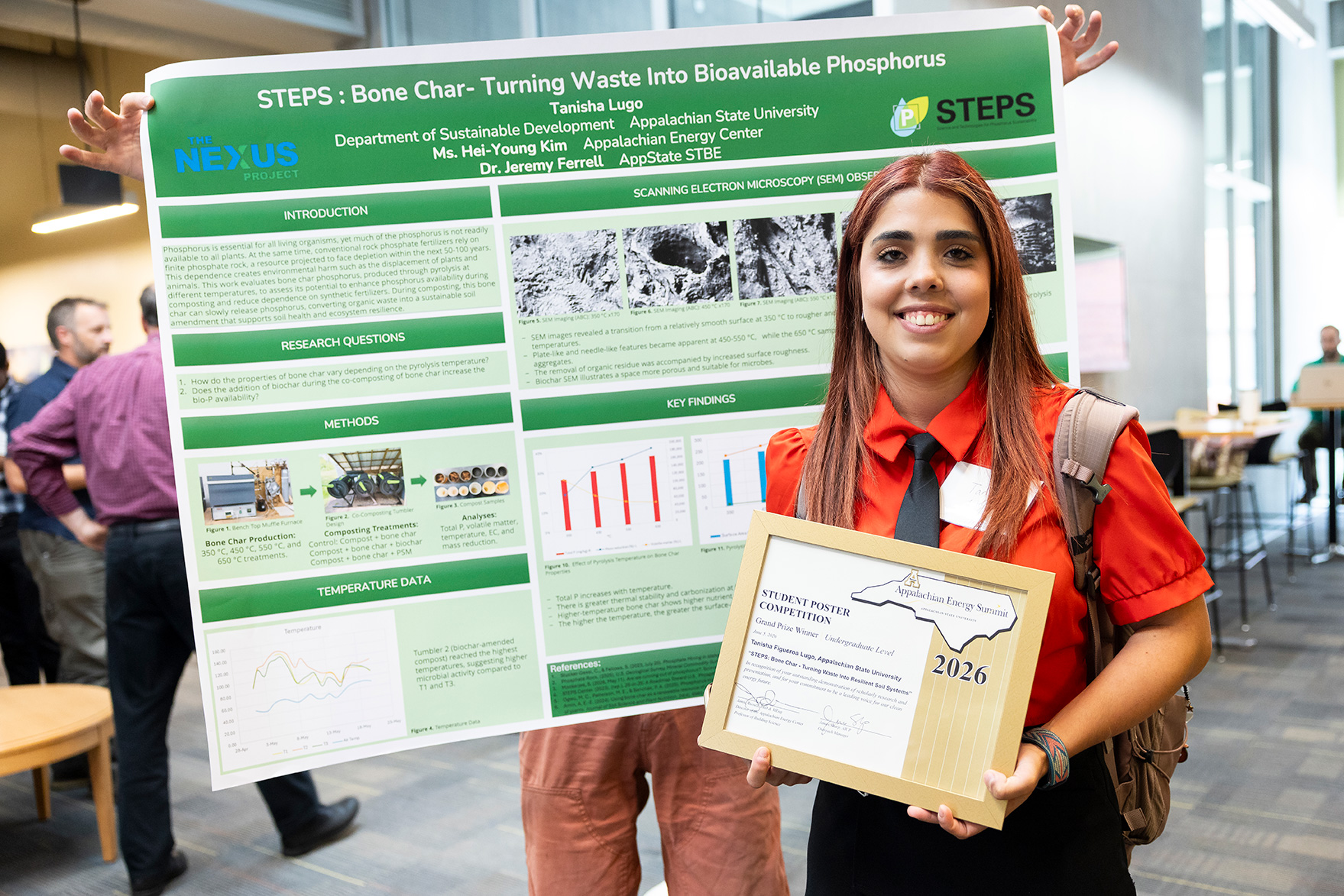
Tanisha Lugo, a senior sustainable development major from Huntersville, won the grand prize in the student poster competition at App State’s 2026 Appalachian Energy Summit for her research on bone char and turning waste into bioavailable phosphorus. Photo by Kyla Willoughby
Powering the future through research and innovation
App State continues to play a leading role in research, technical expertise and partnership-building in the areas of energy, construction and building science, and community resilience. One hub for this work is the Appalachian Energy Center — part of App State’s Research Institute for Environment, Energy and Economics.
The center, celebrating its 25th year in 2026, advances interdisciplinary research and professional engagement among industry professionals, public agencies, educators and community stakeholders navigating an evolving energy landscape.
In addition, App State’s Department of Sustainable Technology and the Built Environment houses multiple research labs, facilities and projects, including the Blackburn Vannoy Estate and Farm, where students gain hands-on experience in agriculture.
What do you think?
Share your feedback on this story.
About Appalachian State University
As a premier public institution, Appalachian State University prepares students to lead purposeful lives. App State is one of 17 campuses in the University of North Carolina System, with a national reputation for innovative teaching and opening access to a high-quality, cost-effective education. The university enrolls more than 21,000 students, has a low student-to-faculty ratio and offers more than 150 undergraduate and 80 graduate majors at its Boone and Hickory campuses and through App State Online. Learn more at https://www.appstate.edu.

![NC universities ranked by free-speech advocacy group [faculty and staff featured]](/_images/_posts/2026/09/free-speech-advocacy-600x400.jpg)

![Nepal’s Hydropower Industry Was Booming. Now 900 Workers Are Missing. [faculty featured]](/_images/_posts/2026/08/hydropower-industry-600x400.jpg)