BOONE, N.C. — Humbling. Awe-inspiring. Life-altering. These are the words of students and alumni who have followed App State professor Dr. Sarah Carmichael and Professor Emeritus Dr. Johnny Waters into remote Mongolia to investigate one of geology’s enduring mysteries.
Over multiple trips spanning more than a decade — and hundreds of miles from civilization in southwestern Mongolia — students in App State’s Department of Geological and Environmental Sciences have joined the international researchers of the DAGGER (Devonian Anoxia, Geochemistry, Geochronology and Extinction Research) team to piece together the puzzle of carbon sequestration, how ancient oceans became oxygen-depleted “dead zones” and ways that ecosystems rebound following mass extinction events.

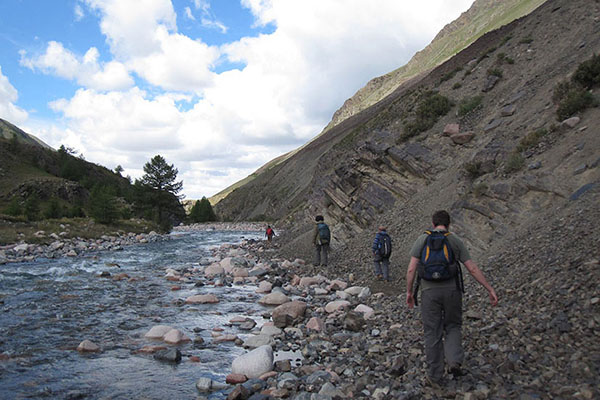
Devonian Anoxia, Geochemistry, Geochronology and Extinction Research (DAGGER) expedition scientist Otgonbaatar Dorjsuren, left, and App State alumna Olivia Paschall ’18 examine Gobi Desert geology linked to mass extinction events more than 350 million years ago. Photo submitted

App State senior Gabriel Wheaton, a geology-quantitative geoscience major from Roanoke, Virginia, is part of the interdisciplinary, App State-led Devonian Anoxia, Geochemistry, Geochronology, and Extinction Research (DAGGER) group, which is studying an area of southwestern Mongolia that has been largely overlooked by science. Photo submitted
Led by Carmichael, the DAGGER group comprises up to 30 scientists from numerous countries whose disciplines range from geochemistry, to paleontology, to sedimentology, to science communication. Their shared goal is to better understand a period of intense climate upheaval preserved in the Central Asian Orogenic Belt — one of the largest and most complex systems of mountain-building events (orogeny) in Earth’s history. App State students participate in the expedition as equals and make vital contributions to scientific results, both in the field and in Carmichael’s lab.
“It’s important to take students off the grid for extended periods of time to do fieldwork in unexplored places,” Carmichael reflected. “We are so saturated now with technology that students — and their professors — are finding it harder and harder to trust themselves. We want to constantly check our phones to make sure we’re ‘right,’ but when you have no cell signal, and when you’re in a place where so little is known, you can only use what’s in your head. It definitely keeps you humble, but it also empowers you to trust yourself because, honestly, there’s no other option.”
The Late Devonian mass extinction event is the least understood among what geologists term the “Big Five” major extinctions. Rather than dying off suddenly in a meteor impact, 75% of species vanished in a relatively slow, complex crescendo tied to atmospheric cooling, changes in carbon dioxide levels and volcanic activity, but the exact kill mechanism remains unknown. The DAGGER team’s fieldwork centers on the causes, mechanics and aftermath of this event series, which took place 350–417 million years ago.
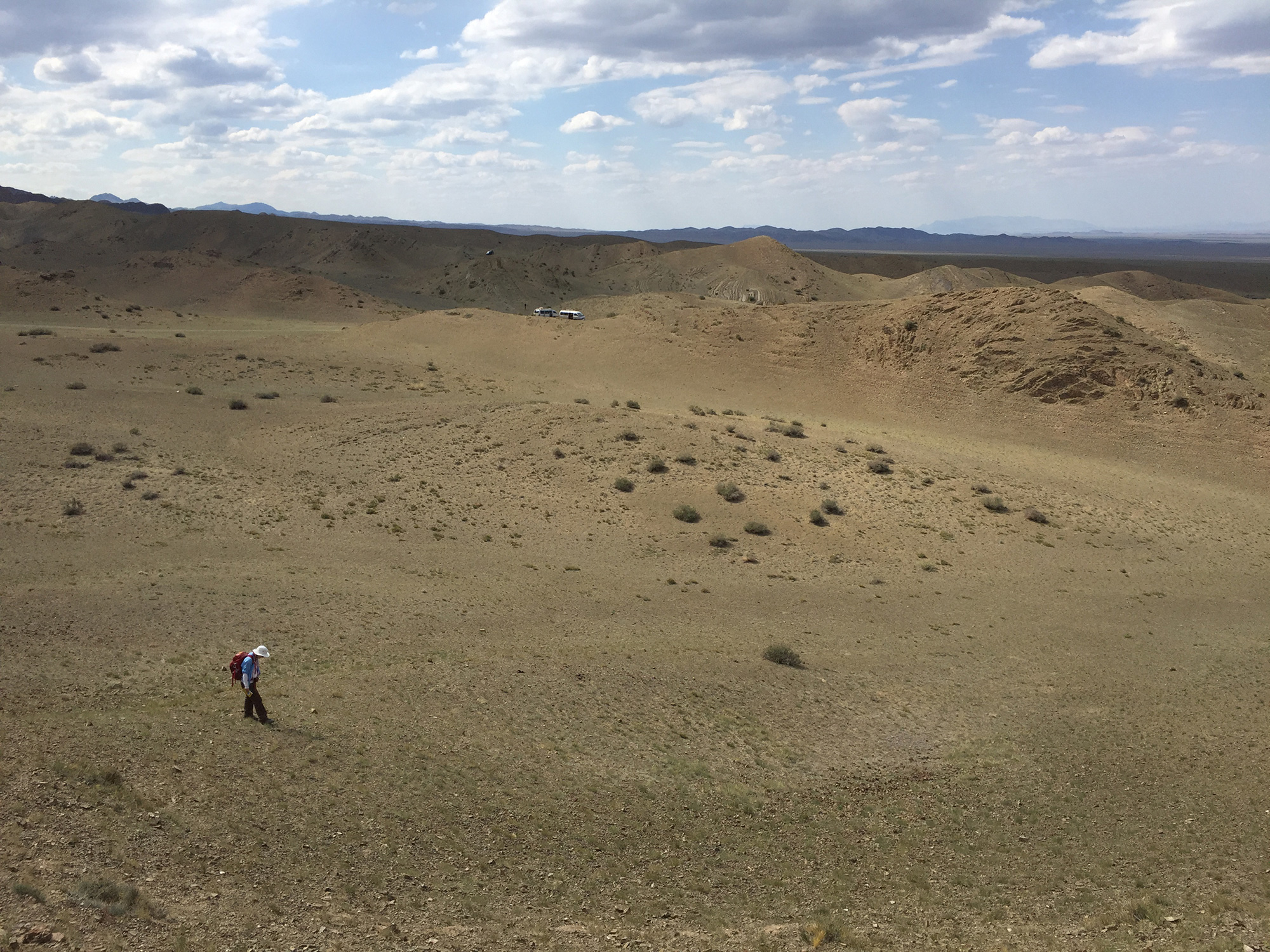
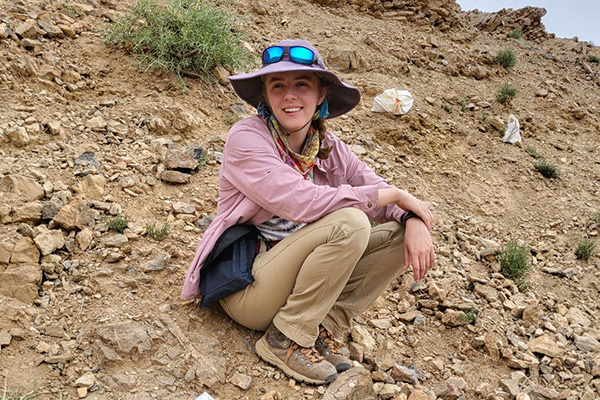
Dr. Sarah Carmichael, professor in App State’s Department of Geological and Environmental Sciences, is pictured in the Gobi Desert during a geology expedition with the App State-led Devonian Anoxia, Geochemistry, Geochronology and Extinction Research (DAGGER) group, which returns to remote Mongolia each year to study the mass extinction event of the Late Devonian period. Photo submitted
A National Geographic Explorer, professor in the Department of Geological and Environmental Sciences (GES) and trained wilderness responder, Carmichael spearheads the DAGGER expeditions alongside Dr. Johnny Waters, former GES department chair and professor emeritus and adjunct research professor of paleontology at App State.
“The Gobi is a harsh, unforgiving physical environment,” Waters explained. “Our field areas are hundreds of miles from anything approaching civilization, and we never really know what we’ll find until we get there.”
He added, “Communications are nonexistent except for a satellite phone. Vehicles break down and supplies can run low. Under the worst conditions, Sarah has never flinched and the students have responded admirably — and we always come back with samples and information that are scientifically valuable.”
To date, seven GES students have gone to Mongolia with Carmichael and Waters: alumni Cameron Batchelor ’15, Olivia Paschall ’18, Allison Dombrowski ’20, Jacqui Foronda ’23 and Cara Cywinski ’23, and seniors Gabriel Wheaton and Vanya Dill, who has been selected to present her research at the Explorers Club’s annual gala in New York City in April. Waters and Carmichael have advised nearly 30 DAGGER students at App State since they began working together in 2011. The students undertook a variety of projects, ranging from detailed lab work to fieldwork in Siberia.
The years of research have yielded numerous journal papers and conference presentations — as well as a new generation of explorers who learned foundational skills, stamina and the courage to push their own boundaries.

Ready for anything, Dr. Sarah Carmichael, professor in App State’s Department of Geological and Environmental Sciences, and the App State-led Devonian Anoxia, Geochemistry, Geochronology, and Extinction Research (DAGGER) team overcome challenges ranging from breakdowns to windstorms while researching the remote geology of southwestern Mongolia. Photo submitted
In terra incognita
Gabriel Wheaton, a geology-quantitative geoscience major from Roanoke, Virginia, took part in the 2025 DAGGER expedition, pushing into an area that had been surveyed only briefly by a Soviet Union expedition in the 1970s. His work with the expedition results and related material over the past two years is foundational to his senior thesis and research under Carmichael.
Wheaton used the technical skills learned in his geoscience courses at App State to measure and characterize rock strata, study fossils and communicate his findings as part of the expedition’s goal of understanding the mechanics of Late Devonian island arcs in the South Gobi. The experience gave him a vivid glimpse of foreign foods, landscapes and nomadic lifestyles.
“I’ve come to believe that traveling to, and engaging with the cultures of, different nations is what makes our world vibrant and interconnected,” he said. “The opportunity to collaborate with scientists on the opposite side of the globe while contributing to important research in an incredible place gave me a lot of confidence in my scientific abilities and had a huge impact on my development as a geoscientist.”
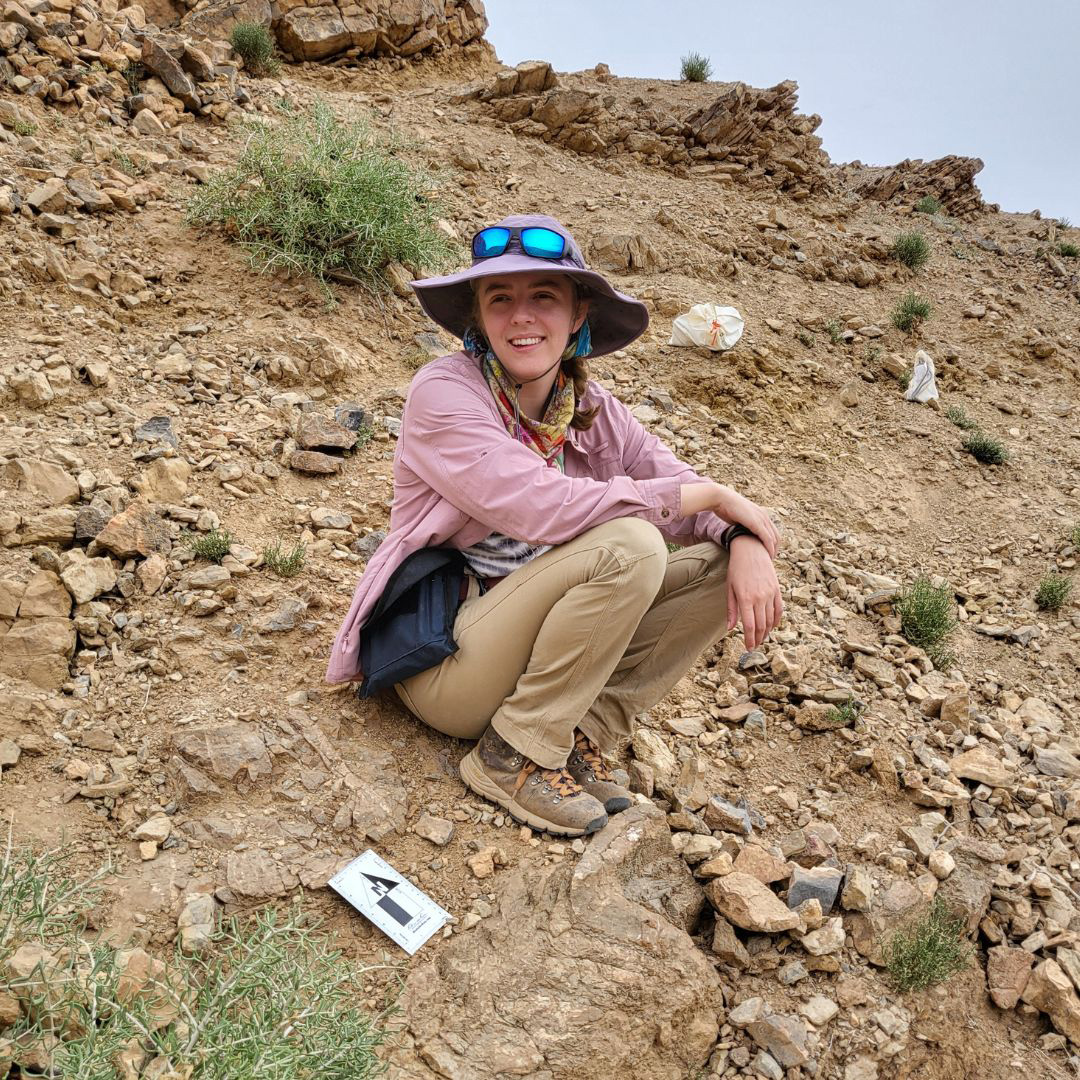
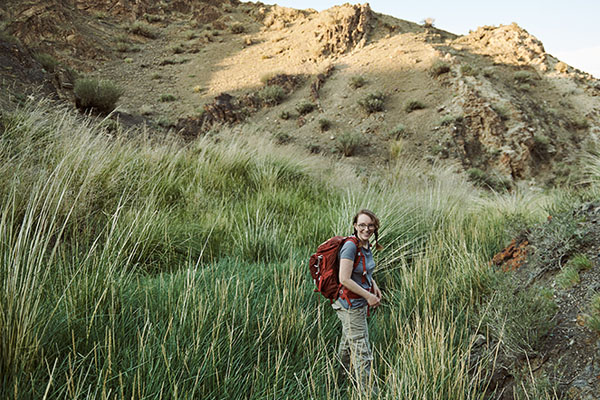
App State senior geology major Vanya Dill, of Morrisville, is pictured at a field site in Mongolia in August 2025, where she joined the App State-led Devonian Anoxia, Geochemistry, Geochronology and Extinction Research (DAGGER) group to sample volcanic rocks. Dill has been selected to present her research project — “Volcanism in the Central Asian Orogenic Belt during the Late Devonian and its Impacts on Local Marine Communities” — at the Explorers Club’s annual gala in New York City in April. Photo by Dr. Sarah Carmichael
Mapping a future of scientific inquiry
During her field experience, Olivia Paschall ’18 awoke from her first night to the sound of yaks grunting outside her tent. She drank a breakfast of warm sheep noodle soup before continuing deep into the Gobi Desert on the most rugged dirt roads she had ever seen. In a sea of arid grass and stone, she mapped the stratigraphy of the research area, excavated fossils, hung hand-washed laundry to dry in the wind and laid the groundwork for her foreseeable future.
“It is a humbling experience being one of the first people to geologically map a region that is so incredibly beautiful, remote and complex,” Paschall said.
With Carmichael, she co-authored a paper on their Mongolia research, published in 2020, and went on to pursue a doctorate in geological sciences at Cornell University, where she focuses on radar-based remote sensing to observe earth surface deformation.
“In classes, there had always been a ‘right’ answer to questions, but suddenly I was thrust into a setting with no reference material, save for some brief notes taken years prior,” Paschall recalled.
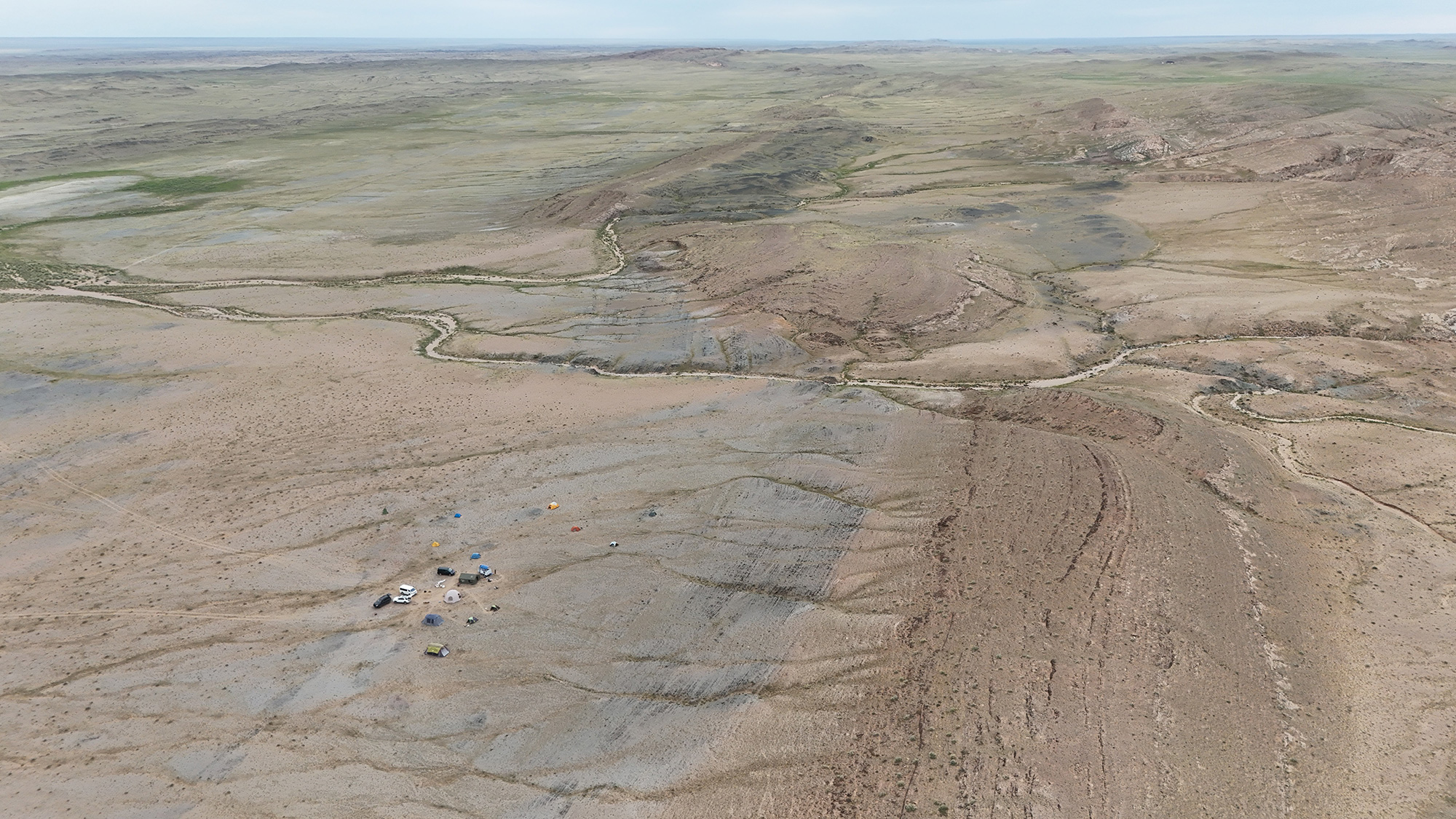
Despite careful planning, the App State-led Devonian Anoxia, Geochemistry, Geochronology and Extinction Research (DAGGER) group is never certain what it will find when it arrives hundreds of miles from civilization to conduct geological research at sites such as this 2025 location in the Gobi Desert. Photo by Will Waters
Skills for a lifetime of discovery
Dr. Cameron Batchelor ’15, an environmental scientist and geochemist at the Wisconsin Department of Natural Resources, knew she wanted to pursue geology after taking an introductory geology course taught by Carmichael. Jumping at the chance for undergraduate research, she had no idea the step would lead her to the other side of the globe.
Batchelor wrote the grant that funded her place on the 2014 DAGGER expedition — one of the longest and most intense of all of the group’s trips. As an App State sophomore, she was the youngest team member, initially feeling intimidated and having no idea she would be able to contribute to the research in a meaningful way.
She rode out a windstorm that flattened expedition tents and climbed the cliffs of the Altai Mountains to collect rock samples before sending them back to North Carolina, where she analyzed the samples in the lab. Batchelor wrote an undergraduate thesis on her findings and incorporated them into her portion of her first peer-reviewed journal publication, on which she was a third author.
Mongolia gave her the confidence and foundation to pursue a doctorate at the University of Wisconsin-Madison, where she studied paleoclimate (the study of ancient climates), and a National Science Foundation fellowship as a postdoctoral researcher at the Massachusetts Institute of Technology.
“I often wonder if I would have gone on to get a Ph.D. if it were not for my experience in Mongolia and everything that came with it — the collaboration, advanced writing skills, the hands-on learning of the scientific method so early in my career,” she said. “Everyone treated me as a colleague, not an inexperienced student. It showed me that becoming a real scientist was not an unattainable, scary goal.”
With Carmichael, Batchelor co-authored two papers in the wake of the Mongolia trip, one focusing on climate instability in the Late Devonian and the other centering on marine fauna during and after mass extinction events.
“The trip was the ultimate adventure,” she said. “I am so lucky to have been able to experience it.”
What do you think?
Share your feedback on this story.

About the Department of Geological and Environmental Sciences
Located in Western North Carolina, Appalachian State University provides the perfect setting to study geological and environmental sciences. The Department of Geological and Environmental Sciences provides students with a solid foundation on which to prepare for graduate school or build successful careers as scientists, consultants and secondary education teachers. The department offers six degree options in geology and two degree options in environmental science. Learn more at https://earth.appstate.edu.
About the College of Arts and Sciences
The College of Arts and Sciences (CAS) at Appalachian State University is home to 17 academic departments, two centers and one residential college. These units span the humanities and the social, mathematical and natural sciences. CAS aims to develop a distinctive identity built upon our university's strengths, traditions and locations. The college’s values lie not only in service to the university and local community, but through inspiring, training, educating and sustaining the development of its students as global citizens. More than 6,800 student majors are enrolled in the college. As the college is also largely responsible for implementing App State’s general education curriculum, it is heavily involved in the education of all students at the university, including those pursuing majors in other colleges. Learn more at https://cas.appstate.edu.
About Appalachian State University
As a premier public institution, Appalachian State University prepares students to lead purposeful lives. App State is one of 17 campuses in the University of North Carolina System, with a national reputation for innovative teaching and opening access to a high-quality, cost-effective education. The university enrolls more than 21,000 students, has a low student-to-faculty ratio and offers more than 150 undergraduate and 80 graduate majors at its Boone and Hickory campuses and through App State Online. Learn more at https://www.appstate.edu.
![NC universities ranked by free-speech advocacy group [faculty and staff featured]](/_images/_posts/2026/09/free-speech-advocacy-600x400.jpg)

![Nepal’s Hydropower Industry Was Booming. Now 900 Workers Are Missing. [faculty featured]](/_images/_posts/2026/08/hydropower-industry-600x400.jpg)